
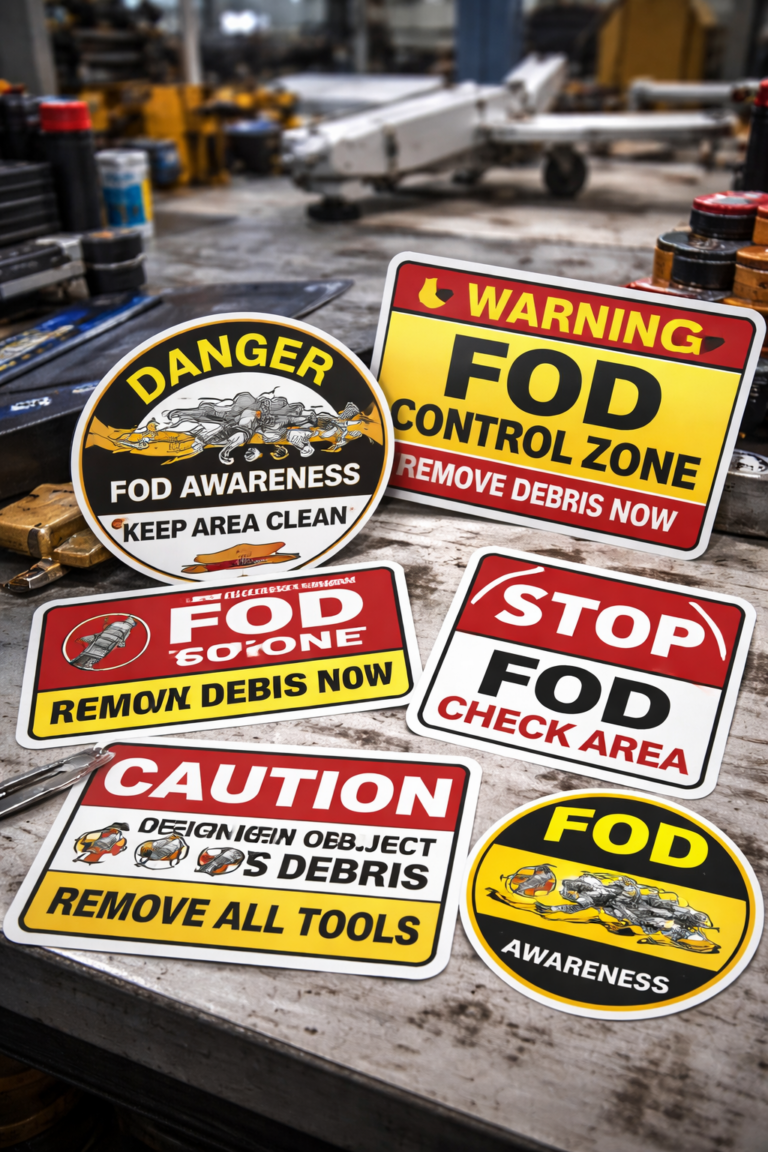
FOD Stickers for Aviation
FOD stickers are used in aviation environments to reinforce awareness, guide behavior, and maintain consistent communication around debris control.
In active operational areas, safety depends on visibility and repetition. Procedures exist, training is conducted, and teams understand the risks. But in fast-moving environments, what matters most is what people see in the moment.
FOD stickers provide that reinforcement. They act as constant visual reminders placed directly on equipment, tools, access points, and operational surfaces, ensuring that FOD awareness remains present at all times
Zero-Tolerance FOD Environment Starts with Visibility
In aviation operations, FOD is not a minor housekeeping issue — it is a direct threat to aircraft integrity, personnel safety, and operational continuity.
Foreign Object Debris has been linked to:
- Turbine ingestion events resulting in catastrophic engine damage
- Multi-million dollar maintenance and downtime costs
- Safety incidents across ramps, hangars, and maintenance facilities
Within a modern Safety Management System (SMS), visual control is not optional, it is foundational.
FOD stickers serve as persistent, high-visibility control points that reinforce:
- FOD zone discipline
- Tool accountability
- Immediate debris removal protocols
When deployed correctly, they transform safety from policy into behavior.
Compliance Framework & Aviation Standards Integration
FOD stickers are effective because they influence behavior at the exact point of action.
When placed strategically, they:
- Prompt technicians before beginning work
- Reinforce checks during maintenance activities
- Remind teams to remove debris before leaving an area
- Support accountability in shared environments
Instead of relying on memory, teams respond to clear, visible cues integrated into their workspace.
Critical Insight: When Safety Labels Become FOD
A poorly manufactured sticker introduces the exact risk it is meant to prevent.
Low-grade decals often fail due to:
- Edge lifting under traffic or environmental stress
- Adhesive breakdown from Skydrol, Jet-A1 exposure, or moisture
- Surface incompatibility leading to premature detachment
Once detached, these materials become secondary FOD hazards, capable of entering engines, systems, or critical work areas.
Engineering Solution
Advanced FOD stickers are designed with:
- Sub-surface printing (protected graphics layer)
- Edge-seal technology to prevent lifting
- Mil-spec adhesive systems for high-shear environments
This ensures the label remains fixed, visible, and non-contributory to debris risk.
FOD Sticker Variations for Aviation Environments
Heavy-Duty Hangar Floor Decals

Designed for high-traffic environments where durability is critical.
These decals incorporate:
- Anti-slip laminate surfaces for personnel safety
- High-load resistance against carts, toolboxes, and equipment
- Chemical resistance to aviation fluids including Skydrol and Jet-A1
Used to define:
- FOD control zones
- Clean aircraft boundaries
- Maintenance work areas
They function as both safety guidance and physical zone enforcement.
Toolbox Shadowing & Accountability Systems (5S Integration)

FOD control is closely tied to tool accountability.
Shadowing systems use precision-cut vinyl layouts to:
- Visually map tool placement
- Immediately identify missing tools
- Reinforce Lean 5S methodology within maintenance operations
Benefits include:
- Faster tool audits
- Reduced risk of tool-related FOD
- Improved maintenance discipline
These systems transform tool control into a visual, real-time process.
High-Temperature Engine & Nacelle Labels
Standard materials fail in elevated temperature environments.
For engine cowling, nacelle zones, and high-heat exposure areas, FOD stickers must be constructed from Polyimide (Kapton) materials.
Key Specifications:
- Temperature tolerance: −40°C to +150°C
- High thermal stability
- Resistance to degradation under prolonged heat exposure
These labels maintain adhesion and visibility in conditions where traditional vinyl would fail.
Reflective Ramp & Airside Safety Decals
Ramp operations require visibility under low-light and night conditions.
Reflective FOD stickers utilize:
- 3M Grade Reflective materials
- High-contrast color schemes for rapid recognition
- Enhanced visibility under vehicle lights and apron lighting
Applications include:
- Ramp safety zones
- Equipment staging areas
- Aircraft approach and clearance zones
These decals improve situational awareness during night operations and adverse visibility conditions.
Engineering Data Hub: Material Performance Comparison
| Variation Type | Base Material | Adhesive Shear Strength | Service Life (Environmental) |
|---|---|---|---|
| Standard Cast Vinyl | PVC Cast Film | Medium-High | 2–4 Years |
| High-Heat Polyimide | Kapton Film | High | 5+ Years (High Temp) |
| Photoluminescent (Glow) | PVC + Luminescent Layer | Medium | 3–5 Years |
| Reflective Aviation Grade | 3M Reflective Film | High | 5+ Years |
Safety Checklist: Proper FOD Sticker Deployment
To maximize effectiveness and prevent failure:
- Ensure surface is clean, dry, and free of contaminants
- Apply pressure evenly to eliminate air gaps
- Avoid installation in extreme temperatures
- Inspect edges regularly for early signs of lifting
- Replace degraded labels immediately
Proper installation directly impacts long-term performance.
FOD Stickers Within a Complete FOD Control System
FOD stickers operate as one layer within a broader control strategy, alongside:
- FOD tape (zone definition)
- FOD cans (debris collection)
- FOD walkdowns (inspection processes)
- FOD awareness programs (training systems)
Together, these elements create a structured, multi-layered defense against debris-related risks.

Next-Generation FOD Sticker Systems (2026 and Beyond)
QR-Integrated Safety Labels
- Enable real-time inspection logging
- Connect physical zones to digital SMS systems
- Support audit traceability
Sustainable & PVC-Free Materials
- Reduced environmental impact
- Compliance with evolving sustainability standards
UV-Stable Long-Life Materials
- Designed for 5+ years of ramp exposure
- Maintain visibility without fading