
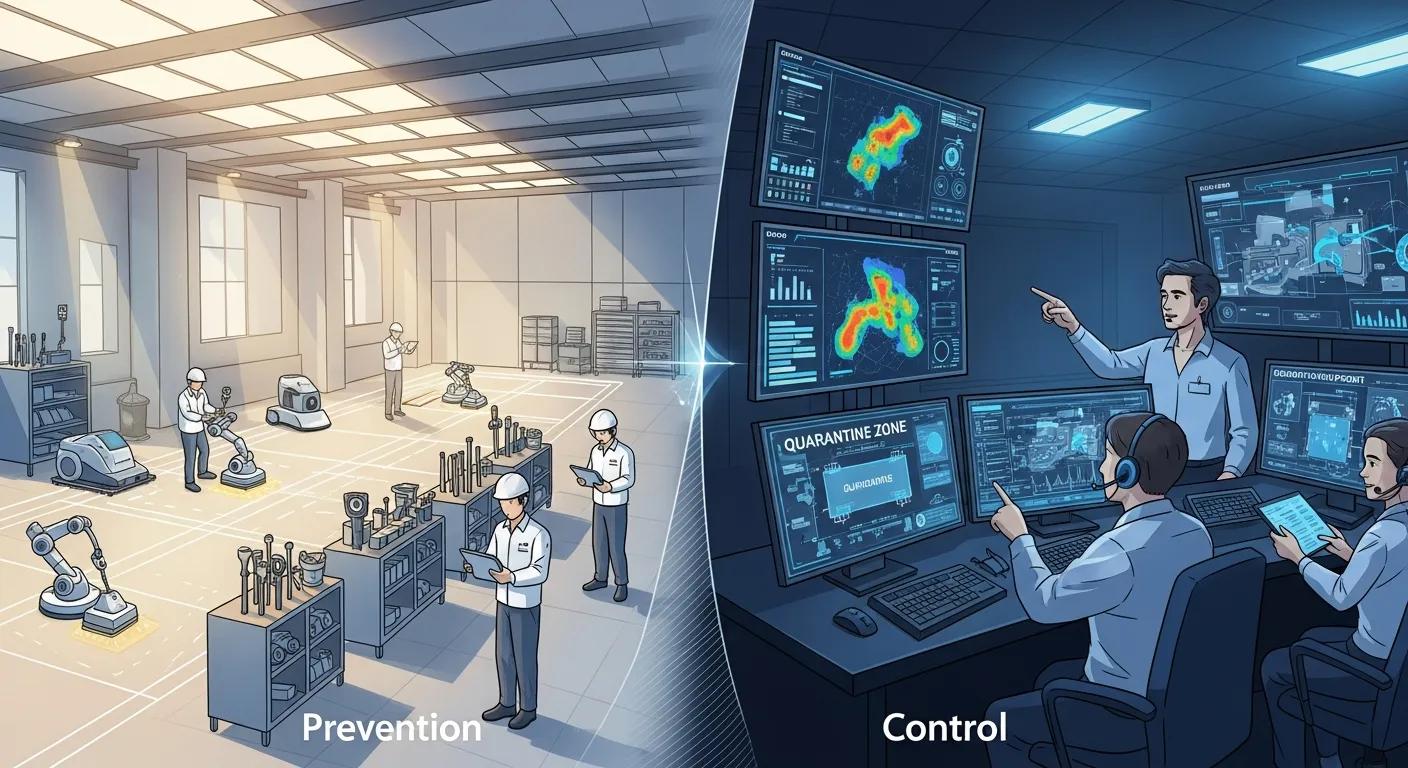
FOD prevention and FOD control are closely related, but they are not exactly the same. Both are used to reduce the risk of Foreign Object Debris in aviation, aerospace, defense, manufacturing, and maintenance environments.
FOD prevention focuses on stopping debris from becoming a hazard in the first place. FOD control focuses on managing debris when it appears by identifying, collecting, containing, reporting, and correcting it.
Quick Answer: FOD prevention is the process of reducing the chance that Foreign Object Debris appears or causes risk. FOD control is the process of managing debris through inspections, FOD bags, containers, tool control, reporting, and corrective action. A strong FOD program needs both.
Read the FOD Prevention Guide | Read the FOD Control Guide | View FOD Control Products
What Is FOD?
FOD usually stands for Foreign Object Debris. It may also refer to Foreign Object Damage when discussing the harm caused by debris.
The FAA describes airport Foreign Object Debris as an object located in an inappropriate place in the airport environment that can injure personnel or damage aircraft. Source: FAA Foreign Object Debris Program
Examples of FOD include:
- Screws
- Bolts
- Nuts and washers
- Safety wire
- Tools
- Pavement fragments
- Stones and gravel
- Plastic wrap
- Paper and packaging
- Broken parts
- Ice or snow
- Wildlife remains
Read more: What Is Foreign Object Debris?
What Is FOD Prevention?
FOD prevention is the practice of reducing the chance that debris appears, remains, or becomes dangerous.
Prevention asks:
- How do we stop tools from being left behind?
- How do we keep work areas clean?
- How do we prevent pavement debris from reaching aircraft?
- How do we stop packaging and loose materials from becoming hazards?
- How do we train personnel to recognize FOD risk?
Examples of FOD prevention include:
- Training personnel
- Using tool-control procedures
- Keeping work areas clean
- Inspecting after maintenance
- Removing packaging quickly
- Placing FOD collection products near work areas
- Repairing pavement or floor surfaces
- Reducing repeat debris sources
Read the full FOD Prevention Guide
What Is FOD Control?
FOD control is the practical system used to manage debris when it appears.
Control asks:
- Where is the debris?
- Who removes it?
- What product or container is used?
- How is the finding documented?
- How do we correct the source?
Examples of FOD control include:
- FOD walks
- Area inspections
- Using FOD bags and pouches
- Placing FOD cans or buckets in work areas
- Reporting debris findings
- Tracking recurring debris
- Assigning corrective action
- Auditing high-risk areas
Read the full FOD Control Guide
FOD Prevention vs. FOD Control Comparison
| Category | FOD Prevention | FOD Control |
|---|---|---|
| Main goal | Stop debris from becoming a hazard | Manage debris when it appears |
| Focus | Before debris creates risk | During and after debris is found |
| Example action | Tool accountability before maintenance closeout | Collecting debris in a FOD bag during inspection |
| Common tools | Training, procedures, tool organization | FOD bags, cans, buckets, inspection logs |
| Best result | Less debris appears | Debris is removed before damage occurs |
Both are needed. Prevention reduces the chance of FOD. Control reduces the impact when FOD is found.
Why Aviation Teams Need Both
Aviation environments are sensitive to loose objects. FOD can be ingested into engines, cut aircraft tires, lodge in mechanisms, damage equipment, or injure personnel.
SKYbrary notes that FOD can damage aircraft engines when ingested, cut aircraft tires, lodge in mechanisms, or injure people when moved by jet blast or prop wash. Source: SKYbrary Foreign Object Debris
FOD prevention alone is not enough because debris can still appear from weather, pavement, maintenance, vehicles, or human activity.
FOD control alone is not enough because collecting the same debris repeatedly without fixing the source means the root problem remains.
A strong system uses prevention and control together.
Examples of Prevention and Control Working Together
Example 1: Loose Hardware in a Hangar
- Prevention: Use tool and fastener accountability procedures.
- Control: Collect loose hardware in a FOD bag and document where it was found.
- Corrective action: Review the work process that allowed the hardware to remain loose.
Example 2: Pavement Debris on a Ramp
- Prevention: Maintain pavement and inspect known problem areas.
- Control: Remove debris during a ramp inspection.
- Corrective action: Report pavement damage and schedule repair.
Example 3: Packaging Debris Near a Workstation
- Prevention: Improve packaging disposal procedures.
- Control: Place a FOD can or container nearby.
- Corrective action: Adjust work-area layout or retrain personnel.
Example 4: Missing Tool After Maintenance
- Prevention: Use tool bags and check-in/check-out procedures.
- Control: Stop work, search the area, and document the missing item.
- Corrective action: Update tool-control process if the issue repeats.
Products That Support FOD Prevention and Control
FOD products support both prevention and control by making debris collection visible and practical.
| Product | Supports Prevention | Supports Control |
|---|---|---|
| FOD bags | Encourages clean work habits | Collects debris during inspections |
| FOD pouches | Keeps collection available to personnel | Helps inspectors collect small items |
| FOD buckets | Provides a designated work-zone container | Contains larger debris |
| FOD cans | Encourages proper disposal | Provides fixed collection point |
| Tool bags | Helps prevent missing tools | Supports tool accountability checks |
| FOD tape and signs | Reinforces awareness | Marks controlled or high-risk areas |
How To Decide Which Approach You Need
Most teams need both, but the immediate priority depends on the problem.
If debris keeps appearing:
Focus on prevention. Find the source and correct the process.
If debris is found but not removed quickly:
Focus on control. Improve inspections and collection tools.
If tools or fasteners are missing:
Focus on tool control and maintenance closeout procedures.
If personnel are unsure what to do:
Focus on training and a clear FOD prevention program.
If FOD collection products are hard to find:
Place FOD bags, cans, buckets, or pouches closer to the work area.
FOD Prevention and Control Checklist
Use this checklist to review whether both sides of the system are working.
Prevention Checklist
- Personnel are trained on FOD risks
- Tool-control procedures are defined
- Work areas are kept clean
- Packaging and trash are removed quickly
- Pavement or floor issues are reported
- FOD products are placed near work areas
- Recurring debris sources are corrected
Control Checklist
- FOD walks are scheduled
- Inspection areas are defined
- FOD bags or containers are available
- Debris findings are documented
- Recurring findings are reviewed
- Corrective actions are assigned
- Program audits are performed
How This Fits Into a FOD Prevention Program
FOD prevention and FOD control should be part of a larger FOD prevention program.
A complete program may include:
- Training
- Scheduled inspections
- FOD walks
- Tool accountability
- FOD bags and containers
- Visual reminders
- Debris reporting
- Corrective action
- Audits
- Continuous improvement
Prevention gives the program direction. Control gives the program daily structure.
FAQ: FOD Prevention vs. FOD Control
What is the difference between FOD prevention and FOD control?
FOD prevention focuses on stopping debris before it becomes a hazard. FOD control focuses on managing debris when it appears through inspections, collection, containment, reporting, and corrective action.
Is FOD control part of FOD prevention?
Yes. FOD control is usually part of a larger FOD prevention system because it helps manage debris before it causes damage.
Which is more important, FOD prevention or FOD control?
Both are important. Prevention reduces the chance debris appears, while control removes debris when it is found.
What are examples of FOD prevention?
Examples include tool accountability, clean work areas, training, packaging control, pavement maintenance, and reducing recurring debris sources.
What are examples of FOD control?
Examples include FOD walks, inspections, FOD bags, FOD cans, FOD buckets, debris logs, visual controls, and corrective action tracking.
What products help with FOD prevention and control?
Useful products include FOD bags, pouches, buckets, cans, tool bags, FOD tape, signs, stickers, and inspection checklists.
Why do aviation teams need both prevention and control?
Aviation teams need both because debris can still appear even with strong prevention. Control ensures debris is collected, contained, reported, and corrected before it causes damage.
Final Takeaway
FOD prevention and FOD control work best together. Prevention reduces the chance that debris appears, while control gives teams a practical way to find, collect, contain, document, and correct debris when it does appear.
For aviation, aerospace, defense, manufacturing, and maintenance teams, the strongest approach combines training, inspections, tool control, FOD bags, FOD cans, reporting, and corrective action.
View FOD Control Products | Shop FOD Bags