
Personal Items and Pocket Control FOD Guide
How to set and run personal item rules for FOD areas: what is allowed, pocket checks at entry, secure storage and how to handle visitors and contractors. Get the Free GuideSee What's Inside6
Pages
6
Sections
2
Printable Forms
1
Free PDF Download
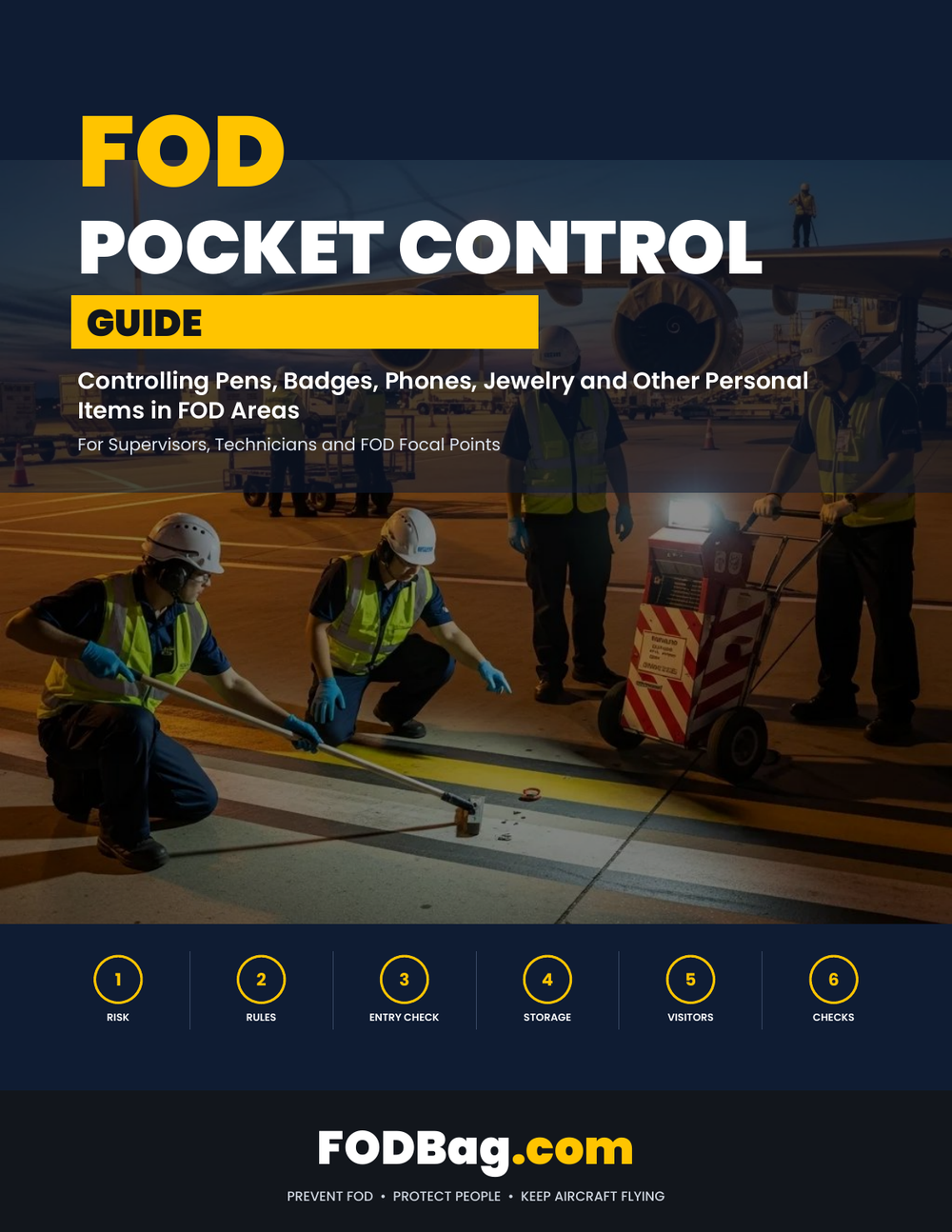
About the Personal Items and Pocket Control FOD Guide
Reviewed by Trent Powell, Founder, FODBag · Reviewed: November 10, 2026
Quick answer: Personal items such as pens, coins, badges, earplugs, phones, jewelry and wrappers are a common source of FOD because they leave the pocket without anyone noticing. Set clear rules for what may enter each FOD area, run a quick pocket check at entry, provide secure storage outside the area and secure anything that must be carried, such as badges on lanyards or clips. Apply the same rules to visitors and contractors.
Who it is for: Supervisors, technicians, area monitors and anyone who escorts visitors into FOD areas.

What’s Inside the Guide
Six sections: why personal items matter, area rules, the entry pocket check, storage, visitors and contractors, and a printable check form.
Why It Matters
Area Rules
Entry Pocket Check
Storage
Visitors and Contractors
Printable Form
Key Practices From the Guide
A short preview of what the guide covers in depth.
Decide what may enter
Empty pockets at entry
Secure what must be carried
Provide storage
Brief every visitor
Spot-check regularly
How to Use This Guide
- Understand the risk with Section 1.
- Set rules with Section 2.
- Run Sections 3 and 4 at each entry.
- Brief visitors with Section 5 and audit with Section 6.
Before You Start
- List items people carry into each area.
- Decide what is allowed per area.
- Set up storage at entries.
- Name who briefs visitors.
Forms in the Toolkit
- Entry Pocket Check Card (Section 6)
- Personal Item Spot Audit (Section 6)
By FODBag.com · Updated November 10, 2026
Reviewed by Trent Powell, Founder, FODBag · Reviewed: November 10, 2026
Personal Items and Pocket Control Playbook: Rules by Area, Check at the Door
Quick answer: Set clear rules for what may enter each FOD area, store personal items outside or in a secure pouch, check pockets at the entry, and secure badges. NASA guidance requires loose items out of pockets above the waist before a control area, all pockets emptied before a critical zone. Apply the same rules to visitors.
This playbook shows how to set and enforce personal item rules. It uses the NASA MSFC-STD-3598 Rev. D personal item section as a reference model and the IAQG list of personal items, and works a pocket check example with checked arithmetic. The rules for your site come from your own area levels and customers; the example numbers are invented and the layout is a FODBag suggestion.
What the opened sources say
IAQG guidance in support of AS9146 expects processes to account for and control consumables, hardware and personal items, and lists keys, phones, wallets, food, jewelry, coins, electronic devices, pens and pencils as personal items, as well as organization-owned items such as badges (IAQG SCMH 3.4.2 Rev. D, slide 29). NASA MSFC-STD-3598 Rev. D says personal items are removed and stored or secured according to the work rules, personal items are not stored in tool bags, badges are not clipped to shirts or worn on lanyards inside control areas, and jewelry is not worn in control areas and critical zones (NASA MSFC-STD-3598 Rev. D, 5.7.1, 5.7.1.3, 5.7.2 and 5.7.3.1). It also says accessories such as phones and key fobs are not worn in those areas, hats are not worn except hoods, snoods or required hard hats, loose items come out of pockets above the waist before a control area, and all pockets are emptied before a critical zone (NASA MSFC-STD-3598 Rev. D, 5.7.5 and 5.7.6).
Setting rules by area
- Use your area levels: stricter rules where the risk is higher.
- List what is allowed in each level, in plain words and pictures.
- Provide storage: lockers, badge boards or pouches at the entry.
- Check at the door: a 10-second pocket check by the person and a buddy.
- Apply to visitors: brief and check them, or escort them.
Badges, phones and medical items
Use a pouch window or a secured holder for badges where required. Medical devices that cannot be removed are handled case by case by the site manager and FOD focal point, as NASA guidance provides for tethering or accommodation.
Records
Count what the pocket checks find and review it weekly. Frequent finds of one item tell you to change the rule or the storage, not just remind people.
Worked example: a shift of pocket checks
This example is illustrative, not real data:
| Item | Count |
|---|---|
| People checked at entry | 40 |
| Pens | 4 |
| Coins | 3 |
| Badge clips and lanyards | 2 |
| Items removed | 4 + 3 + 2 = 9 |
| Share of people with a loose item | 9 ÷ 40 = 22.5% (one item each) |
Check: 4 + 3 + 2 = 9 items; 9 ÷ 40 = 22.5%. Pens lead the list, so the supervisor adds a pen-and-pencil holder at the entry and checks next shift whether the count falls.
What good looks like
- Rules are written by area level.
- Storage is available at the entry.
- A pocket check is part of entry.
- Badges are secured as the area requires.
- Visitors follow the same rules.
Matching FODBag products and resources
Products for personal item control: belt pouches; FOD signs; FOD stickers; FOD bags; FOD field posters.
About FODBag. FODBag.com, a Powell Pack Products company in Mesa, Arizona, has made FOD bags, FOD tape, FOD stickers, FOD signs, FOD posters, FOD cans and FOD containers since 2016. FOD tape is 2 in × 108 ft and FOD signs start at $29.99. Questions? Call 602-874-1313, Monday–Friday, 9:00 a.m.–5:00 p.m. Arizona time.
Sources opened for this page
- IAQG SCMH 3.4.2 Rev. D, FOD Prevention Program: Guidance in Support of IAQG Standard 9146 (June 19, 2023) — Slide 29 on personal items. Opened and read for this page on November 10, 2026.
- NASA MSFC-STD-3598 Rev. D, Standard for Foreign Object Damage/Foreign Object Debris (FOD) Prevention (effective July 26, 2021) — Sections 5.7.1, 5.7.2, 5.7.3, 5.7.5 and 5.7.6. Opened and read for this page on November 10, 2026.
Get the Personal Items and Pocket Control FOD Guide
Enter your details and we will email you the PDF right away.
- 6-page guide (PDF)
- Area rules for personal items
- Entry pocket check steps
- Pocket check card and spot audit
Free for internal organizational use. Educational resource from FODBag.com, a Powell Pack Products company. Questions? Call 602-874-1313.
Get the Free Guide
Enter your details and we will email you the PDF of Personal Items and Pocket Control FOD Guide right away.
Related Reading
Go deeper on the topics in the Personal Items and Pocket Control FOD Guide.
More Free FOD Prevention Guides
Each guide is free to request and written for aerospace, aviation, MRO and manufacturing teams.
Equip Your FOD Program
Frequently Asked Questions
Why are personal items a FOD risk?
Pens, coins, badges, earplugs, jewelry and wrappers can fall from pockets or clothing without anyone noticing and end up in aircraft, engines or assemblies.
What is a pocket check?
A quick check at the entry to a FOD area where people empty or secure their pockets and remove items not allowed in the area.
Are phones allowed in FOD areas?
That is a site decision. If phones are allowed, require secure carry, such as a zipped pocket, and never on aircraft surfaces or open assemblies.
How should badges be carried in FOD areas?
Secure them with a lanyard, clip or retractable holder so they cannot drop, following your site security rules.
Do visitors follow the same rules?
Yes. Brief visitors and contractors before they enter and apply the same personal item rules, with an escort where required.
What is a FOD pocket check?
A short check at the entry to remove loose items. NASA MSFC-STD-3598 Rev. D has loose items removed from pockets above the waist before a control area and all pockets emptied before a critical zone (section 5.7.6).
How should badges be carried in FOD areas?
NASA MSFC-STD-3598 Rev. D says badges are not clipped to shirts or worn on lanyards inside control areas and may be placed in the clear window of a personal FOD pouch (section 5.7.2). Your area rules decide.
Do visitors follow the same personal item rules?
As a FODBag suggestion, yes. IAQG guidance expects visitors, customers and contractors entering designated areas to have training or be escorted (slide 24).