
12 FOD Toolbox Talk Scripts
Twelve ready-to-deliver FOD toolbox talks, one for each month, each designed to run in about 15 minutes at the work location. Get the Free GuideSee What's Inside10
Pages
12
Talk Scripts
15
Minutes per Talk
1
Attendance Record
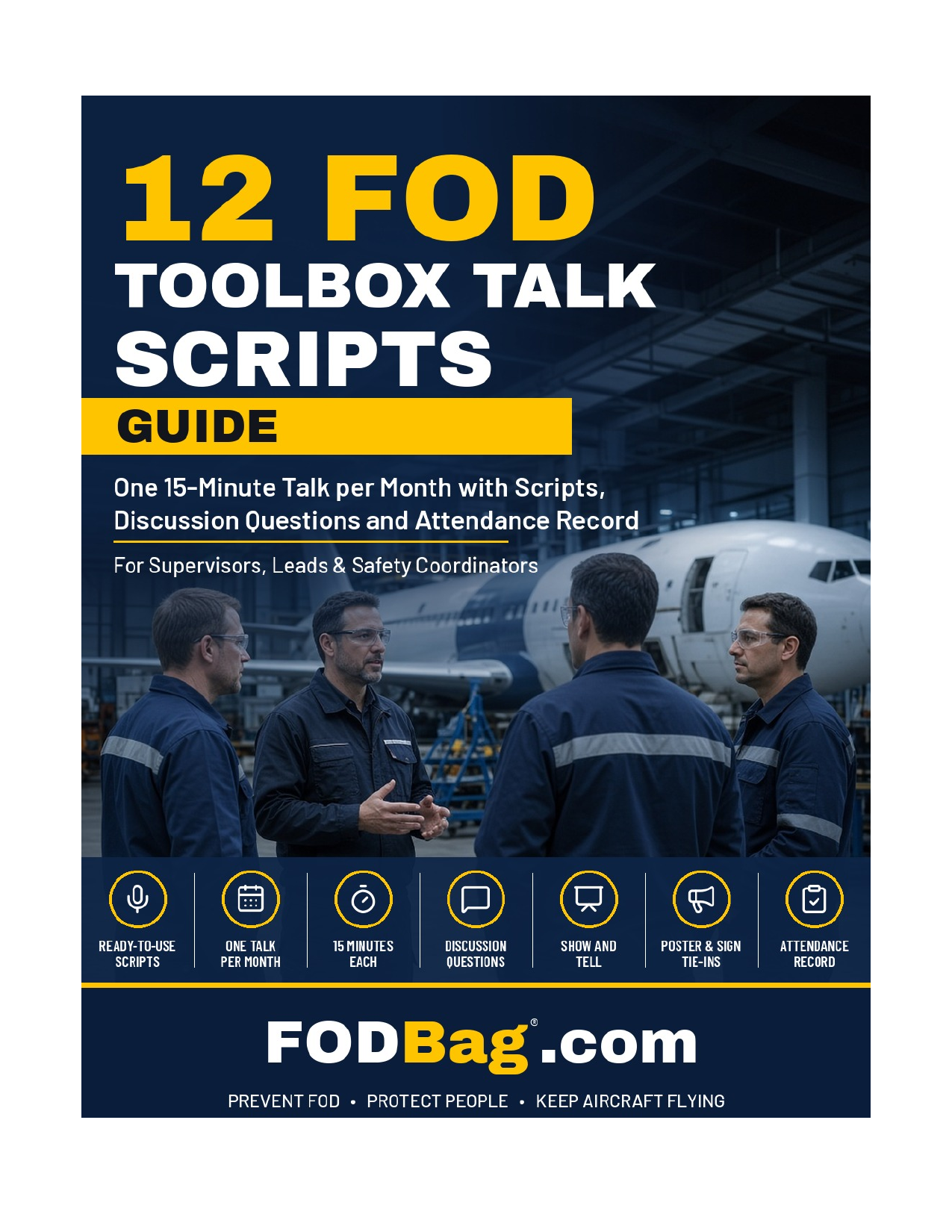
About the 12 FOD Toolbox Talk Scripts
Reviewed by Trent Powell, Founder, FODBag · Reviewed: November 10, 2026
Quick answer: A toolbox talk is a short, focused safety and quality conversation held at the start of a shift, at the work location. Delivered every month, FOD toolbox talks keep FOD awareness current, reinforce the behaviors that prevent foreign object damage, and give supervisors a structured way to discuss local findings with their teams. This pack is a year of recurrent FOD awareness training in 15-minute sessions. Several scripts cover what should you do if you find FOD so the team practices the same stop, contain and report steps.
Who it is for: Supervisors, leads, safety coordinators and FOD focal points in MRO, flight line, manufacturing and assembly environments.
What’s Inside the Guide
Five sections: how to deliver a talk, the annual plan, twelve scripts and an attendance record.
How to Deliver a FOD Toolbox Talk
Delivery Tips for Supervisors
Annual Talk Plan
July to December Topics
Every Script, Ready to Use
Printable Attendance Record
Key Practices From the Guide
A short preview of what the guide covers in depth.
Hold the talk at the work location
Use the script as a guide, in your own words
Show a real object
Let the team answer first
Close with one action for the shift
Add a recent local finding
How to Use This Guide
- Use Section 1 to learn the 15-minute structure and delivery tips.
- Use Section 2 to schedule one talk per month across the year.
- Use Section 3 to prepare each talk: objective, items to bring, poster or sign tie-in, script and questions.
- Use the attendance record in Section 4 as training evidence.
Before You Start
- Pick who delivers the talk on each shift.
- Schedule the twelve talks on the annual plan.
- Collect recent FOD finds from your area to show.
- Post the poster or sign that ties in with the month’s talk.
- Adapt examples to your aircraft, products and areas.
- Decide where attendance records are kept.
Forms in the Toolkit
- Annual Talk Plan (Section 2)
- Talks 1 to 12 Scripts (Section 3)
- Printable Attendance Record (Section 4)
By FODBag.com · Updated November 10, 2026
Reviewed by Trent Powell, Founder, FODBag · Reviewed: November 10, 2026
FOD Toolbox Talk Playbook: How to Deliver, Schedule and Prove Recurrent Training
Quick answer: A FOD toolbox talk is a 15-minute conversation at the work location. Say why it matters, show the real hazard, ask questions, and close with one behavior to practice. Run twelve topics across the year, keep attendance records, and track makeups. Toolbox talks reinforce formal FOD training; they do not replace it.
This playbook is for supervisors, leads, safety coordinators and FOD focal points who run monthly talks in MRO, flight line, manufacturing and assembly work. It shows what the public NASA and IAQG documents say about FOD training content, intervals and records, and works an attendance-tracking example. The 15-minute format and monthly cadence are FODBag suggestions, and the crew and attendance numbers are invented for illustration.
What the opened sources say about training
IAQG guidance expects a FOD prevention training program that fits the risk assessment, with initial and recurring training content and intervals, evaluation of effectiveness and documented training compliance (IAQG SCMH 3.4.2 Rev. D, slide 23). NASA requires FOD training courses to include awareness of entrapment hazards and susceptibility of hardware to impact damage, leaks and spills (NASA MSFC-STD-3598 Rev. D, 5.11.1), awareness training for people in FOD Awareness Areas or who occasionally enter FOD Sensitive Areas, repeated every three years (NASA MSFC-STD-3598 Rev. D, 5.11.2), prevention training for people in FOD Control Areas that covers control of tools, consumables, personal items and clean-as-you-go, repeated every two years (NASA MSFC-STD-3598 Rev. D, 5.11.3), and annual refresher training for FOD monitors (NASA MSFC-STD-3598 Rev. D, 5.11.4.3). Training records are kept (NASA MSFC-STD-3598 Rev. D, 5.11.5). Those are NASA flight-hardware intervals; a toolbox talk fills the time between formal courses and is not a replacement.
A 15-minute structure that works
- Say (2 min): state why the topic matters using a real example from your area.
- Key points and show (7 min): three points maximum, demonstrated at the work location.
- Ask (4 min): questions that make people describe what they would do.
- Close (2 min): one behavior to practice this month.
Hold the talk next to the aircraft, bench or line, not in an office. The structure is a FODBag suggestion.
Twelve topics for the year
- What FOD is
- Clean as you go
- Tool control and shift change
- Hardware and consumables
- Personal items
- Covers, caps and plugs
- FOD walks and the ramp
- Lost tool or item
- Area levels
- Signs and floor markings
- Close-out inspections
- Non-standard work and time pressure; learning from FOD finds
Prove the talks happened and worked
Keep an attendance record with date, topic, presenter and attendee signatures, plus a short note of the questions people asked and actions raised. Compare attendance to plan monthly, schedule makeups, and watch finding trends for the topic just trained, which is how IAQG says to evaluate effectiveness (competency, nonconformity trends).
Worked example: tracking attendance through September
This example is illustrative, not a customer case. A 25-person crew has held 9 of 12 planned monthly talks by the end of September.
| Measure | Count | Result |
|---|---|---|
| Talks held (January to September) | 9 | 9 of 12 planned |
| Possible attendances | 9 × 25 = 225 | |
| Recorded attendances | 207 | 207 ÷ 225 = 92% |
| Missed (makeup needed) | 225 − 207 = 18 | 18 ÷ 225 = 8% |
Check: 9 × 25 = 225 possible; 225 − 207 = 18 missed; 207 ÷ 225 = 92% and 18 ÷ 225 = 8%. The 18 misses go on a makeup list for the next two weeks. Also check the time budget: 4 sections of 2 + 7 + 4 + 2 = 15 minutes, and 12 × 15 = 180 minutes, or 3 hours per employee a year, a modest load for continuous reinforcement.
What good looks like
- Each talk is held at the work location with a real example from the area.
- The same four-part structure is used every time.
- Attendance, topic and questions are recorded and makeups tracked.
- Topics rotate through the year and respond to recent findings.
- Talks reinforce, but do not replace, required formal training.
Matching FODBag products and resources
Pair each talk with a visible prop: FOD field posters; FOD walk awareness signs; FOD belt pouches; FOD tool bags; FOD stickers.
About FODBag. FODBag.com, a Powell Pack Products company in Mesa, Arizona, has made FOD bags, FOD tape, FOD stickers, FOD signs, FOD posters, FOD cans and FOD containers since 2016. FOD tape is 2 in × 108 ft and FOD signs start at $29.99. Questions? Call 602-874-1313, Monday–Friday, 9:00 a.m.–5:00 p.m. Arizona time.
Sources opened for this page
- IAQG SCMH 3.4.2 Rev. D, FOD Prevention Program: Guidance in Support of IAQG Standard 9146 (June 19, 2023) — Slide 23 on the training program. Opened and read for this page on November 10, 2026.
- NASA MSFC-STD-3598 Rev. D, Standard for Foreign Object Damage/Foreign Object Debris (FOD) Prevention (effective July 26, 2021) — Sections 5.11.1 to 5.11.5 on course content, intervals and records. Opened and read for this page on November 10, 2026.
Get the 12 FOD Toolbox Talk Scripts
Enter your details and we will email you the PDF right away.
- 10-page script pack (PDF)
- 12 monthly FOD toolbox talk scripts
- 15-minute Say, Show, Ask, Close structure
- Printable attendance record
Free for internal organizational use. Educational resource from FODBag.com, a Powell Pack Products company. Questions? Call 602-874-1313.
Get the Free Guide
Enter your details and we will email you the PDF of 12 FOD Toolbox Talk Scripts right away.
Related Reading
Go deeper on the topics in the 12 FOD Toolbox Talk Scripts.
More Free FOD Prevention Guides
Each guide is free to request and written for aerospace, aviation, MRO and manufacturing teams.
Equip Your FOD Program
Frequently Asked Questions
What is a FOD toolbox talk?
A short, focused safety and quality conversation held at the start of a shift at the work location. Monthly FOD toolbox talks keep FOD awareness current and give supervisors a structured way to discuss local findings.
How long is each FOD awareness training talk?
About 15 minutes: 2 minutes on why the topic matters, 7 minutes on key points with something to show, 4 minutes of discussion questions and 2 minutes to close with one action and record attendance.
What topics should FOD awareness training cover?
The pack's annual plan covers what FOD is, clean as you go, tool control and shift change, hardware and consumables, personal items, covers and plugs, FOD walks, lost items, area levels and signs, close-out inspections, non-standard work and learning from FOD finds.
How do you record FOD safety training?
Use the printable attendance record for each talk and keep completed records with training files as evidence of recurrent FOD awareness training.
Who should deliver FOD toolbox talks?
Supervisors, leads, safety coordinators and FOD focal points, at the work location rather than in an office.
How long should a FOD toolbox talk be?
About 15 minutes: 2 to say why it matters, 7 for key points and demonstration, 4 to ask questions and 2 to close with a behavior to practice. The length is a FODBag suggestion, not a published requirement.
How often is formal FOD training required?
It depends on your program. NASA MSFC-STD-3598 Rev. D requires FOD awareness training every three years (5.11.2.4), FOD prevention training every two years (5.11.3.4) and annual refresher training for FOD monitors (5.11.4.3). IAQG guidance asks organizations to set recurring training criteria and intervals (SCMH 3.4.2 Rev. D, slide 23).
Do toolbox talks count as FOD training records?
Keep attendance records for them as evidence of recurrent awareness. They support, but do not replace, the formal training your procedures or customer requirements specify. IAQG expects documented information of training program compliance (slide 23).