
FOD Training Guide and Employee Handout
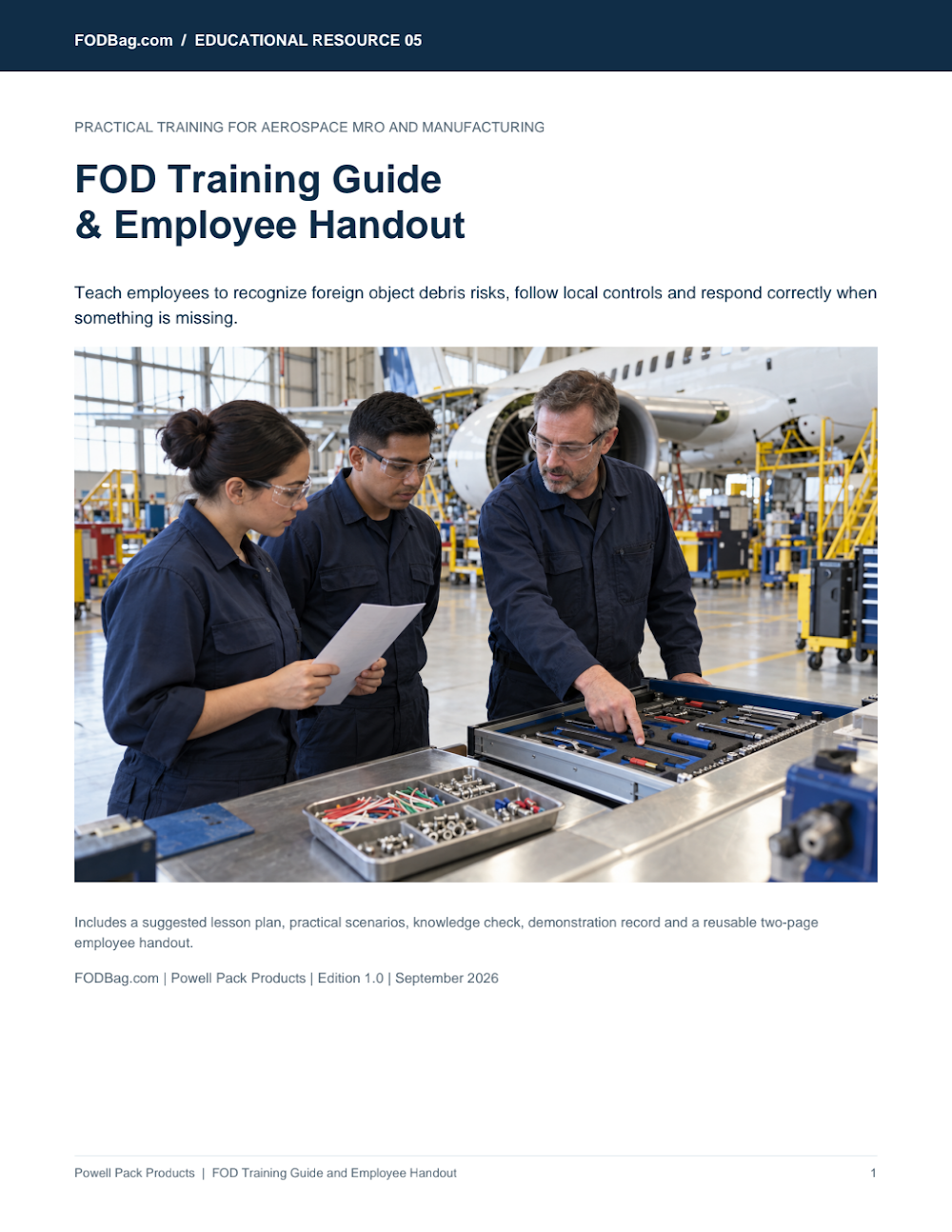
Teach employees to recognize foreign object debris risks, follow local controls and respond correctly when something is missing. Includes a lesson plan, scenarios, knowledge check and a reusable employee handout. Get the Free GuideSee What's Inside21
Pages
35 min
Suggested Session
4
Discussion Scenarios
8
Knowledge-Check Questions
About the FOD Training Guide and Employee Handout
Reviewed by Trent Powell, Founder, FODBag · Reviewed: November 10, 2026
Quick answer: This training package supports your approved FOD prevention program for new employees, task changes and refresher training in aerospace manufacturing, assembly and maintenance, repair and overhaul (MRO). It gives instructors a suggested 35-minute session, practical scenarios, an observed demonstration, a written knowledge check with answer key, a training record and a print-ready employee handout.
Who it is for: Instructors, supervisors and FOD program owners training employees in aerospace manufacturing, assembly and MRO environments.

What’s Inside the Package
Instructor tools, learner tools and a print-ready handout in one training package.
Instructor Preparation
Debris and Damage Fundamentals
Core Behaviors
Scenarios and Demonstration
Knowledge Check and Records
Employee Handout
Suggested 35-Minute Session
A planning example from the guide, not a required duration.
5 minutes: local scope and risks
10 minutes: core behaviors
10 minutes: demonstration and practice
5 minutes: scenarios
5 minutes: knowledge check and recap
What an Employee Should Be Able to Do
- Recognize objects and conditions that could introduce debris or damage.
- Identify the local entry rules and know where to obtain help.
- Demonstrate approved tool, personal-item and cleanup controls.
- Protect hardware and communicate status at handoff.
- Apply the local missing-item or FOD reporting process.
How to Use This Training Package
- Tailor the guide to your approved FOD prevention program before delivery.
- Complete the local procedure, area and contact fields on the handout.
- Teach the session, then run the observed demonstration against approved criteria.
- Use the knowledge check and answer key to confirm understanding.
- Record training and demonstration results.
- Refresh learning when the work, procedures or assignments change.
Included in the Package
- Suggested lesson plan
- Four discussion scenarios
- Observed demonstration checklist
- Written knowledge check and answer key
- Training and demonstration record
- Two-page print-ready employee handout
By FODBag.com · Updated November 10, 2026
Reviewed by Trent Powell, Founder, FODBag · Reviewed: November 10, 2026
FOD Training Delivery Playbook: What the Sources Require, an 18-Person Roster and a 35-Minute Count
This playbook is for the instructor, supervisor or FOD program owner about to run a first-month class from the downloadable package on this page. It sets out what a NASA standard, IAQG public guidance and an FAA advisory circular actually say about training levels, audiences, records and escorts; works one 18-person avionics shop through a two-level roster, a 35-minute session and a record count; and gives a delivery-readiness check. The 35-minute agenda, the written knowledge check and the two-page handout are a FODBag suggestion for format and timing, not a published course.
What the published sources say about who is trained, to what depth and how it is recorded
NASA requires a FOD awareness and prevention training program to be developed and made available to personnel who are assigned to work in or support FOD Sensitive Areas (NASA MSFC-STD-3598 Rev. D, paragraph 5.11). Training courses shall include awareness of FOD entrapment hazards and of how susceptible hardware is to impact damage and to leaks and spills (5.11.1).
The standard then splits the program into three courses. FOD Awareness Training is an introduction to the causes and effects of FOD on hardware, FOD prevention approaches, the concept and concerns for intrusion-detection-system (IDS) hardware, and familiarization with FOD control logos, signs, area agreements and general work rules. It is required for personnel assigned to work in FOD Awareness Areas and for personnel who occasionally require entry into FOD Sensitive Areas, and it is required every three years (5.11.2–5.11.2.4). FOD Prevention Training builds on that introduction: it shall increase employee awareness of causes and effects, promote active involvement through specific FOD control techniques, and stress good work habits and compliance with FOD control work disciplines. It shall address control of tools, consumables, personal items and “clean-as-you-go” processes. It is required for personnel assigned to work in FOD Control Areas and FOD Critical Zones, and for personnel who create written lifting, handling and transportation plans or instructions for FOD-sensitive hardware, and it is required every two years (5.11.3–5.11.3.4). FOD Monitor Training covers walkdowns, area monitoring, area tool-control systems, the FOD database, and procedures for lost tools and FOD incidents. It is required for personnel assigned to serve as FOD Monitors and as Site Managers for FOD Control Areas and FOD Critical Zones, with annual refresher training, and the prevention course is a prerequisite (5.11.4–5.11.4.5). Training records for Marshall civil servants go in SATERN; records shall be maintained to the Center training procedure; contractor records that do not use SATERN shall be recorded at the time of training and reported in accordance with the contract (5.11.5.1–5.11.5.3).
IAQG’s public guidance tells an organization, in order to comply with the standard the slides support, to establish, implement and maintain a FOD Prevention training program commensurate with FOD risk-assessment results: determine the appropriate initial training criteria and content; identify internal and external personnel training requirements; establish training methods (for example, lecture or electronic); establish recurring training criteria, content and intervals; evaluate training effectiveness (for example, measuring employee competency and FOD/FOd nonconformities); and maintain documented information of training-program compliance (IAQG SCMH 3.4.2 Rev. D, slide 23). The next slide requires provisions so that anyone entering FOD Prevention designated areas has received the required FOD Prevention training or is escorted by trained personnel, including customers, visitors, contractors and infrastructure maintenance staff not typically assigned to the area (slide 24). Those slides do not set a session length, a passing score or a number of months between refreshers.
The FAA circular, which applies to airport FOD management, says each person with access to the air operations area should understand their role in preventing FOD, including airport operations, construction, aircraft maintenance and permanent or seasonal servicing staff, and other contractors. A formal orientation should include FOD management training and can supplement general FOD awareness already in driver or apron-walking training (AC 150/5210-24A, paragraph 3.2.1). Typical features of a FOD training and education program are a documented process to identify training requirements, a validation process that measures effectiveness, recurrent training and education to help maintain awareness, and human and organizational factors (3.2.2). Primary objectives are to increase employee awareness of the causes and effects of FOD damage and to promote active participation in eliminating FOD in daily work; a 14-point subject list follows, from an overview of the airport program through clean-as-you-go, tool and hardware accountability, reporting, detection and removal (3.2.3). Training requirements and activities should be documented, and, to the extent possible, a training file should be developed for each employee, including management (3.2.4). Those paragraphs are airport guidance. Using the 14-point list as a hangar lesson outline is a FODBag suggestion.
Worked example: an 18-person avionics shop, first-month delivery
This example is illustrative. It is not a customer case, and it does not claim that NASA’s Marshall intervals or course names apply to this shop. The shop uses the NASA three-course ladder only as a way to split the roster. The 35-minute session, the class size of eight, the 20-minute monitor module and the rule that a written check is retaken the same day are FODBag suggestions.
Bay 4 is an avionics shop of 18 people. Twelve technicians are assigned to work in FOD Control Areas. Two leads among those twelve are also designated as FOD Monitors. Two planners, who sit just off the floor, write lifting, handling and transportation instructions for FOD-sensitive hardware. Four storekeepers and coordinators work in FOD Awareness Areas and only occasionally enter the higher-control bays, escorted until their awareness class is complete.
| Group | Headcount | Course this month | Why (NASA ladder used as a map) |
|---|---|---|---|
| Control-area technicians (not also monitors) | 10 | Prevention | Assigned to FOD Control Areas (5.11.3.2). |
| Leads also designated as monitors | 2 | Prevention, then Monitor | Prevention is the prerequisite for Monitor training (5.11.4.2, 5.11.4.5). |
| Planners who write handling instructions | 2 | Prevention | They create written lifting, handling and transportation plans for FOD-sensitive hardware (5.11.3.3). |
| Storekeepers and coordinators | 4 | Awareness | Assigned to Awareness Areas / occasional entry (5.11.2.2–5.11.2.3). Escorted in the higher bays until the class is recorded (IAQG slide 24). |
Headcount check: 10 + 2 + 2 + 4 = 18 people. Prevention seats this month: 10 + 2 + 2 = 14. Awareness seats: 4. Monitor seats (in addition to prevention): 2. Training records to open this month: 14 + 4 = 18 people, but 14 + 4 + 2 = 20 records, because the two leads each have a prevention record and a monitor record.
The package’s suggested session is 35 minutes: 5 minutes on local scope and risks, 10 minutes on core behaviors, 10 minutes on demonstration and practice, 5 minutes on scenarios, and 5 minutes on the knowledge check and recap. That addition is 5 + 10 + 10 + 5 + 5 = 35, and it already appears in the session accordion on this page. The shop caps a class at eight people so the observed demonstration stays visible to the instructor.
Prevention therefore runs as two classes: 14 people in a class cap of eight, which is one class of eight and one class of six, or 2 × 35 = 70 minutes of prevention instruction. Awareness is one class of four: 35 minutes. The two leads stay 20 minutes after their prevention class for a monitor module on walkdowns, area tool control, and lost-tool and incident procedures (a FODBag length; NASA 5.11.4.1 lists those tasks but does not set a time). Total instructor delivery this month: 70 + 35 + 20 = 125 minutes, not counting setup or record entry.
All 14 prevention trainees complete an observed demonstration against the shop’s approved criteria and a written knowledge check from the package. Thirteen pass the check on the first try; one retakes it the same afternoon and passes. Completions: 13 + 1 = 14. The written check is evidence of understanding, not of task competence. The demonstration record is what the supervisor signs. Four awareness trainees complete the shorter familiarization and a knowledge check; 4 = 4. Two monitor modules are signed off after the leads have already completed prevention: 2 = 2. Records closed: 14 + 4 + 2 = 20.
Handouts: each of the 18 people receives the two-page print-ready sheet with local area rules and contacts filled in. Pages printed: 18 × 2 = 36. The instructor also posts the shop’s area signs and walks the class to them during the familiarization segment, because NASA 5.11.2.1 includes logos, signs, area agreements and general work rules. That is a reason to have the actual FOD signs (from $29.99), FOD area signs, and FOD stickers on the wall before the first class, and to walk the floor tape that marks the doorway the class will use — FOD floor tape in 2 in × 108 ft rolls.
If this shop later chose to follow the Marshall refresh intervals, awareness would be due again in three years, prevention in two years and monitor training in one year. That choice would be a local decision, not a requirement of this package. IAQG slide 23 still requires the shop to write its own recurring criteria and to evaluate effectiveness, for example by competency and by FOD/FOd nonconformities after the class, not only by attendance.
Arithmetic recap, all checked: 10 + 2 + 2 + 4 = 18 people; 10 + 2 + 2 = 14 prevention seats; 14 + 4 + 2 = 20 records; 5 + 10 + 10 + 5 + 5 = 35 minutes; 2 × 35 = 70; 70 + 35 + 20 = 125 minutes of delivery; 13 + 1 = 14 knowledge-check completions; 18 × 2 = 36 handout pages.
Delivery-readiness check (illustrative)
This six-point check is a FODBag suggestion for the instructor the morning of the first class, not a published audit list.
| Check | Pass if | Fail / action |
|---|---|---|
| The roster is split by role, not by whoever can make the meeting | Each name has a course level (awareness, prevention, monitor) that matches the area they work in or the plans they write. | One generic class for all 18: split the roster before you start (NASA 5.11.2–5.11.4; IAQG slide 23). |
| The lesson names this shop’s areas, signs and missing-item process | The handout fields are filled in, and the 5-minute open actually states the local scope. | A generic lecture with blank contacts: complete the local fields first (NASA 5.11.3.5; IAQG slide 23). |
| The 35 minutes add up, or the length you actually planned adds up | 5 + 10 + 10 + 5 + 5 = 35, or a different written total that is equally exact. | A session that drops the demonstration to “save time”: restore the observed check (this package; the About note on this page). |
| Untrained people are not already walking the higher bays alone | Escort rules are in force until awareness or prevention, as applicable, is recorded. | Storekeepers already unescorted in a Control Area: hold access until the class and a record exist (IAQG slide 24). |
| A written check is not treated as competence | The record has both a knowledge-check result and a signed observed demonstration for prevention trainees. | A quiz score alone used to authorize work: add the demonstration before you close the record. |
| Records will exist the same day | Name, date, course level, check, demonstration and instructor will be written at the time of training (NASA 5.11.5.3; IAQG slide 23; FAA 3.2.4 as airport guidance). | A sign-in sheet only: use the training and demonstration record in the package, or your equivalent, before the class leaves. |
Where to go next
The downloadable Training Guide and Employee Handout on this page holds the suggested lesson plan, four discussion scenarios, the observed demonstration checklist, the written knowledge check and answer key, the training and demonstration record, and the two-page handout. Request it with the form below. A separate, complementary knowledge check is the FOD Awareness Quiz and Competency Assessment. For the signs, stickers and doorway tape the familiarization segment should actually walk to, shop FOD signs (from $29.99), FOD area signs, FOD stickers, and FOD floor tape in 2 in × 108 ft rolls. Questions about matching a first class to signs, stickers or tape? Call FODBag at 602-874-1313, Monday–Friday, 9:00 a.m.–5:00 p.m. America/Phoenix.
Sources and how we used them
- NASA MSFC-STD-3598 Rev. D, Standard for FOD Prevention (effective July 26, 2021) — Paragraphs 5.11 (awareness and prevention training program for personnel assigned to work in or support FOD Sensitive Areas), 5.11.1 (entrapment hazards and susceptibility to impact damage and to leaks and spills), 5.11.2–5.11.2.4 (awareness course content, audiences and the three-year Marshall interval), 5.11.3–5.11.3.5 (prevention course content, audiences, the two-year Marshall interval, and tailoring by the Project FOD Focal Point), 5.11.4–5.11.4.5 (monitor course tasks, audiences, annual refresher, and prevention as a prerequisite), and 5.11.5.1–5.11.5.3 (records in SATERN or recorded at the time of training and reported per contract). Free public PDF, read from the copy saved under sources/. Those paragraphs do not set a 35-minute session, a class size, a passing score, or a required handout. Accessed for this page Nov. 10, 2026.
- FAA Advisory Circular 150/5210-24A, Airport Foreign Object Debris (FOD) Management (February 8, 2024; updated by errata May 20, 2024) — Paragraphs 3.2.1 (audience: each person with AOA access, including operations, construction, aircraft maintenance and servicing staff, and contractors; orientation may include FOD management training), 3.2.2 (typical features: documented requirements process, validation of effectiveness, recurrent training, human and organizational factors), 3.2.3 (objectives and a 14-point subject list), and 3.2.4 (document requirements and activities; a training file for each employee, including management, to the extent possible). Free public PDF, opened from the official FAA copy saved under sources/FAA_AC_150_5210_24A.txt. This AC is airport guidance, not a hangar or factory standard. Accessed for this page Nov. 10, 2026.
- IAQG SCMH 3.4.2 Rev. D, FOD Prevention Program: Guidance in Support of IAQG Standard 9146 (June 19, 2023) — Slides 23–24 (establish, implement and maintain a FOD Prevention training program commensurate with the FOD risk assessment, including initial criteria and content, internal and external personnel, methods, recurring criteria and intervals, evaluation of effectiveness, and documented information of compliance; provisions so that anyone entering designated areas has received required training or is escorted, including customers, visitors, contractors and infrastructure maintenance). Slide numbers are the footer numbers in the PDF. Free public document, read from the copy saved under sources/. The slides we read do not set a session length, a passing score, or a refresh interval in months. Accessed for this page Nov. 10, 2026.
AS9146 and NAS 412 are paid documents and are not reproduced or quoted here, and no clause numbers from them are cited. The 35-minute agenda, the class size of eight, the 20-minute monitor module, the same-day retake, and the six-point delivery-readiness check are FODBag instruments described in this playbook; they are not published standard requirements. The worked example is illustrative and is not a customer case.
Get the FOD Training Guide and Employee Handout
Enter your details and we will email you the PDF right away.
- 25-page training guide (PDF)
- Lesson plan, scenarios and demonstration checklist
- Knowledge check with instructor answer key
- Print-ready employee handout
Free for internal organizational use. Educational resource from FODBag.com, a Powell Pack Products company.
Get the Free Guide
Enter your details and we will email you the PDF of FOD Training Guide & Employee Handout right away.
Related Reading
Go deeper on the topics in the FOD Training Guide and Employee Handout.
More Free FOD Prevention Guides
Each guide is free to request and written for aerospace, aviation, MRO and manufacturing teams.
Equip Your FOD Program
Frequently Asked Questions
How long should a FOD training session be?
No duration is required by the NASA, IAQG or FAA sources cited on this page. The 35-minute lesson plan in this package (5 minutes on local scope, 10 on core behaviors, 10 on demonstration and practice, 5 on scenarios, and 5 on the knowledge check and recap) is a FODBag suggestion. Add time when you need individual verification or task-specific controls.
What is the difference between FOD awareness training and FOD prevention training?
In NASA MSFC-STD-3598 Rev. D, awareness training is an introduction to causes and effects, prevention approaches, intrusion-detection-system hardware concerns, and familiarization with logos, signs, area agreements and general work rules, and it is required for people assigned to FOD Awareness Areas or who occasionally enter FOD Sensitive Areas (paragraphs 5.11.2 through 5.11.2.3). Prevention training builds on that introduction, stresses active involvement, good work habits and control of tools, consumables, personal items and clean-as-you-go, and is required for people assigned to FOD Control Areas and FOD Critical Zones and for people who write lifting, handling and transportation plans for FOD-sensitive hardware (5.11.3 through 5.11.3.3). Those assignments and course names are Marshall Space Flight Center requirements. Other sites should map the two levels to their own area classes and contract.
How often should employees take FOD refresher training?
NASA MSFC-STD-3598 Rev. D requires awareness training every three years (5.11.2.4), prevention training every two years (5.11.3.4) and annual refresher training for FOD Monitors (5.11.4.3). Those intervals apply to the Marshall program that uses this standard. IAQG SCMH 3.4.2 Rev. D, slide 23, tells an organization to establish recurring training criteria, content and intervals commensurate with its FOD risk assessment; it does not publish a number of months. The FAA circular, which is airport guidance, lists recurrent training as a typical feature (paragraph 3.2.2) without setting an interval. Use your contract and your risk assessment.
Does a written knowledge check prove an employee is competent?
No. A written quiz supports learning but does not prove task competence. Use an observed demonstration against approved criteria. Completing training does not authorize hardware release, restricted access or work beyond the employee's assigned role. The package does not establish a universal passing score.
Who needs FOD training before entering a designated area?
IAQG SCMH 3.4.2 Rev. D, slide 24, says the organization needs to establish provisions so that anyone entering FOD Prevention designated areas has received the required FOD Prevention training or is escorted by trained personnel, including customers, visitors, contractors and infrastructure maintenance staff not typically assigned to the area. NASA 5.11 requires awareness or prevention training, as applicable, for personnel assigned to work in or support FOD Sensitive Areas, with a higher prevention course for Control Areas and Critical Zones. Your area designations and escort rules decide who may enter before the class is complete.
What belongs in a FOD training record?
IAQG slide 23 calls for documented information of training-program compliance. NASA 5.11.5 requires records: Marshall civil-servant records in SATERN, records maintained to the Center training procedure, and contractor records recorded at the time of training and reported per the contract. FAA paragraph 3.2.4, which is airport guidance, says training requirements and activities should be documented and, to the extent possible, a training file should be developed for each employee, including management. This package includes a training and demonstration record you can tailor. Keep the name, date, course level, result of the knowledge check and of the observed demonstration, and the instructor.
Can I deliver this package without tailoring it to our procedures?
No. Tailor the guide to your approved FOD prevention program before delivery, and complete the local procedure, area and contact fields on the handout. NASA 5.11.3.5 notes that the Marshall prevention course may be tailored by the Project FOD Focal Point for the specific project, FOD Control Area and audience. IAQG slide 23 says initial criteria and content should be determined, and methods established, commensurate with the risk assessment. A generic lecture that never names your areas or your missing-item process is not a finished class.
Does this package replace NAS 412 or AS9146 training requirements?
No. The package does not reproduce NAS 412 or AS9146 and does not establish universal passing scores or refresher intervals. Those are paid standards and are not quoted or cited by clause here. Use this package to support the training element of your approved program, then confirm the contract and the standard that actually bind you.