
FOD Tool Control and Accountability Guide
Best practices, procedures, checklists and templates to prevent Foreign Object Damage. Know what entered the work area, who is responsible for it, and that it leaves or is properly secured when work is complete. Get the Free GuideSee What's Inside22
Pages
17
Sections
6
Ready-to-Use Forms
1
Supervisor Closeout Reference
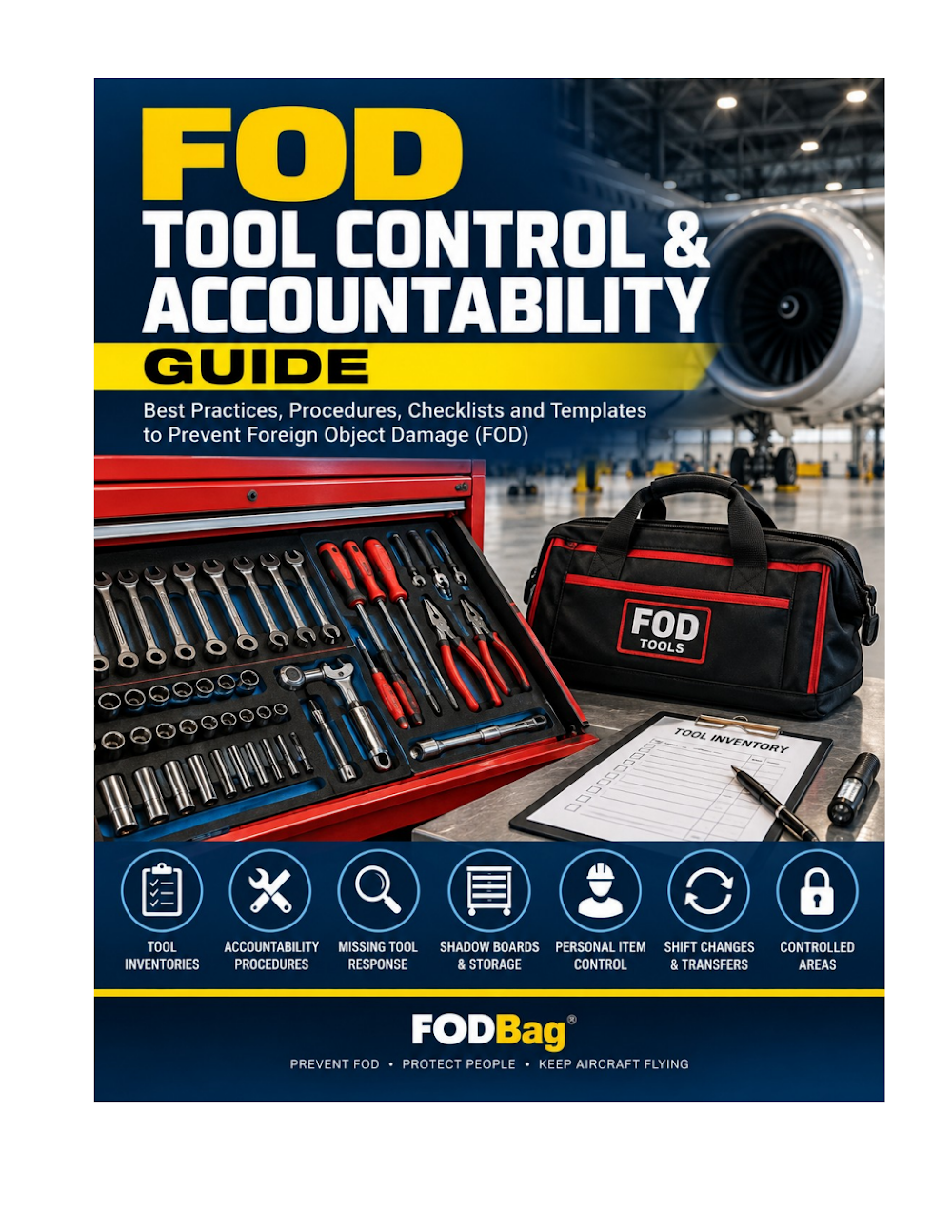
About the FOD Tool Control and Accountability Guide
Quick answer: Tool control is one of the most important layers in a mature FOD prevention program. A missing socket, drill bit, fastener, pen, flashlight or personal item can migrate into an aircraft, engine, assembly, vehicle or production line. The goal of tool accountability is simple: know what entered the work area, know who is responsible for it, and verify that it leaves or is properly secured when work is complete.
Who it is for: FOD managers, quality teams, supervisors, maintenance organizations, manufacturing operations, contractors and employees working in FOD-sensitive environments.

What’s Inside the Guide
Seventeen sections from tool-control policy to supervisor closeout.
Policy, Identification and Inventory
Issue, Return and Accountability
Toolboxes, Kits and Shadow Boards
Small Items and Personal Items
Missing Tool Response and Shift Change
Training, Audits and Forms
Key Practices From the Guide
A short preview of what the guide covers in depth.
Write a policy that is specific enough to apply consistently
Make accountability visible
Increase control as risk increases
Do not improvise the search for a missing tool
Treat shift change as a risk point
Audit whether the system actually works
How to Use This Guide
- Use Sections 1 to 5 to establish or strengthen your tool-control policy and accountability system.
- Use Sections 6 to 11 to address storage, personal items, missing tools, shift changes and special work situations.
- Use Sections 12 to 14 to train employees, audit performance and measure effectiveness.
- Use the implementation checklist and forms in the final sections as working documents or a starting point for your own controlled forms.
Before You Start
- Define where tool accountability is required and identify any heightened-control areas.
- Define which items are included: company tools, employee-owned tools, specialty tools and consumables.
- Establish approved methods for identifying, issuing, storing and returning tools.
- Assign responsibility to employees, supervisors, tool-room personnel and program owners.
- Define job-start, shift-change and job-closeout inventory requirements.
- Create a documented response for missing tools, broken tools and unaccounted-for items.
Forms in the Toolkit
- Form A: Tool Issue / Return Log
- Form B: Toolbox / Kit Inventory
- Form C: Missing Tool / Lost Item Report
- Form D: Shift Tool-Control Handoff
- Form E: Tool-Control Audit Checklist
- Form F: Tool-Control Corrective Action
Get the FOD Tool Control and Accountability Guide
Enter your details and we will email you the PDF right away.
- 22-page guide (PDF)
- 6 ready-to-use forms and templates
- Tool-control implementation checklist
- Supervisor closeout quick reference
Free for internal organizational use. Educational resource from FODBag.com, a Powell Pack Products company.
Get the Free Guide
Enter your details and we will email you the PDF of FOD Tool Control & Accountability Guide right away.
Related Reading
Go deeper on the topics in the FOD Tool Control and Accountability Guide.
More Free FOD Prevention Guides
Each guide is free to request and written for aerospace, aviation, MRO and manufacturing teams.