
NAS 412 FOD Compliance Guide
An implementation guide and compliance toolkit for building a defensible, risk-based FOD prevention system, with worksheets, checklists and templates you can adapt. Get the Free GuideSee What's Inside29
Pages
17
Sections
9
Incident Response Steps
30-60-90
Day Implementation Plan
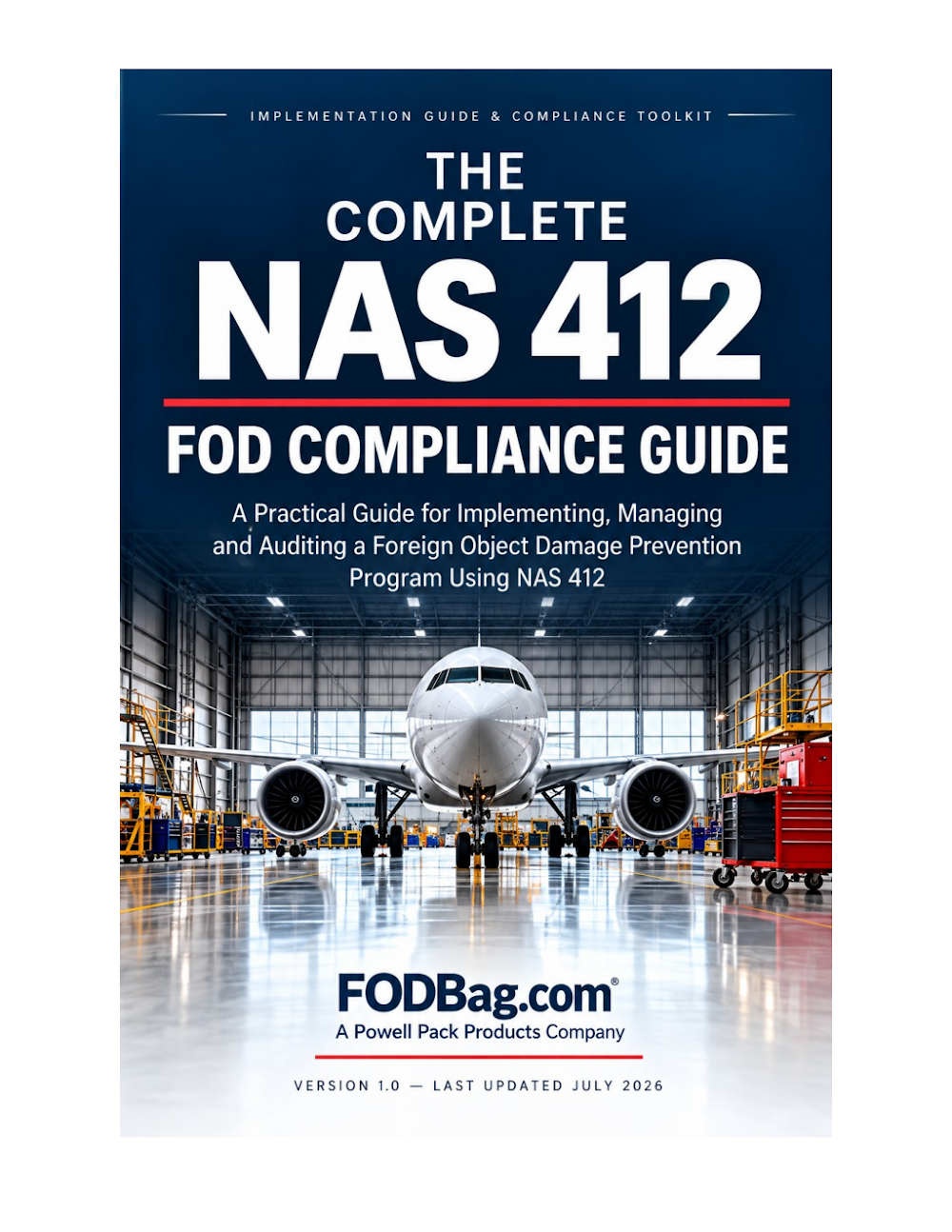
About the NAS 412 FOD Compliance Guide
Reviewed by Trent Powell, Founder, FODBag · Reviewed: November 10, 2026
Quick answer: NAS412 Rev. 3 is Foreign Object Damage prevention guidance published through the Aerospace Industries Association (AIA), while AS9146, published by SAE International/IAQG, is a requirements standard that can be flowed down contractually. This guide shows how to build a risk-based FOD prevention system around both, covering leadership, risk assessment, area controls, product protection, tool accountability, inspection, incident response and continual improvement.
Who it is for: FOD program managers, quality leaders, manufacturing supervisors, maintenance organizations, safety teams and suppliers.
For a plain-language overview, read NAS 412 explained.
What’s Inside the Guide
Seventeen sections moving from the standards landscape through risk-based controls to audit readiness.
Standards and Terminology
Risk-Based Program and Worksheet
Leadership, Areas and Training
Product Protection and Housekeeping
Tools, Hardware and Personal Items
Response, Measurement and Audit Readiness
Key Principles From the Guide
A short preview of the practices the guide develops in depth.
Clean is not the same as controlled
Build the program around risk
Know which documents are guidance and which are requirements
Protect product and verify before closure
Treat non-standard work as its own risk
Respond to FOD events in a defined order
Questions This Guide Helps You Answer
- Where can foreign objects enter, migrate, become trapped in, or damage our product?
- What controls are proportionate to the risk in each process, product and work area?
- How do we prove that the controls are understood, followed and effective?
- How do we detect weak signals and improve the program before a FOD event occurs?
How to Use This Guide
- Read the Standards Landscape and Risk-Based Program sections.
- Complete the FOD Risk Assessment Worksheet for each significant process or area.
- Use the Program Self-Assessment to identify gaps.
- Assign corrective actions and owners using the 30-60-90 Day Implementation Plan.
- Use the included FOD Walk, Tool Accountability, Training and Incident templates to create objective evidence.
- Reassess after process changes, non-standard work, incidents, customer findings or meaningful trend changes.
Templates in the Toolkit
- FOD Risk Assessment Worksheet
- Training record
- Tool / controlled-item log
- FOD finding log
- Non-standard work mini-assessment
- FOD incident report template
- Pre-closure verification questions
- FOD walk checklist
By FODBag.com · Reviewed November 9, 2026
NAS 412 FOD Program Playbook: Roles, Cadence and Records
This playbook is for the person who has been handed the NAS 412 or AS9146 flow-down and has to turn it into a program a floor supervisor and an auditor can both follow. It covers who owns each element, how often each check runs, and which records prove it. Every published source it relies on is listed at the bottom with the paragraph or slide used. Barrier controls at open systems, such as covers, plugs, controlled entry and close-out checks, can be written up as a separate foreign material exclusion procedure inside the same program.
What NAS 412 Rev. 3 changed, and what this page does not do
On August 31, 2023 the Aerospace Industries Association (AIA) released a revised NAS412. AIA’s announcement says the revision adds a risk assessment section with tables on methodologies and recommended performance, new guidance on non-standard work risk assessment, clearer wording on intended use and the order of precedence of foreign objects, foreign object debris and foreign object damage, and enhanced definitions for accountability, inventory, item, risk assessment, tool/item control and traceability.
The eight program elements: owner, evidence and starting cadence
IAQG’s public guidance for AS9146 groups a FOD prevention program into eight primary elements (SCMH 3.4.2 Rev. D, slide 10). The owner and cadence columns are FODBag’s suggested starting points for a mid-size shop. They are not NAS 412 or AS9146 requirements. Your risk assessment should set the real intervals, because IAQG states that the level of controls varies with the risk assessment results (slide 18).
| Element (IAQG slide) | Typical owner | Evidence an auditor will ask for | Suggested starting cadence |
|---|---|---|---|
| Program management (slides 10, 16) | FOD program manager | Written program, risk assessment, management review minutes, nonconformity records | Review monthly; management review at least quarterly |
| Operations (19–20) | Process engineering and production supervisors | Identified openings and cavities needing protection; inspection step before closure in work instructions | Review when a process or work instruction changes |
| Area designation (21–22) | Program manager with area supervisors | Area map with Awareness, Control and Critical designations, posted signs, and entry rules per area | Walk each area daily; re-designate after a risk reassessment |
| Training and personnel access (23–24) | Training lead and area supervisors | Initial and recurring training records; evidence that visitors and contractors are trained or escorted | Initial before access; recurring interval set by your risk assessment |
| Product protection (25–26) | Production and quality | Rules for how protective devices are delivered, applied and removed, and what happens to them afterward | Check at every operation that opens or closes protection |
| Housekeeping and Clean-As-You-Go (27) | Every operator; supervisor verifies | Defined intervals, for example at completion of each operation and at end of shift (IAQG examples) | Per operation and end of shift |
| Consumables, hardware and personal items (29) | Supervisor and stockroom | Process for counting, controlling and reporting lost items, including personal items | Count at kitting and at the end of the operation |
| Tool accountability and control (31) | Tool crib and supervisor | Tool inventory, location knowledge, condition checks, and a lost tool reporting process | Inventory at shift start and end; condition check at each issue |
Roles that make the program auditable
| Role | What published programs say | Source |
|---|---|---|
| FOD program manager | Designate one accountable person. Define the responsibilities along clear lines of communication. Allow that person to report to the highest levels of management. Communicate program status and lessons learned to staff. | FAA AC 150/5210-24A, paragraphs 3.1.2.2.1–3.1.2.2.3 |
| FOD committee | Stakeholders who can produce or remove FOD, such as tenants, operations, public safety and contractor representatives, typically chaired by the FOD manager. It serves as a resource to the manager and evaluates collected FOD data. | FAA AC 150/5210-24A, paragraphs 3.1.2.3.1–3.1.2.3.3 |
| FOD monitor or focal point | Completes FOD training, verifies that people entering controlled areas are trained, walks the area at the start of the shift, is last out at the end of the shift, runs the end-of-shift tool inventory, reports exceptions and informs the site manager immediately of a lost tool or FOD incident. | NASA MSFC-STD-3598 Rev. D, paragraph 4.3.3.3 (a)–(k) |
Records to keep, and why
- Risk assessment for each product family, process and area, with the date of the last review and what triggered it.
- Area designation map and the signs posted at each entrance (NASA 5.5.7.1 requires signs at entrances that clearly indicate the level of control for the areas that standard covers).
- Training file for each employee, including management, so you can show who has been trained on what (FAA AC paragraph 3.2.4).
- Tool and controlled-item log, and a documented process for reporting lost tools and missing tool pieces (IAQG slide 31).
- FOD finding log. The FAA AC (paragraph 6.1.1) recommends capturing how the item was detected, date and time, description with size and color, location, possible source, who found it, and relevant conditions.
- Incident investigation file: source of the FOD, damage caused, corrective action and final disposition (FAA AC paragraph 6.1.3).
- Management review minutes showing program nonconformities and FOD product nonconformities were reported (IAQG slide 16).
Retention: the FAA circular says airport FOD records should be kept in sufficient detail for at least two years (paragraph 6.1.4). That is an airport-specific recommendation. Use the retention period in your own contract or quality manual.
Non-standard work: eight questions before the job starts
NAS412 Rev. 3 added guidance on non-standard work risk assessment (AIA announcement). The text of that section is paywalled, so the checklist below is FODBag’s own working list, not a copy. Run it whenever a work instruction cannot be followed as written. The downloadable guide includes a mini-assessment template for the same purpose.
- Which opening, cavity or system is exposed that is normally closed?
- What foreign objects will this job create (chips, wire ends, adhesive, fasteners, packaging)?
- Which temporary tools, fixtures or access equipment are being introduced, and who accounts for them?
- Who else will work in the same space during the job, and are they trained for this area designation?
- Where will product protection be applied and removed, and who verifies removal?
- What is the inspection method and point before the area is closed, and can it still be performed after assembly?
- Does the area designation need to be raised for the duration of the job?
- Who signs that tools, hardware and consumables are all accounted for at completion?
First 30 days
- Name the program manager in writing and set the monthly review.
- Pull the contract and purchase order clauses that mention NAS412, AS9146 or FOD, and list what each requires.
- Draw the area map and assign Awareness, Control or Critical to each area.
- Start the tool and controlled-item log in the highest-risk area and run the shift-start and shift-end counts.
- Place and mark collection points, and decide who empties them and how often.
- Run one FOD walkdown per week and file the records.
Equipment that supports each element
Documents and training set the program, and physical controls make it visible. These FODBag product lines map to the elements above. Colors are your choice; IAQG shows Awareness, Control and Critical as commonly used designations (slide 22).
| Program element | What it needs on the floor | FODBag product |
|---|---|---|
| Area designation | Floor boundaries and entrance signs that state the level of control | FOD floor tape (2 in × 108 ft rolls in blue, yellow, red and green), FOD area signs (signs from $29.99) |
| Housekeeping and Clean-As-You-Go | Marked collection points that are emptied before they overflow | FOD cans (12 in × 12 in × 30 in color-coded stands with covered, removable bags) and the FOD collection point sign |
| Tool and hardware accountability | Keep small items on the person, not in pockets or on the product | FOD belt pouches, tool bags and vinyl-coated nylon FOD bags, plus the tool accountability sign |
| Training and awareness | Visible reminders at entrances and workstations | FOD walk and awareness signs and FOD stickers |
Questions about matching products to your area designations? Call FODBag at 602-874-1313. We have served aviation and aerospace teams since 2016.
Sources and how we used them
- AIA announcement, Updated Foreign Object Damage Prevention Standard NAS412 (Aug. 31, 2023) — Rev. 3 changes (Aug. 31, 2023). Accessed Nov. 9, 2026.
- IAQG SCMH 3.4.2 Rev. D, FOD Prevention Program: Guidance in Support of IAQG Standard 9146 (June 19, 2023) — Eight program elements, area designation, training, product protection, Clean-As-You-Go, tool accountability, nonconformity reporting. Slide numbers are the slide footers in the PDF. Accessed Nov. 9, 2026.
- FAA Advisory Circular 150/5210-24A, Airport Foreign Object Debris (FOD) Management (Feb. 8, 2024) — Paragraphs 3.1.2.2, 3.1.2.3, 3.2.4, 6.1.1, 6.1.3, 6.1.4. Accessed Nov. 9, 2026.
- NASA MSFC-STD-3598 Rev. D, Standard for FOD Prevention (effective July 26, 2021) — Paragraphs 4.3.3.3 and 5.5.7.1. Accessed Nov. 9, 2026.
- IAQG 9146 standard page (SCMH) — Describes AS9146 as a requirements standard that can be flowed down contractually.
NAS412 and AS9146 themselves are not reproduced or quoted here. Obtain them from AIA and SAE International.
By FODBag.com · Updated November 10, 2026
Reviewed by Trent Powell, Founder, FODBag · Reviewed: November 10, 2026
NAS 412 Playbook: What It Is, How Public Sources Point to It, How It Differs from AS9146 and a Clean-As-You-Go Count
Quick answer: NAS 412 is the Aerospace Industries Association’s Foreign Object Damage (FOD) prevention guidance document; AIA released Revision 3 on August 31, 2023. It suggests general practices and standard terms. AS9146 is the requirements standard that contracts flow down. Use NAS 412 for how-to practice and AS9146 for what your contract can require.
This playbook is for FOD program managers, quality leaders and suppliers who see NAS 412 named in a contract, a customer clause or an audit and need to know what it is. NAS 412 is a paid document; we have not opened it and do not cite clause numbers or reproduce its text. What follows draws on public statements about it from AIA, NASA and FAA, public IAQG guidance for AS9146, and a worked count based on the clean-as-you-go steps NASA says follow NAS 412. Anything beyond the opened sources is a FODBag suggestion.
What NAS 412 is, from the publisher
AIA released a revised NAS 412 on August 31, 2023, describing it as an industry standard for the prevention of FOD to aerospace products and operating environments, produced through a cross-industry review by FOD prevention subject matter experts from AIA member companies. Listed new content in this revision includes a new section on risk assessment with tables on methodologies and recommended performance, a new section on risk assessment for non-standard work, clarification of intended use and order of precedence of foreign objects, foreign object debris and foreign object damage, and enhanced definitions for accountability, inventory, item, risk assessment, tool/item control and traceability (AIA release, Aug. 31, 2023, August 31, 2023 release). The publisher description in a standards-store listing calls it a Foreign Object Damage (FOD) Prevention Guidance Document that suggests general practices and establishes standard terms, with “should” marking the activities and controls a company needs to define (Accuris listing of NAS412 Rev 3, publisher description). Read it as guidance for building a program, not as a contract clause set, unless your contract makes it one.
How NASA and FAA point to NAS 412
NASA’s standard says it is derived from National Aerospace Standard NAS-412 as required by NASA-STD-6016 (NASA MSFC-STD-3598 Rev. D, 1.2). NASA also states the required steps for clean-as-you-go, in accordance with NAS 412, as: clean the immediate area when work cannot continue; when debris could migrate to an out-of-sight or inaccessible area; after work is completed and before inspection; at the end of each shift; and, if you drop an item or hear something drop, pick it up (NASA MSFC-STD-3598 Rev. D, 3.2.1). It also says the FOD database metrics should support continual improvement as required by NAS 412 (NASA MSFC-STD-3598 Rev. D, 5.12.2.2). FAA’s airport circular tells readers who want a more effective tool control program to see NAS 412, Tool Accountability, and lists checklists, shadow boards and cut-out tool tray liners as aids (FAA AC 150/5210-24A, paragraph 4.3.1.1.6). These are second-hand statements from public documents; they are not a reading of NAS 412 itself.
NAS 412 and AS9146 side by side
| Point | NAS 412 | AS9146 |
|---|---|---|
| Publisher | Aerospace Industries Association (AIA) | SAE International, developed through the International Aerospace Quality Group (IAQG) |
| Nature | Guidance document suggesting general practices and standard terms (Accuris listing of NAS412 Rev 3, publisher description) | Requirements standard; IAQG says it identifies FOD prevention program requirements that can be flowed down in contractual agreements (IAQG SCMH 3.4.2 Rev. D, slide 3) |
| Scope of use | Aerospace products and operating environments, from fabrication to flight operations (Accuris listing of NAS412 Rev 3, publisher description) | Organizations that design, develop and provide aviation, space and defense products and services, and post-delivery support (IAQG SCMH 3.4.2 Rev. D, slide 4) |
| Contract role | Applies when a contract or customer names it; otherwise a source of practice | Flows down by contract; complementary to customer, statutory and regulatory requirements, and those take precedence in a conflict (IAQG SCMH 3.4.2 Rev. D, slide 4) |
| Where to read more | Purchase from AIA or an authorized distributor | Purchase from SAE; IAQG publishes free supporting guidance, SCMH 3.4.2 |
Building one program that serves both
Do not build two programs. Start from the contract: list every document that applies and which words are binding. Then build the eight program elements that IAQG’s public guidance lists for AS9146: program management, operations, area designation, training and personnel access, product protection, housekeeping and Clean-As-You-Go, accountability and control of consumables, hardware and personal items, and tool accountability (IAQG SCMH 3.4.2 Rev. D, slide 10). Add what AIA says is new in NAS 412 Revision 3 as a gap check: a documented risk assessment, a separate risk assessment for non-standard work, and traceable definitions of accountability and tool or item control. The result is one procedure set, one risk assessment and one set of records, with a short matrix showing which document drives each requirement.
Worked example: a clean-as-you-go count for a five-operation shift
This example is illustrative, not a customer case, and the operation names are invented. It applies the five clean-as-you-go steps NASA states in accordance with NAS 412 to one shift: five planned operations and an end-of-shift clean. Count one cleaning for each scheduled trigger; a dropped item is an event, not a scheduled cleaning.
| Step | Trigger | Cleanings |
|---|---|---|
| A: remove panel and disconnect lines | After operation (3.2.1: after each planned operation) | 1 |
| B: inspect bay (inspection hold) | Clean after work and before inspection; covered by the post-operation cleaning of B | 1 |
| C: install new harness | After operation | 1 |
| D: functional check | After operation, before the next inspection | 1 |
| E: close-out preparation | After operation | 1 |
| End of shift | Clean at the end of each shift | 1 |
| Dropped item or dropped-item noise (event) | If you drop an item or hear something drop, pick it up | 1 (event) |
Check: 5 operation cleanings + 1 end-of-shift cleaning = 6 scheduled cleanings; adding the 1 event gives 7 actions that day. The inspection hold after operation B does not add a cleaning because the post-operation clean already happens before inspection. If the crew logs fewer than 6 scheduled cleanings, the shift record shows where a step was skipped.
What good looks like
- The contract names which documents apply, and the procedure says which words are binding.
- A single risk-based program covers the AS9146 elements, with a documented risk assessment and a non-standard-work assessment.
- Clean-as-you-go triggers are written down, trained and recorded each shift.
- Tool accountability uses shadow boards, checklists or cut-out liners and records losses.
- The organization has bought and read the authorized editions of the standards its contracts name.
Matching FODBag products and resources
Support the program with tools, signs and containers: FOD tool bags; FOD area signs; FOD floor tape (2 in × 108 ft); FOD cans; FOD stickers.
About FODBag. FODBag.com, a Powell Pack Products company in Mesa, Arizona, has made FOD bags, FOD tape, FOD stickers, FOD signs, FOD posters, FOD cans and FOD containers since 2016. FOD tape is 2 in × 108 ft and FOD signs start at $29.99. Questions? Call 602-874-1313, Monday–Friday, 9:00 a.m.–5:00 p.m. Arizona time.
Sources opened for this page
- Accuris Standards Store listing: AIA NAS412 Foreign Object Damage (FOD) Prevention Guidance Document, Rev 3 (published 08/31/2023), publisher description — Publisher description of NAS412 Rev 3: guidance nature, scope and purpose. Opened and read for this page on November 10, 2026.
- AIA news release: AIA Announces Updated Foreign Object Damage Prevention Standard (August 31, 2023) — Release announcing NAS412 Revision 3 on August 31, 2023 and listing new content. Opened and read for this page on November 10, 2026.
- NASA MSFC-STD-3598 Rev. D, Standard for Foreign Object Damage/Foreign Object Debris (FOD) Prevention (effective July 26, 2021) — Sections 1.2, 3.2.1 and 5.12.2.2 for NASA’s statements about NAS 412. Opened and read for this page on November 10, 2026.
- FAA Advisory Circular 150/5210-24A, Airport Foreign Object Debris (FOD) Management (February 8, 2024) — Paragraph 4.3.1.1.6 on tool accountability and NAS 412. Opened and read for this page on November 10, 2026.
- IAQG SCMH 3.4.2 Rev. D, FOD Prevention Program: Guidance in Support of IAQG Standard 9146 (June 19, 2023) — Slides 3, 4 and 10 on AS9146 purpose, scope and the eight elements. Opened and read for this page on November 10, 2026.
Get the NAS 412 FOD Compliance Guide
Enter your details and we will email you the PDF right away.
- 32-page implementation guide and compliance toolkit (PDF)
- Risk assessment worksheet and self-assessment tools
- Walk, tool accountability, training and incident templates
- 30-60-90 day implementation plan
Free for internal organizational use. Educational resource from FODBag.com, a Powell Pack Products company.
Get the Free Guide
Enter your details and we will email you the PDF of NAS 412 FOD Compliance Guide right away.
Related Reading
Go deeper on the topics in the NAS 412 FOD Compliance Guide.
More Free FOD Prevention Guides
Each guide is free to request and written for aerospace, aviation, MRO and manufacturing teams.
Equip Your FOD Program
Frequently Asked Questions
What are the NAS 412 foreign object damage prevention requirements?
NAS 412 is the Aerospace Industries Association’s FOD prevention guidance document, not a requirements standard; AIA released Revision 3 on August 31, 2023, with a new risk assessment section, a non-standard-work risk assessment section and enhanced definitions. A contract or customer clause can make it binding. Buy the authorized edition for clause-level detail; FODBag does not reproduce it.
What is the difference between NAS 412 and AS9146?
NAS 412 is AIA guidance that suggests general practices and terms. AS9146 is a requirements standard from SAE and the IAQG that can be flowed down by contract. IAQG guidance says the 9146 standard identifies FOD prevention program requirements that can be flowed down in contractual agreements (SCMH 3.4.2 Rev. D, slide 3).
What are the clean-as-you-go steps in NAS 412?
NASA MSFC-STD-3598 Rev. D, section 3.2.1, states the required steps in accordance with NAS 412: clean when work cannot continue, when debris could migrate out of sight, after work and before inspection, and at the end of each shift; and pick up anything you drop or hear drop. This is NASA’s statement, not a reading of NAS 412 itself.