
Foreign Material Exclusion (FME) Guide
A practicamework for planning, operating and auditing foreign material exclusion in MRO, engine shop and aerospace manufacturing environments. Keep foreign material out of open systems, components and work areas. Get the Free GuideSee What's Inside11
Pages
13
Sections
3
FME Zone Levels
3
Ready-to-Use Templates
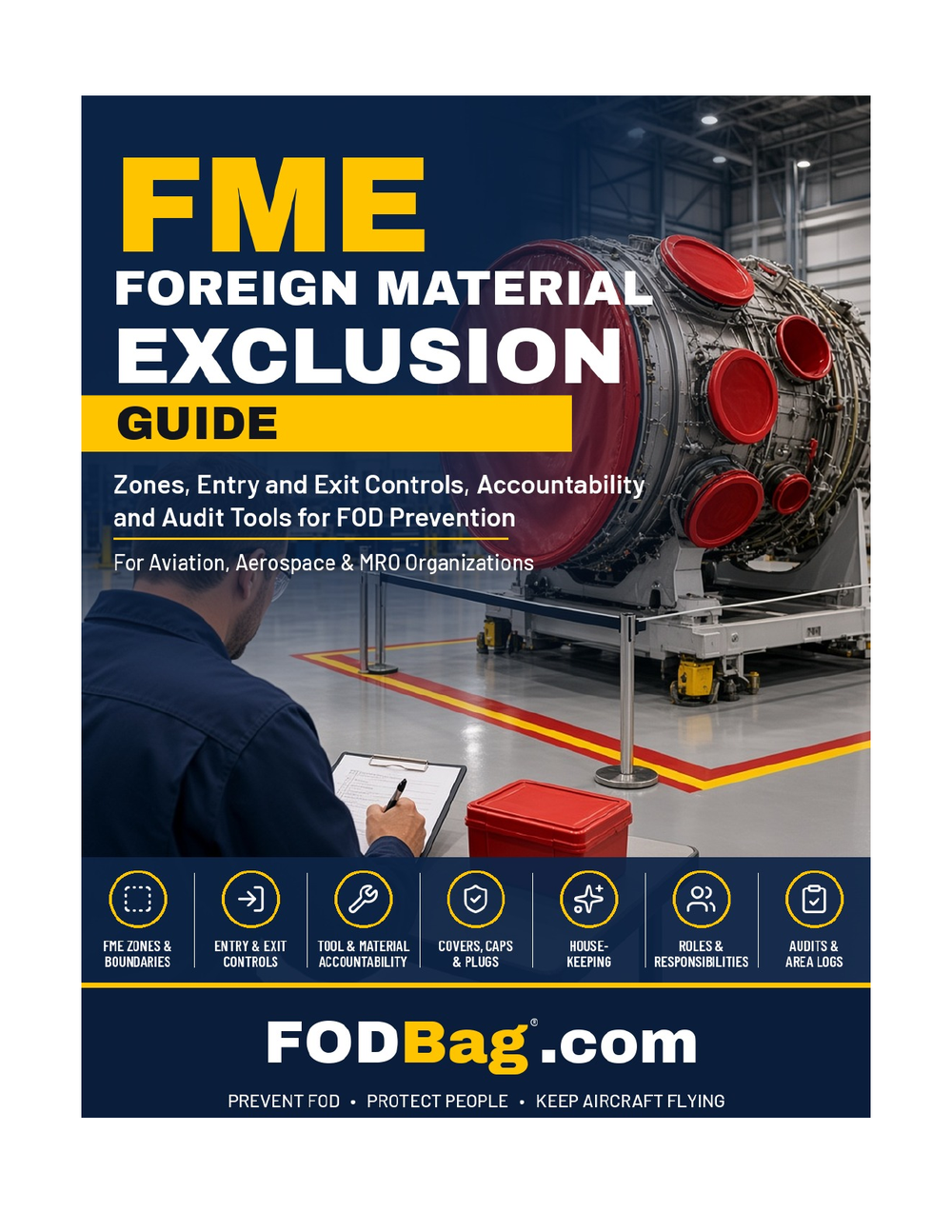
About the Foreign Material Exclusion (FME) Guide
Reviewed by Trent Powell, Founder, FODBag · Reviewed: November 10, 2026
Quick answer: Foreign material exclusion (FME) is the discipline of keeping foreign material out of systems, components and work areas where it could cause damage, contamination or a nonconformance. In aviation and aerospace, FME is the zone-based, barrier-focused part of a broader FOD Prevention Program: defined zone levels, controlled entry points, item logs, covers and plugs, and closeout verification.
Who it is for: FOD and FME program coordinators, quality managers, maintenance and production supervisors, engine shop leads and internal auditors who need a practical framework they can adapt to their own facilities.
What’s Inside the Guide
Thirteen sections from FME definitions to a printable FME area log.
FME and FOD: Definitions and Scope
FME Zone Levels and Boundaries
Entry and Exit Controls and Logs
Tool and Material Accountability
Covers, Caps and Plugs
Loss of Control Response and Audits
Key Practices From the Guide
A short preview of what the guide covers in depth.
Treat FME as part of your FOD Prevention Program
Base each zone level on a documented risk assessment
Make the boundary real
Log every item in and out
Close every opening that is not being worked
Stop and secure when control is lost
How to Use This Guide
- Use Sections 1 to 3 to define FME for your organization, decide where it applies and set up zone levels and boundaries.
- Use Sections 4 to 7 to put entry and exit controls, item accountability, closures and housekeeping in place at the point of work.
- Use Sections 8 and 9 to assign responsibilities and prepare a consistent response to loss of FME control.
- Use the audit checklist and printable area log in Sections 10 and 11 as working documents or a starting point for your own controlled forms.
Before You Start
- Identify where systems or components are open, where retrieval of a lost item would be difficult and where an undetected item could cause serious damage.
- Define your FME zone levels and align their names with your existing area classification.
- Choose a floor-marking and signage scheme, document it and apply it the same way across buildings.
- Assign who establishes, monitors and releases each zone, including the Level 1 area monitor.
- Identify FME requirements from customers and contracts and flow them down.
- Agree on the response to loss of FME control and who gives the documented disposition.
Forms in the Toolkit
- FME Audit Checklist (Section 10)
- Printable FME Area Log Template (Section 11)
- Closure Control Record (Section 6)
- Personal Items Expectations Table for Level 1 Zones (Section 4)
By FODBag.com · Updated November 10, 2026
Reviewed by Trent Powell, Founder, FODBag · Reviewed: November 10, 2026
Foreign Material Exclusion Playbook: What the Sources Require, a Seven-Opening Worked Example and a Close-Out Check
This playbook is for the engine-shop, component-shop or hangar lead who has to keep foreign material out of an open system, not just off the floor. It sets out what two public documents actually say about caps, plugs, covers and open ports; states plainly that they do not use the term FME or define a three-level FME zone model; and works one accessory-gearbox job through a seven-opening closure count and a 12-tool log. The three-level FME model and the area-log form in the downloadable guide remain a FODBag suggestion for how to organize that work.
What the published sources say about openings, covers and protection (and what they do not say)
NASA starts FOD prevention in design: early design considerations shall include the use of covers, screens or barriers over exposed openings when appropriate, and it gives fluid-system openings and vents as examples (NASA MSFC-STD-3598 Rev. D, paragraph 5.3(c)). Operations planning shall include a clean-as-you-go approach and parts protective devices (5.4). Work instructions shall, as applicable, include these steps after manufacturing and assembly tasks:
- Upon completion of a final machining operation, clean or flush the machined component to assure that it is free of debris and immediately cap or seal exposed openings to deny foreign object entry (5.4.3(b)).
- Verify required protective devices (dust covers, temporary seals, cushioning, etc.) are present and properly installed. Items with protective devices missing are to be inspected for FOD, cleaned if necessary, and protective devices re-installed (5.4.3(e)).
- After fluid and pneumatic system lines and tubing are cut and de-burred, remove debris and other contaminants by cleaning, and then cap ends of the lines (5.4.3(f)).
- Inspect production tooling (jigs, fixtures, handling equipment, etc.) to assure these are clean, undamaged and free of foreign material before installation and build-up of components or assemblies (5.4.3(h)). This is the one sentence in the NASA paragraphs we read that uses the words “foreign material.” It is a tooling-inspection requirement, not a definition of an FME program.
For handling and packaging, NASA lists protective devices as edge protectors, caps, plugs, covers, filters and rub strips, and requires that they be secured to prevent accidental damage or dislodging (5.10.2.6). Unauthorized removal of protective devices shall be prohibited (5.10.2.7). Removal shall be authorized through written work instructions, and the hardware shall be inspected for FOD and impact damage (5.10.2.8). Temporary protective covers and other temporary, non-flight hardware installations, when hardware is prepared for the launch site, shall be controlled so that they do not themselves become a source of FOD (5.10.2.9, which points to an MSFC work instruction we have not opened and do not quote).
IAQG’s public guidance says that, to comply with the standard it supports, an organization needs to identify methods and materials to protect product characteristics from foreign objects and debris as defined by a FOD risk assessment, and to establish, implement and maintain a process for product protection through all stages of operations. Protection against contamination includes, as examples, plastic material, caps, covers and plugs. The same slide says product protection devices should be designed to fit securely and meet at least one of three criteria: they prevent subsequent assembly until they are removed; they contain a “Remove Before Flight” type feature or visual indicator; or they are controlled by tool-accountability processes. Methods for receipt, application and removal of those devices should be defined, for example in work instructions, standard work or process documents (IAQG SCMH 3.4.2 Rev. D, slide 25). The following slide adds storage, handling and transportation (cleanliness of carts, containers and pallets), protection against physical and functional damage such as blocked passages or damage to connectors or fittings, and protection against manufacturing-process debris (slide 26).
| Practice | What the sources we read actually say | What they do not set |
|---|---|---|
| Cap or seal an exposed opening | NASA 5.4.3(b) and 5.4.3(f): immediately cap or seal after final machining; cap line ends after cut, de-burr and clean. NASA 5.3(c): covers, screens or barriers over exposed openings when appropriate. | A brand, color or FME-labelled cap. Use only closures permitted by your approved data. |
| Control the device itself | NASA 5.10.2.6–5.10.2.8: secure it, prohibit unauthorized removal, authorize removal in written work instructions, inspect the hardware. IAQG slide 25: define receipt, application and removal; fit securely; at least one of the three design criteria. | A required count sheet. A written closure-control record is a FODBag suggestion. |
| Area classification around the work | NASA 5.1: Awareness, Control or Critical, from a hardware-and-risk decision. | FME Critical / FME Control / FME Awareness as published names. |
| Logs of people and tools in a zone | IAQG slides 29–31 require processes to account for and control consumables, hardware, personal items and tools, and to report lost items. NASA requires a written tool record in FOD Control Areas (5.8.2.1(d), cited in our tool-control guide). | The specific FME area-log fields in this guide. Those fields are a FODBag suggestion. |
Worked example (illustrative): seven openings on an accessory gearbox
This is an illustrative example. The engine, the opening list, the tool count and the times are invented to show the method and the arithmetic. Your approved maintenance data, risk assessment and tool-control procedure set the real list. The setting is a component shop: one accessory gearbox is open on a stand for a single-shift repair.
- List the openings before you start, and treat each one as a closure obligation. In this example there are seven openings: 1 intake, 2 fluid ports, 3 tube ends and 1 electrical connector. Check: 1 + 2 + 3 + 1 = 7. Each opening gets an approved cap, plug or cover as soon as it is created, and whenever work on that opening pauses (NASA 5.4.3(b), 5.4.3(f), 5.10.2.6). The closure itself is a FODBag-suggested line on a closure-control record, because a loose cap is FOD (NASA 5.10.2.9 makes the same point for temporary covers at the launch site).
- Mark the work as a Level 1 FME Critical zone in the FODBag model, and align it with your NASA-style area class. Retrieval from inside the gearbox would be difficult, so this guide would call it Level 1. If your written program already classes this stand as a FOD Critical Zone or a FOD Control Area, keep those names on the sign and on the floor. Do not post a second, conflicting color key. Floor marking, if you use it, can be FOD floor tape in 2 in × 108 ft rolls; a 10 ft by 12 ft stand boundary is a perimeter of 2 × (10 + 12) = 44 ft, which is less than one roll. That layout is a FODBag suggestion, not a NASA tape rule.
- Log what enters. Two technicians and one area monitor enter at the designated point. Twelve tools are logged in against a shadowed kit. Eight consumable items (rags and pre-cut lockwire bundles, in this example) are logged in by description and quantity. Closures: seven devices issued and installed, each against one opening. The area is not a place to store extra caps or loose hardware.
- Close out with arithmetic you can check. At shift end: 12 tools logged in and 12 logged out (12 = 12). Consumables: 5 were used and recorded as consumed; 3 were returned unused; 5 + 3 = 8, matching the in-count. Closures: all 7 are removed under written work instructions, counted, and bagged; the seven openings are inspected for FOD and impact damage before the next close-out or build-up (NASA 5.10.2.8). People: all three are logged out. If any line does not reconcile, stop work, protect the openings that are still exposed, and run your lost-item or loss-of-control process. Do not release the zone on an unmatched log.
| Item | Count in | Count at close-out | Check |
|---|---|---|---|
| Openings / approved closures | 7 (1 + 2 + 3 + 1) | 7 removed, inspected and bagged | 7 = 7 |
| Tools from the kit | 12 | 12 returned to the shadow | 12 = 12 |
| Consumables | 8 | 5 consumed + 3 returned | 5 + 3 = 8 |
| People in the zone | 3 (2 technicians + 1 monitor) | 3 logged out | 3 = 3 |
| Stand boundary (optional tape) | 44 ft | One 2 in × 108 ft roll is enough (44 < 108), with remainder unused | FODBag layout suggestion |
Check the arithmetic before you copy the method: 1 + 2 + 3 + 1 = 7; 12 = 12; 5 + 3 = 8; 2 + 1 = 3; 2 × (10 + 12) = 44, and 44 is less than 108.
Close-out check (illustrative)
This six-point check is a FODBag suggestion for the area monitor or a second person at close-out, not a published audit list. Use it against the job you just finished.
| Check | Pass if | Fail / action |
|---|---|---|
| Every opening has a history | The closure record has seven lines, one per opening, with install and removal. | An opening with no cap on the record, or a cap with no opening: stop and reconcile before release. |
| Removal was authorized and the hardware was inspected | Removal is against a work instruction, and the inspection for FOD and impact damage is noted (NASA 5.10.2.8). | Caps pulled by habit with no inspection: inspect now; do not close the job. |
| The device itself is accounted for | All seven closures are in the count bag or returned to the kit, not left in a pocket or on the stand. | A missing cap is a lost item and is itself FOD. Protect any still-open port and start the search. |
| Tools reconcile | 12 out equals 12 in, or a chit explains any tool still in use. | A hole in the shadow with a blank log: lost-tool process, not a verbal assurance. |
| Consumables reconcile | Used plus returned equals the in-count (here, 5 + 3 = 8). | A short count with no consumption note: search and document before release. |
| The zone sign and the area class agree | The posted name matches the written program (NASA 5.1 names, or your mapped FME label), not a second unofficial color key. | Two conflicting signs: fix the posting before the next job. |
Where to go next
The downloadable Foreign Material Exclusion (FME) Guide on this page is the 11-page working document this playbook supports, including the area log and closure-control record. It is requested with the form below. For the closures themselves, use only devices your maintenance data permits, and see FODBag FOD covers when a cover is the right type of product. Mark a temporary boundary, if you use one, with FOD floor tape in 2 in × 108 ft rolls, and post the area class with FOD area signs (signs from $29.99). The FOD tool control and accountability guide covers the kit and lost-tool process the 12-tool log sits in. Questions about covers, tape or signs for an open-system job? Call FODBag at 602-874-1313, Monday–Friday, 9:00 a.m.–5:00 p.m. America/Phoenix.
Sources and how we used them
- NASA MSFC-STD-3598 Rev. D, Standard for FOD Prevention (effective July 26, 2021) — Paragraphs 5.1 (FOD Awareness, Control and Critical area classes), 5.3(c) (covers, screens or barriers over exposed openings), 5.4 and 5.4.3(b), (e), (f) and (h) (clean-as-you-go and protective devices in work instructions; immediately cap or seal after machining; verify dust covers; cap line ends; tooling free of foreign material), and 5.10.2.6–5.10.2.9 (secure caps, plugs and covers; prohibit unauthorized removal; authorize removal in work instructions and inspect; temporary covers must not become FOD). Free public PDF, read from the copy saved under sources/. The word FME does not appear in the standard we read, and those paragraphs do not define a three-level FME zone model or a required closure-count form. Accessed for this page Nov. 10, 2026.
- IAQG SCMH 3.4.2 Rev. D, FOD Prevention Program: Guidance in Support of IAQG Standard 9146 (June 19, 2023) — Slides 25–26 (product protection through all stages of operations; caps, covers and plugs as examples of protection against contamination; the three design criteria; define receipt, application and removal; storage, handling, blocked passages, process debris) and slides 29–31 (accountability for consumables, hardware, personal items and tools; report lost items). Slide numbers are the footer numbers in the PDF. Free public document, read from the copy saved under sources/. The slides we read do not use the term FME and do not define FME zone levels. Accessed for this page Nov. 10, 2026.
AS9146 and NAS 412 are paid documents and are not reproduced or quoted here, and no clause numbers from them are cited. The three-level FME zone model, the FME area log fields and the closure-control count are FODBag instruments described in this guide; they are not published standard requirements. The worked example is illustrative and is not a customer case.
Get the Foreign Material Exclusion (FME) Guide
Enter your details and we will email you the PDF right away.
- 11-page guide (PDF)
- Three-level FME zone model
- FME audit checklist and printable area log
- Seven-step loss of FME control response
Free for internal organizational use. Educational resource from FODBag.com, a Powell Pack Products company.
Get the Free Guide
Enter your details and we will email you the PDF of Foreign Material Exclusion (FME) Guide right away.
Watch: Foreign Material Exclusion (FME) — Zones, Logs and Closures
A short video on FME versus FOD, a three-level FME zone model, entry and exit controls, covers, caps and plugs, and the response when FME control is lost. Use it with the free Foreign Material Exclusion (FME) Guide on this page.
Related Reading
Go deeper on the topics in the Foreign Material Exclusion (FME) Guide.
More Free FOD Prevention Guides
Each guide is free to request and written for aerospace, aviation, MRO and manufacturing teams.
Equip Your FOD Program
Frequently Asked Questions
What is foreign material exclusion (FME)?
Foreign material exclusion is the planned set of barriers, controls and behaviors used to prevent foreign material from entering open systems, components or designated areas, and to detect and retrieve it if entry is suspected.
What is the difference between FME and FOD?
A FOD Prevention Program is organization-wide and covers prevention, detection, removal, training, investigation and improvement. FME is the set of focused controls at the point of work where systems are open. The guide recommends treating FME as controls inside the FOD Prevention Program, not as a separate program.
What are FME zone levels?
The guide uses a three-level model: Level 1 FME Critical for open systems where retrieval is difficult, Level 2 FME Control for areas where openings may be created during work, and Level 3 FME Awareness for adjacent support areas. Base each level on a documented risk assessment.
What are FME covers, caps and plugs?
They are closures that protect intakes, exhausts, ports, fittings, tube ends and connectors when an opening is not being worked. Use closures specified or permitted by approved maintenance data, and count them at installation and removal.
What should an FME area log record?
Every person and every item entering a Level 1 zone: time in, name, description of each tool, part or material, quantity in and out, time out and verification. The zone is not released until all entries are reconciled and verified.
What happens when FME control is lost?
Stop work in the zone, secure the opening, notify the supervisor and quality, search systematically, document the item and search, obtain a documented disposition from the authorized engineering or quality function, then correct the cause.
Do NASA or IAQG documents use the term FME or require a three-level FME zone model?
No. In NASA MSFC-STD-3598 Rev. D and IAQG SCMH 3.4.2 Rev. D, which we opened for this page, the term foreign material exclusion (FME) does not appear, and there is no three-level FME Critical / FME Control / FME Awareness model. NASA classifies FOD Sensitive Areas as Awareness, Control and Critical (section 5.1). The three-level FME model in this guide is a FODBag suggestion for work around open systems; align the names with your written area classification so people learn one system.
Do published sources require a written count of covers, caps and plugs?
Not in those words. NASA 5.10.2.6 through 5.10.2.8 require that protective devices (it lists caps, plugs and covers among them) be secured, that unauthorized removal be prohibited, and that removal be authorized through written work instructions, with the hardware inspected for FOD and impact damage. IAQG SCMH 3.4.2 Rev. D, slide 25, says methods for receipt, application and removal of product protection devices should be defined, for example in work instructions. A separate closure-control count at installation and removal is a FODBag suggestion for proving that control, not a published form.