
AS9146 Requirements Guide
A plain-English implementation framework for an AS9146-aligned FOD Prevention Program, with a 30-day roadmap, gap analysis and ready-to-use templates. Get the Free GuideSee What's Inside14
Pages
18
Sections
5
Ready-to-Use Templates
30
Day Roadmap
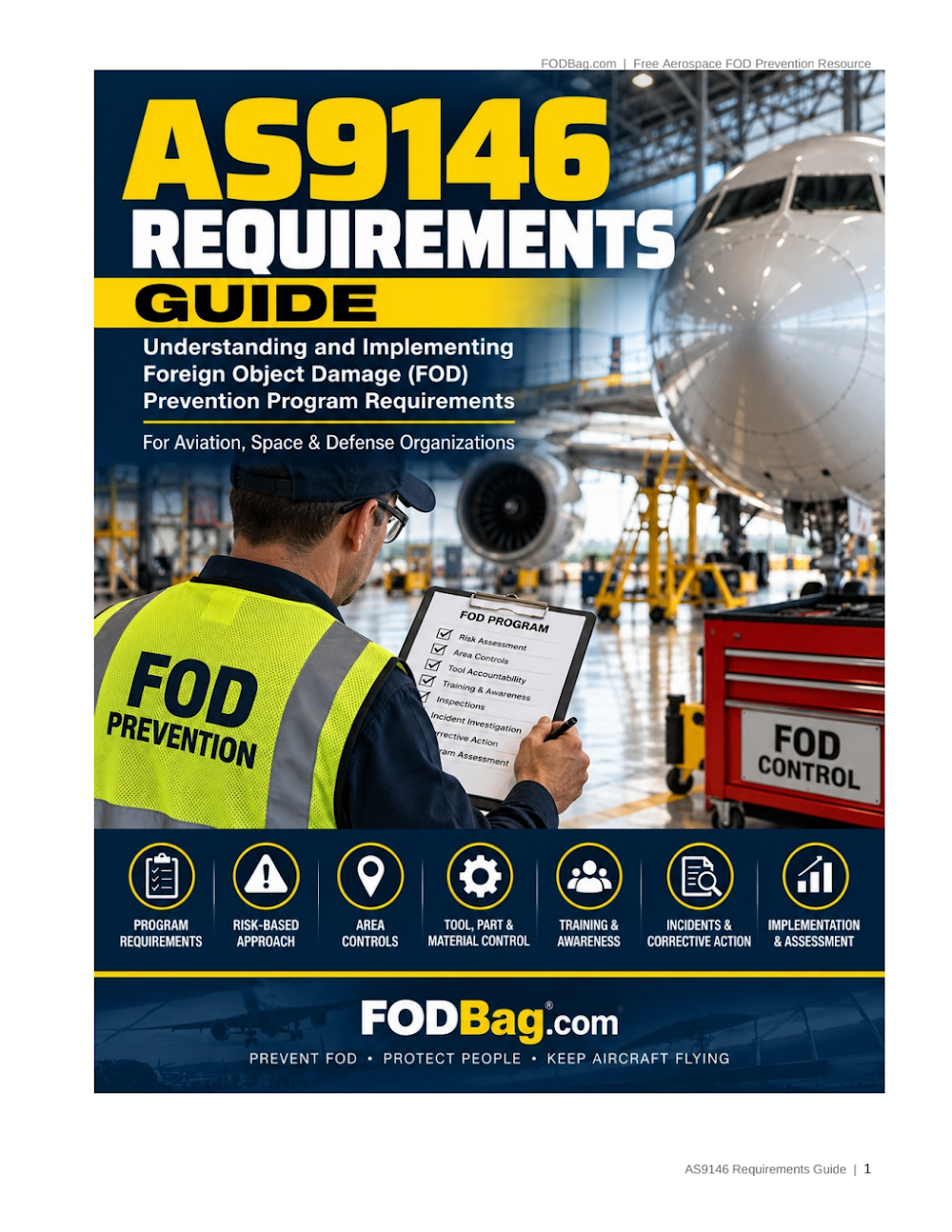
About the AS9146 Requirements Guide
Reviewed by Trent Powell, Founder, FODBag · Reviewed: November 10, 2026
Quick answer: AS9146 is the aerospace-industry standard titled Foreign Object Damage (FOD) Prevention Program – Requirements for Aviation, Space, and Defense Organizations. SAE International lists AS9146 as current and reaffirmed September 8, 2022. This guide explains the practical work involved in building a risk-based FOD Prevention Program aligned to it.
Who it is for: FOD managers, quality leaders, operations managers, manufacturing teams, maintenance organizations, suppliers and internal auditors.
What’s Inside the Guide
Eighteen sections from AS9146 in context to templates and references.
AS9146 in Context and Leadership
Risk-Based Prevention and Assessment
Area Controls, Housekeeping and Accountability
Protection, Detection and Training
Events, Suppliers and Records
Assessment, Roadmap and Templates
What Is AS9146?
AS9146 is an SAE International standard, developed through the International Aerospace Quality Group (IAQG), that sets requirements for a foreign object damage prevention program in aviation, space and defense organizations. First issued in April 2017 and reaffirmed in 2022, it requires a risk-based program covering areas, training, product protection, housekeeping and accountability for tools, hardware and consumables. Customers can flow it down by contract. Many shops organize the point-of-work product protection, such as covers, plugs, controlled entry and close-out checks on open systems, as an FME program within the FOD prevention program.
Key Ideas From the Guide
A short preview of how the guide frames AS9146.
A requirements framework that can be flowed down
Process approach and risk-based thinking
A repeatable risk assessment
Respond to events in a defined order
Extend the program to your supply chain
What This Guide Gives You
- A plain-English implementation framework for an AS9146-aligned FOD Prevention Program.
- A risk-based method for deciding where stronger FOD controls are needed.
- Practical coverage of area controls, housekeeping, tools, parts, personal items, training, incidents, corrective action, suppliers and assessments.
- A 30-day roadmap, gap-analysis worksheet, risk-assessment template, program-assessment checklist and management review worksheet.
- Direct links to authoritative SAE International and IAQG resources for verification and deeper study.
Where to Start
- Read AS9146 in Context and confirm the requirements that apply to you.
- Define program leadership and responsibilities.
- Complete a FOD risk assessment for each area or process.
- Use the readiness gap analysis to find gaps.
- Follow the 30-day implementation roadmap.
- Verify against the authorized current standard.
Templates in the Toolkit
- Template A: FOD Risk Assessment
- Template B: FOD Area Control Plan
- Template C: FOD Prevention Assessment
- Template D: FOD Event / Investigation Record
- Template E: Management Review Snapshot
By FODBag.com · Reviewed November 9, 2026
AS9146 Audit-Readiness Playbook: What to Show for Each Requirement Area
AS9146 audits are about evidence. This playbook turns the program areas IAQG describes in its public guidance into the questions an auditor or customer is likely to ask and the records worth having ready. It is a planning aid, not a copy of the standard. The requirement wording lives in AS9146 itself, which is a paid SAE International document. We cite no AS9146 clause numbers; the slide references below point to IAQG’s free guidance presentation.
Scope and precedence
- Scope: IAQG states that 9146 applies to organizations that design, develop and provide aviation, space and defense products and services, and to organizations providing post-delivery support such as maintenance, spare parts or materials (SCMH 3.4.2 Rev. D, slide 4).
- Precedence: the same slide says 9146 requirements are complementary, not alternative, to customer, statutory and regulatory requirements, and that statutory or regulatory requirements take precedence in a conflict.
- Status: SAE International lists AS9146 as first issued in April 2017 and reaffirmed September 8, 2022 (SAE listing).
How the program is meant to run
IAQG frames the program as a plan-do-check-act cycle (slide 11): establish the scope through a FOD risk assessment, implement the applicable elements, maintain them, then report metrics and act to improve. It also says leadership must provide support and resources and must designate a FOD Prevention Program management representative with the responsibility and authority to establish, implement and maintain the program (slide 12). Name that person in writing before the audit, because the first question is usually who owns the program.
Evidence map: question, record and where IAQG describes it
| Program area | Question to be ready for | Records worth having ready | IAQG slide |
|---|---|---|---|
| Leadership and management representative | Who is accountable, and what authority and resources do they have? | Appointment letter or procedure section, resource decisions, management review minutes | 12 |
| FOD risk assessment | Did you assess product characteristics, operations and detectability, and does the program match the result? | Completed assessments per product, process and area; date of last reassessment; link from rating to controls | 14, 17 |
| Procured product and flow-down | Which suppliers can introduce FOD into your product, and how did you flow requirements to them? | Documented risk assessment of procured product, purchase order flow-down language, supplier responses | 12, 13 |
| Operations | Which openings, cavities and compartments need protection, and where is inspection done before they close? | Work instructions with protection and pre-closure inspection steps; process capability notes for cleaning and inspection | 20 |
| Area designation | How did the risk assessment decide each area’s level of control? | Area map, designation rationale, signs and floor marking, controls per designation | 21, 22 |
| Training and personnel access | Is everyone entering a designated area trained or escorted, including visitors and contractors? | Training content, recurring intervals, effectiveness measures, escort and access procedure | 23, 24 |
| Product protection | How are protective devices delivered, applied, removed and dispositioned? | Defined method in work instructions or standard work; storage, handling and transport cleanliness rules | 25, 26 |
| Housekeeping and Clean-As-You-Go | What are the cleaning intervals, and who verifies them? | Defined intervals (for example, end of shift and after each operation), checklists, completed logs | 27 |
| Consumables, hardware and personal items | How do you account for them and report a loss? | Count or kitting records, personal item rules, documented lost-item reporting process | 29 |
| Tool accountability and control | Can you show where every tool is, and what happens when one goes missing? | Inventory, storage and identification, condition checks, lost or broken tool reports | 31 |
| Nonconformities and effectiveness | How do you categorize, trend and report FOD events and program nonconformities? | Nonconformity log by type, point of detection and origin; management review input; communication of results | 16 |
Product protection devices: the three criteria
On slide 25 IAQG notes that product protection devices should fit securely and meet at least one of these criteria:
- They prevent subsequent assembly until removed.
- They carry a Remove Before Flight type feature or visual indicator.
- They are controlled through tool accountability processes.
The same slide lists four questions to answer in your documented method: how devices reach the process, how, when and where they are applied, what happens to them when the operation is complete, and what happens after removal.
The risk assessment trap
IAQG’s slide 14 gives a good and a bad example. The good example reviews and records the characteristics questions for each risk element and ends in an overall rating that drives action. The bad example covers product characteristics only and skips operations and detectability, which IAQG calls equally critical. IAQG points to SCMH 3.4.3 (FOD Risk Assessment) and SCMH 3.4.4 (FOD Prevention Assessment) as example tools (slide 15). Our guide’s Template A and Template C are original templates in the same spirit.
Nonconformity record: fields to capture
Slide 16 says FOD product nonconformities should be categorized by type, point of detection and origin to support root cause analysis. A practical log row therefore carries:
- Date, time and location found, and who found it.
- Item description with size and material (see FAA AC 150/5210-24A paragraph 6.1.1 for a similar data list).
- Type of foreign object, point of detection and suspected origin.
- Product or area affected and the containment action taken.
- Root cause, corrective action owner and verification date.
Supplier flow-down checklist
- List the procured products and services that could introduce foreign objects into your product.
- Assess FOD risk for each and record the result, because IAQG expects documented information of that assessment (slide 12).
- Flow down 9146 requirements, or the controls that fit the risk, in the purchase order commensurate with that risk.
- Ask the supplier for their program owner and their area designation approach.
- Review supplier FOD nonconformities in your management review.
Self-audit gaps to check this week
- The program owner is not named, or has no stated authority.
- The risk assessment covers products but not operations or detectability.
- Area signs exist, but the rationale for each designation is not written down.
- Visitors and contractors are escorted in practice, but there is no procedure.
- Tools are counted, but there is no lost tool report form.
- FOD events are cleaned up, but not categorized by origin or reviewed.
Physical controls that support the evidence
Records show that a control exists, and the physical control makes it work on the floor. These FODBag items support the areas above; tape is 2 in × 108 ft per roll and signs start at $29.99.
| Program area | Floor control | FODBag product |
|---|---|---|
| Area designation | Color-coded boundaries and entrance signs | FOD floor tape and FOD area signs |
| Housekeeping and Clean-As-You-Go | Marked collection points that people actually use | FOD cans and the FOD collection point sign |
| Personal items and consumables | Pockets stay empty; small items stay on the person or in a closed container | FOD belt pouches, clear FOD bags and self-closing FOD pouches |
| Tool accountability | Tools held on the person and returned to a known location | tool bags and the tool accountability sign |
Need help matching products to your area designations? Call 602-874-1313. FODBag has supplied FOD prevention products since 2016.
Sources and how we used them
- IAQG SCMH 3.4.2 Rev. D, FOD Prevention Program: Guidance in Support of IAQG Standard 9146 (June 19, 2023) — Slides 4, 11–18, 20–27, 29, 31. Slide numbers are the footers in the PDF. Accessed Nov. 9, 2026.
- SAE International AS9146 listing — Issue date and reaffirmation status. Accessed Nov. 9, 2026.
- IAQG 9146 standard page (SCMH) — IAQG description of 9146 as flow-down requirements. Accessed Nov. 9, 2026.
- FAA Advisory Circular 150/5210-24A, Airport Foreign Object Debris (FOD) Management (Feb. 8, 2024) — Paragraph 6.1.1 data fields, used only as a comparison for the finding log. Accessed Nov. 9, 2026.
AS9146 is not reproduced or quoted here. Obtain the authorized current standard from SAE International.
By FODBag.com · Updated November 10, 2026
Reviewed by Trent Powell, Founder, FODBag · Reviewed: November 10, 2026
AS9146 Requirements Playbook: The Eight Program Elements, a Readiness Score and What to Do First
Quick answer: AS9146 sets FOD prevention program requirements for aviation, space and defense organizations, flowed down by contract. IAQG guidance groups them into eight elements: program management, operations, area designation, training and personnel access, product protection, housekeeping, consumables, hardware and personal items, and tool control. Controls are scaled to a documented FOD risk assessment.
This playbook is for FOD managers, quality leaders and auditors who need to turn AS9146 into a working program. AS9146 itself is a paid SAE International standard and is not reproduced here. What follows is built from the public IAQG guidance that supports it: the eight elements, what each asks an organization to do, a readiness score for a sample shop, and an order of work. The 0–2 scoring method is a FODBag suggestion, not part of the standard.
Where AS9146 came from and what it is for
IAQG’s public guidance explains that plenty of FOD prevention advice existed until April 2017, but no requirements standard did; the 9146 standard identifies program requirements that can be flowed down in contractual agreements (IAQG SCMH 3.4.2 Rev. D, slide 3). It applies to organizations that design, develop and provide aviation, space and defense products and services, and to those providing post-delivery support such as maintenance, spare parts or materials. Its requirements are complementary to customer, statutory and regulatory requirements, and where they conflict the statutory or regulatory requirement takes precedence (IAQG SCMH 3.4.2 Rev. D, slide 4). The guidance is supplemental and is meant to be used with the standard, not instead of it.
The eight elements and what each asks for
IAQG lists eight primary elements and says the program is built and maintained with a process approach and risk-based thinking, in a plan-do-check-act cycle (IAQG SCMH 3.4.2 Rev. D, slides 10 and 11). The table gives the element, what the public guidance says the organization needs to do, and where it sits.
| Element | What the opened guidance says the organization needs to do | Where |
|---|---|---|
| Program management | Show leadership and commitment with resources, designate a management representative with responsibility and authority, and keep a documented risk assessment for procured product and flow-down of the requirements through the supply chain commensurate with that risk. | IAQG slide 12 |
| Operations | Identify product characteristics that need protection (examples include openings, compartments, tanks and intakes), evaluate process capability, and set inspection and detection at appropriate steps or intervals, such as before compartment closure. | IAQG slides 19 and 20 |
| Area designation | Set area designations from the FOD risk assessment and give each a level of controls covering the other elements; area signs communicate the level of risk. | IAQG slides 21 and 22 |
| Training and personnel access | Run a training program matched to the risk assessment and make sure anyone entering a designated area is trained or escorted, including visitors and contractors. | IAQG slides 23 and 24 |
| Product protection | Identify methods and materials to protect product characteristics, define how protective devices are applied and removed, and protect during storage, handling and transportation. | IAQG slides 25 and 26 |
| Housekeeping and Clean-As-You-Go | Run housekeeping in all work areas and clean the product’s immediate work area at appropriate intervals, for example after each operation. | IAQG slide 27 |
| Consumables, hardware, personal items | Account for and control them, and keep a documented process for reporting lost items. | IAQG slide 29 |
| Tool accountability and control | Account for and control company and personally owned tools, including storage, inventory, location, condition, and reporting of lost or broken tools. | IAQG slide 31 |
Risk assessment: the document everything else hangs on
The guidance requires documented information of a FOD Prevention Program that is commensurate with a FOD risk assessment for product characteristics and operations, and says elements and levels of control vary with the results (IAQG SCMH 3.4.2 Rev. D, slides 17 and 18). It gives a pair of examples. A good assessment reviews, evaluates and records the characteristic questions for each risk element and produces an overall rating. A bad one covers only product characteristics and skips operations and detectability, which the guidance calls equally critical (IAQG SCMH 3.4.2 Rev. D, slide 14). The guidance also notes that the 9146 standard does not itself define foreign object severity or acceptability limits; those depend on customer requirements and product definition (IAQG SCMH 3.4.2 Rev. D, slide 5).
Measure and report: nonconformities and effectiveness
The program must keep documented information of FOD Prevention Program nonconformities and evaluate its effectiveness against internal, customer, statutory and regulatory requirements. Foreign object, debris and damage product nonconformities go through the organization’s control of nonconforming outputs and are categorized by type, point of detection and origin to support root cause analysis. Results are reported through management review and communicated to interested parties (IAQG SCMH 3.4.2 Rev. D, slide 16). This is why a program that only collects debris, without recording where it was found and where it came from, does not meet the intent.
Worked example: scoring a 60-person MRO shop against the eight elements
This example is illustrative, not a customer case and not an audit result. The 0–2 scale is a FODBag suggestion: 0 = not in place, 1 = partly in place or not evidenced, 2 = in place and evidenced. A shop scores each of the eight elements, then totals them.
Add the scores: 2 + 1 + 2 + 1 + 1 + 2 + 0 + 2 = 11 out of a possible 8 × 2 = 16. That is 11 ÷ 16 = 0.6875, or 69%. The percentage is a planning aid, not a pass mark: one element at 0 can still be a nonconformity regardless of the total.
| Element | Score (0–2) | Evidence found | Guidance reference |
|---|---|---|---|
| Program management | 2 | Management representative named; risk assessment on file | slide 12 |
| Operations | 1 | Protected openings listed, but no inspection point before closure | slides 19 and 20 |
| Area designation | 2 | Areas set from the risk assessment and marked | slides 21 and 22 |
| Training and personnel access | 1 | Initial training done; no recurring interval or escort rule for visitors | slides 23 and 24 |
| Product protection | 1 | Caps and plugs used, but no issue-and-removal method | slides 25 and 26 |
| Housekeeping and Clean-As-You-Go | 2 | Defined intervals; end-of-shift cleaning recorded | slide 27 |
| Consumables, hardware, personal items | 0 | No lost-item report process | slide 29 |
| Tool accountability and control | 2 | Inventory, marking and lost-tool reporting in place | slide 31 |
| Total | 11 of 16 | 11 ÷ 16 = 69% |
Order of work for this shop: first the element at 0 (a lost-item reporting process, which the guidance says must be documented), then the four elements at 1, starting with training and access because visitors and contractors are the quickest gap to close. Re-score after each fix and keep the dated scores as effectiveness evidence.
What good looks like
- A named management representative with authority and resources, and a dated FOD risk assessment that covers product, operations and detectability.
- Each area has a designation and a defined level of control, marked with signs.
- Training has an initial and a recurring interval, and visitors and contractors are trained or escorted.
- Protective devices have defined application and removal methods; housekeeping has set intervals.
- Lost items, tools and nonconformities are reported and categorized, and results reach management review.
Matching FODBag products and resources
Use the program elements to choose the visual controls and carriers: FOD area signs; FOD floor tape (2 in × 108 ft); FOD stickers; FOD tool bags; FOD cans.
About FODBag. FODBag.com, a Powell Pack Products company in Mesa, Arizona, has made FOD bags, FOD tape, FOD stickers, FOD signs, FOD posters, FOD cans and FOD containers since 2016. FOD tape is 2 in × 108 ft and FOD signs start at $29.99. Questions? Call 602-874-1313, Monday–Friday, 9:00 a.m.–5:00 p.m. Arizona time.
Sources opened for this page
- IAQG SCMH 3.4.2 Rev. D, FOD Prevention Program: Guidance in Support of IAQG Standard 9146 (June 19, 2023) — Slides 3–5, 10–12, 14, 16–27, 29 and 31 for the program elements, risk assessment and nonconformity requirements. Opened and read for this page on November 10, 2026.
Get the AS9146 Requirements Guide
Enter your details and we will email you the PDF right away.
- 21-page guide (PDF)
- 5 ready-to-use templates
- AS9146 readiness gap analysis
- 30-day implementation roadmap
Free for internal organizational use. Educational resource from FODBag.com, a Powell Pack Products company.
Get the Free Guide
Enter your details and we will email you the PDF of AS9146 Requirements Guide right away.
Related Reading
Go deeper on the topics in the AS9146 Requirements Guide.
More Free FOD Prevention Guides
Each guide is free to request and written for aerospace, aviation, MRO and manufacturing teams.
Equip Your FOD Program
Frequently Asked Questions
What are the AS9146 FOD prevention program requirements?
AS9146 requires a risk-based FOD prevention program for aviation, space and defense organizations. IAQG guidance supporting it lists eight elements: program management, operations, area designation, training and personnel access, product protection, housekeeping and Clean-As-You-Go, accountability of consumables, hardware and personal items, and tool accountability (SCMH 3.4.2 Rev. D, slide 10). The controls scale with a documented FOD risk assessment.
Is AS9146 free to read?
No. AS9146 is a paid SAE International standard. The IAQG publishes free supporting guidance, SCMH 3.4.2, which this page uses. Use the authorized current edition of the standard your contract names for clause-level requirements.
Does AS9146 define how much foreign material is acceptable?
No. IAQG guidance notes the 9146 standard does not define foreign object severity or acceptability limits; they depend on customer requirements and the product definition (SCMH 3.4.2 Rev. D, slide 5).