
FOD Container and Collection Station Guide
A practical guide to selecting, placing, identifying, inspecting, emptying, maintaining and improving FOD collection points in aerospace, aviation, manufacturing, MRO and defense environments. Get the Free GuideSee What's Inside17
Pages
14
Sections
6
Forms and Templates
1
Example Station Standard
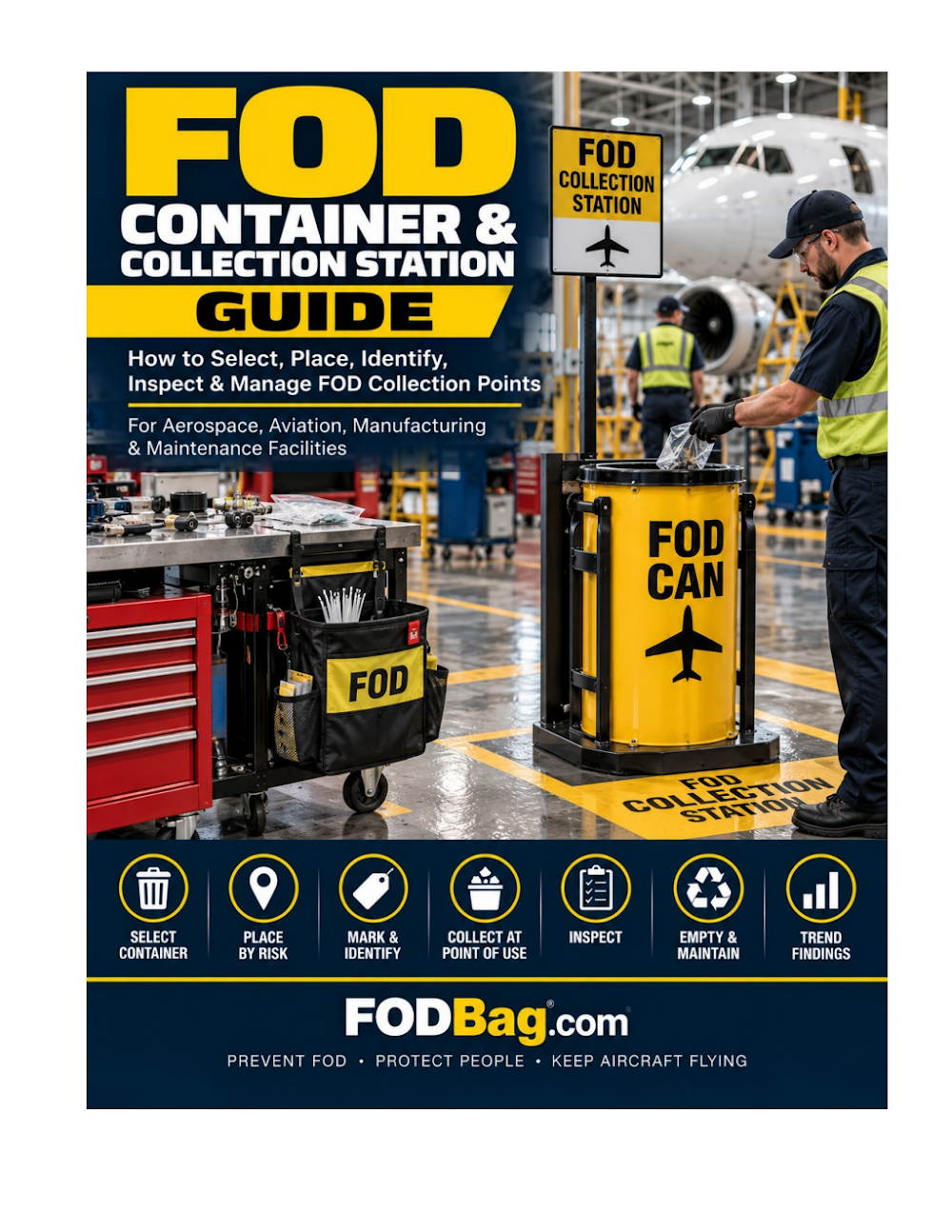
About the FOD Container and Collection Station Guide
Quick answer: A FOD container is more than a place to discard debris. Properly located and maintained collection points support clean-as-you-go behavior, reduce the distance personnel carry loose debris, help contain process waste and can provide useful information about recurring FOD sources. FAA AC 150/5210-24A recommends designated FOD containers that are conspicuously placed, well marked, secured and emptied frequently.
Who it is for: FOD managers, supervisors, facilities teams and quality personnel responsible for collection points in hangars, maintenance areas, manufacturing cells and similar environments.

What’s Inside the Guide
Fourteen sections from collection strategy to ready-to-use forms.
Strategy and Container Selection
Placement, Marking and Standardization
Point-of-Use and Critical Zones
Inspection, Emptying and Maintenance
Special Debris and Mobile Collection
Data, Failures and Forms
Key Practices From the Guide
A short preview of what the guide develops in depth.
Make the correct behavior easy
Place by risk and workflow
Use closed containers in windy areas
Keep waste in the right container
Read the debris
Avoid common failures
What a Good Collection System Should Do
- Provide an obvious, convenient destination for ordinary FOD generated or discovered during work.
- Support clean-as-you-go practices and point-of-use containment.
- Prevent collected debris from escaping back into the work area.
- Avoid creating a new trip, tip-over, contamination, fire or FOD hazard.
- Keep prohibited or incompatible waste out of ordinary FOD containers.
Implementation Starting Point
- Map FOD generation and discovery points by area and process.
- Select container types that match the risk.
- Place and mark collection points consistently.
- Set inspection and emptying routines.
- Track collection data and review trends.
- Audit the stations and correct failures.
Forms in the Toolkit
- Form A: FOD Collection Station Setup Checklist
- Form B: Container Placement Assessment
- Form C: FOD Container Inspection Log
- Form D: Collection Station Supervisor Audit
- Form E: FOD Collection Trend Log
- Template F: Example FOD Collection Station Standard
Get the FOD Container and Collection Station Guide
Enter your details and we will email you the PDF right away.
- 17-page guide (PDF)
- 5 forms plus an example station standard
- Placement, marking and inspection guidance
- Program implementation checklist
Free for internal organizational use. Educational resource from FODBag.com, a Powell Pack Products company.
Get the Free Guide
Enter your details and we will email you the PDF of FOD Container & Collection Station Guide right away.
Related Reading
Go deeper on the topics in the FOD Container and Collection Station Guide.
More Free FOD Prevention Guides
Each guide is free to request and written for aerospace, aviation, MRO and manufacturing teams.