
Layered FOD Audit Checklist
A ready-to-use layered FOD audit system and foreign object debris audit checklist: four sets of audit questions, a frequency plan, a scoring and escalation method and a trend summary page for management review. Get the Free GuideSee What's Inside13
Pages
11
Sections
4
Audit Layers
10–30
Minutes per Audit
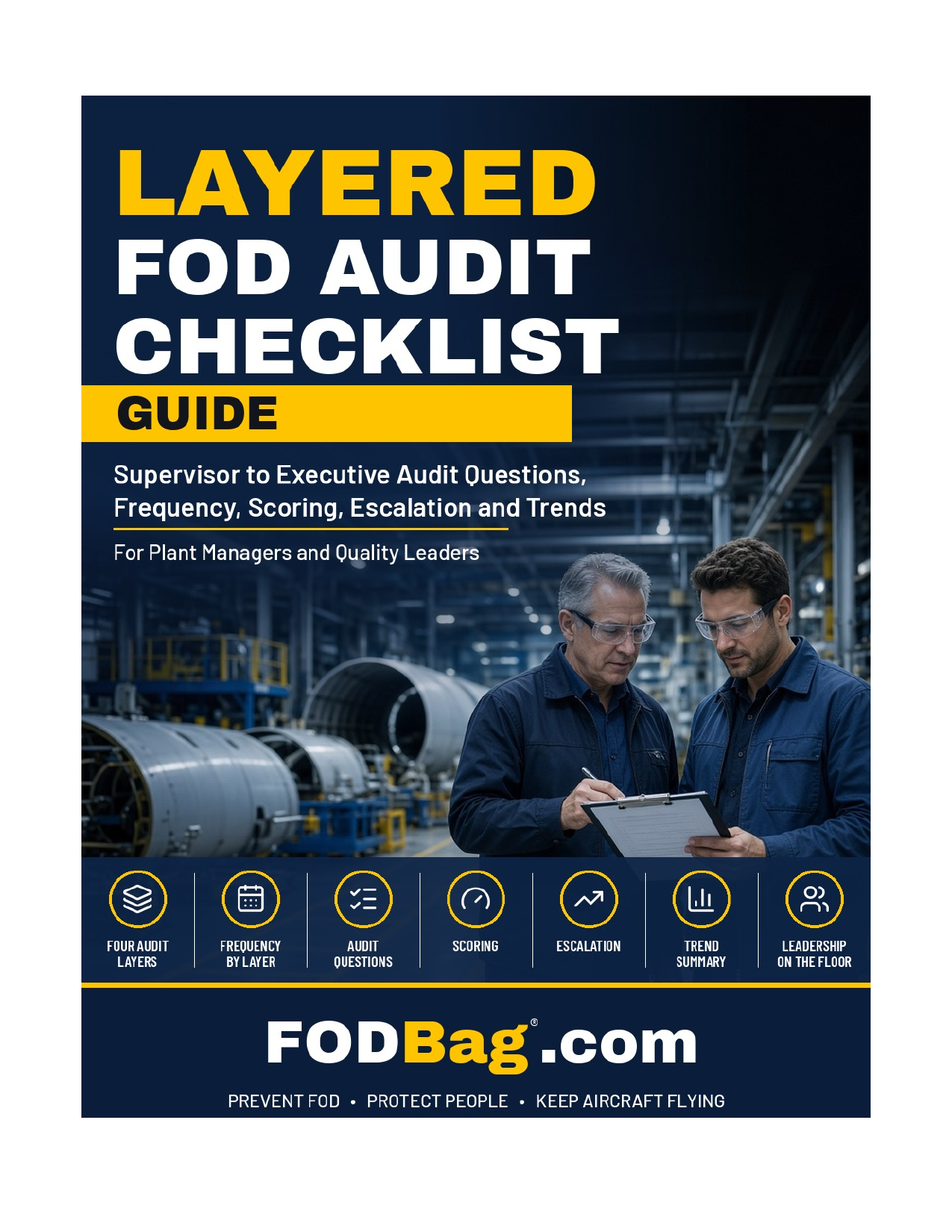
About the Layered FOD Audit Checklist
Reviewed by Trent Powell, Founder, FODBag · Reviewed: November 10, 2026
Quick answer: A FOD prevention program is only as strong as what actually happens on the floor, shift after shift. A layered FOD audit puts the same program under regular, short, structured checks by several levels of the organization, from the front-line supervisor to the executive team. Supervisors confirm daily behaviors, managers confirm the systems that support them, and leaders confirm that the program is resourced, measured and improving.
Who it is for: Plant managers, quality leaders and FOD program managers who need a structured FOD audit system across every level of the organization.

What’s Inside the Guide
Eleven sections, from what a layered FOD audit is to a trend summary page.
What a Layered FOD Audit Is
Layer Structure and Frequency
Layer 1 and Layer 2 Checklists
Layer 3 and Layer 4 Checklists
Scoring and Escalation
Schedule Matrix and Trend Summary
Key Practices From the Guide
A short preview of what the guide covers in depth.
Audit the same program from different heights
Keep each audit short
Go to the floor
Score what was found, not what was fixed
Escalate open findings
Audit FOD critical areas more often
How to Use This Guide
- Use Sections 1 and 2 to set up layers, auditors, frequency and duration.
- Use Section 3 for how to run a layered audit on the floor.
- Use the Layer 1 to Layer 4 checklists in Sections 4 to 7.
- Use Sections 8 to 10 for scoring, escalation, the schedule matrix and the trend summary.
Before You Start
- Name the auditors at each layer.
- Set frequency by area using your FOD risk assessment.
- Build the annual audit schedule matrix.
- Agree escalation thresholds in your own procedure.
- Decide how findings are tracked to closure.
- Set when the trend summary goes to management review.
Forms in the Toolkit
- Layer 1 to Layer 4 FOD Audit Checklists (Sections 4 to 7)
- Scoring and Escalation Table (Section 8)
- Audit Schedule Matrix (Section 9)
- Trend Summary Page (Section 10)
By FODBag.com · Updated November 10, 2026
Reviewed by Trent Powell, Founder, FODBag · Reviewed: November 10, 2026
Layered FOD Audit Playbook: Short Checks at Every Level
Quick answer: A layered FOD audit uses short, frequent checks by several levels: supervisors daily, managers weekly and leaders monthly. Keep each check to a few observable questions, record results the same way, fix findings quickly and report trends upward. FAA guidance describes program evaluation as systematically reviewing effectiveness against targets and communicating findings to staff.
This playbook shows how to set up layered FOD audits and budget the time. It uses FAA airport FOD guidance on program evaluation and IAQG guidance on effectiveness and management review, and works a time budget with checked arithmetic. The frequencies and minutes are invented and the layers are a FODBag suggestion; neither the FAA nor IAQG specifies layered audits.
What the opened sources say
FAA AC 150/5210-24A says safety performance monitoring validates the FOD management program, and that program evaluation should systematically review effectiveness, verify that performance indicators and targets are met, solicit input, and communicate findings to staff and implement agreed corrective procedures (FAA AC 150/5210-24A, 6.2.1 and 6.2.3). IAQG guidance expects effectiveness to be evaluated and program nonconformities to be documented and reported through management review (IAQG SCMH 3.4.2 Rev. D, slide 16), and a plan, do, check, act cycle (IAQG SCMH 3.4.2 Rev. D, slide 11).
Layers and frequency
- Supervisor: daily, a few questions at the work area.
- Manager: weekly, a different area each time, plus the supervisor’s results.
- Senior leader: monthly, one area on the floor with the manager.
- Same form at every level so results compare.
- Escalate repeat findings to the next level.
Writing the questions
Ask what a person can see: Are tools accounted for? Is the area free of loose items? Are containers closed and emptied? Is the area sign current? Two or three questions are better than twenty.
Closing the loop
A finding needs an owner and a date and goes on the area board. The next layer checks whether it was closed. Audits that find the same thing three times in a row are a system problem, not a people problem.
Worked example: monthly time for three layers
This example is illustrative. A plant sets frequencies for one area with 21 working days a month:
| Layer | Frequency and minutes | Time |
|---|---|---|
| Supervisor | 10 min × 21 days | 210 min |
| Manager | 20 min × 4 weeks | 80 min |
| Senior leader | 30 min × 1 month | 30 min |
| Total per month | 210 + 80 + 30 = 320 min = 5.3 hours |
Check: 10 × 21 = 210; 20 × 4 = 80; 30 × 1 = 30; 210 + 80 + 30 = 320 minutes; 320 ÷ 60 = 5.3 hours. The leaders see that the largest share is the supervisor layer, which is also where the daily behavior sits.
What good looks like
- Each layer has a frequency and a short form.
- Questions are observable.
- Findings have owners and dates.
- Repeat findings escalate.
- Results are reported to management review.
Matching FODBag products and resources
Items that make checks easy to see: FOD signs; FOD floor tape (2 in × 108 ft); FOD cans; FOD tool bags; FOD field posters.
About FODBag. FODBag.com, a Powell Pack Products company in Mesa, Arizona, has made FOD bags, FOD tape, FOD stickers, FOD signs, FOD posters, FOD cans and FOD containers since 2016. FOD tape is 2 in × 108 ft and FOD signs start at $29.99. Questions? Call 602-874-1313, Monday–Friday, 9:00 a.m.–5:00 p.m. Arizona time.
Sources opened for this page
- FAA Advisory Circular 150/5210-24A, Airport Foreign Object Debris (FOD) Management (February 8, 2024) — Sections 6.2.1 and 6.2.3 on monitoring and evaluation. Opened and read for this page on November 10, 2026.
- IAQG SCMH 3.4.2 Rev. D, FOD Prevention Program: Guidance in Support of IAQG Standard 9146 (June 19, 2023) — Slides 11 and 16. Opened and read for this page on November 10, 2026.
Get the Layered FOD Audit Checklist
Enter your details and we will email you the PDF right away.
- 13-page audit system (PDF)
- Four layered FOD audit checklists
- Scoring method and escalation table
- Schedule matrix and trend summary page
Free for internal organizational use. Educational resource from FODBag.com, a Powell Pack Products company. Questions? Call 602-874-1313.
Get the Free Guide
Enter your details and we will email you the PDF of Layered FOD Audit Checklist right away.
Related Reading
Go deeper on the topics in the Layered FOD Audit Checklist.
More Free FOD Prevention Guides
Each guide is free to request and written for aerospace, aviation, MRO and manufacturing teams.
Equip Your FOD Program
Frequently Asked Questions
What is a layered FOD audit?
A quality method in which people at different levels of an organization audit the same FOD program at different frequencies, using short checklists, with findings corrected quickly.
How often should FOD audits be done at each layer?
The guide's starting point is Layer 1 supervisors every shift or daily, Layer 2 managers weekly, Layer 3 site leadership and quality monthly, and Layer 4 executives quarterly.
How long does a FOD audit take?
About 10 minutes at Layer 1, 15 to 20 minutes at Layer 2, 20 to 30 minutes at Layer 3 and about 30 minutes at Layer 4.
How is a FOD audit checklist scored?
Divide the number of Yes answers by the number of applicable questions. Items corrected on the spot are recorded as No with the correction noted.
Where does the layered audit method come from?
Layered process audits were formalized in the automotive industry, for example in the AIAG CQI-8 guideline, and transfer well to FOD prevention because FOD controls depend on consistent daily behavior.
What is a layered FOD audit?
A set of short checks at several levels of the organization, such as supervisors daily, managers weekly and leaders monthly. Layered audits are a general quality method; neither FAA AC 150/5210-24A nor the IAQG guidance prescribes them.
What should a FOD program evaluation cover?
FAA AC 150/5210-24A says an evaluation should review the effectiveness of procedures, verify performance indicators and targets, solicit input, and communicate findings and corrective actions to staff (section 6.2.3).
How long does a layered FOD audit take?
A few minutes per check. In the worked example, 10 minutes daily for supervisors, 20 weekly for managers and 30 monthly for a leader total 320 minutes a month.