
FOD Audit and Inspection Checklist
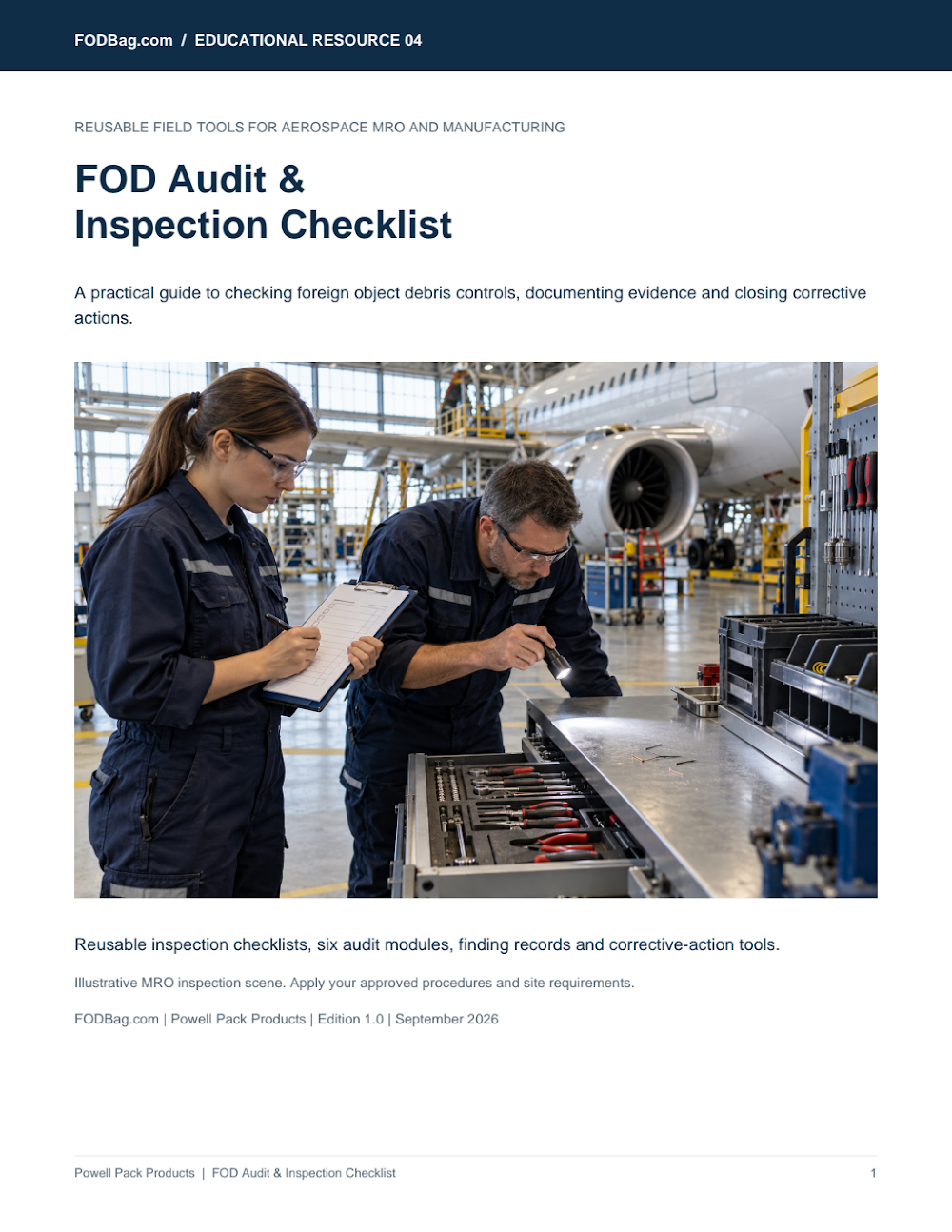
A practical guide to checking foreign object debris controls, documenting evidence and closing corrective actions, with reusable checklists, six audit modules and finding records. Get the Free GuideSee What's Inside22
Pages
6
Audit Modules
3
Reusable Checklists
4
Reusable Forms
About the FOD Audit and Inspection Checklist
Reviewed by Trent Powell, Founder, FODBag · Reviewed: November 10, 2026
Quick answer: An inspection answers whether the current area and task controls are in place. A program audit tests whether documented controls work across sampled operations. This guide gives you reusable inspection checklists, six audit modules, finding and containment records, and corrective-action and effectiveness tools to keep objective evidence of both. Pair this audit with the daily FOD checklist so floor inspections and program audits use the same items.
Who it is for: Quality auditors, FOD managers, supervisors and inspectors in aerospace manufacturing, assembly and MRO work areas, and airport operators using the airside supplement.
What’s Inside the Checklist
Reusable checklists, six audit modules and recording forms.
Criteria and Timing
Daily and Task Inspection
Six Audit Modules
Contractor and Airside Checklists
Findings and Corrective Action
Summary, Log and Tailoring
Key Practices From the Guide
A short preview of how the checklist is meant to be used.
A question is not an audit criterion
Write findings someone can act on
Do not transfer hangar controls to the airfield
Prove the fix worked
Tailor and control your version
Choose the Right Tool for the Job
- FOD inspection: are the current area and task controls in place?
- FOD program audit: do documented controls work across the sampled operations?
- Hardware inspection: does the item meet its approved inspection requirements?
How to Use the Checklist
- Decide whether you are performing an inspection, a program audit or a hardware inspection.
- Set criteria and choose timing and sample.
- Use the daily or task checklist, or the relevant audit modules.
- Record findings with criterion, evidence and consequence.
- Contain the condition and assign corrective action with an effectiveness check.
- Summarize the audit, decide follow-up and log recurring inspections.
Tools in the Checklist
- Reusable Checklist 01: Daily and task FOD inspection
- Reusable Checklist 02: Contractor and temporary-work inspection
- Reusable Checklist 03: Optional airside FOD inspection
- Six original audit modules (A to F)
- Form 04: Finding and immediate containment record
- Form 05: Corrective action and effectiveness record
- Form 06: Audit summary and follow-up decision
- Form 07: Recurring FOD inspection log
By FODBag.com · Updated November 10, 2026
Reviewed by Trent Powell, Founder, FODBag · Reviewed: November 10, 2026
FOD Audit and Inspection Playbook: Inspection vs Audit, Criteria, Sampling and a Written Finding
Quick answer: A FOD inspection checks whether controls are in place in an area now; a program audit samples records and operations to test whether documented controls work. Set criteria first, sample on purpose, write each finding as criterion, evidence and consequence, categorize it by type, detection point and origin, and track corrective action to verified closure.
This playbook is for quality auditors, FOD managers, supervisors and inspectors who run floor inspections and program audits in manufacturing, assembly and MRO areas. It separates inspection from audit, shows what the public IAQG and NASA documents say about measurement, records and nonconformities, and works a checked sampling and finding example. The sample sizes and percentages are FODBag suggestions, not published requirements; neither source sets an audit sample size.
Inspection and audit are different jobs
An inspection answers a present-tense question: are the controls in place in this area, on this task, right now? An audit asks whether the documented program works across sampled operations. Both produce records, but they answer different questions, and neither replaces product inspection or release authority. A clean-looking area can still hide weak controls, and an audit cannot prove an inaccessible cavity is clear; the inspection has to do that at the right intervals. IAQG guidance calls for inspection and detection at appropriate steps, with examples including prior to compartment closures and safety-of-flight inspections (IAQG SCMH 3.4.2 Rev. D, slide 20).
What the opened sources require you to measure and record
IAQG guidance says the organization needs to keep documented information of FOD program nonconformities and evaluate the program’s effectiveness against internal, customer, statutory and regulatory requirements; FO, FOd and FOD product nonconformities are categorized by type, point of detection and origin to support root cause analysis and corrective action, and reported through management review (IAQG SCMH 3.4.2 Rev. D, slide 16). It also gives a good and a bad example of a risk assessment: a good one records the characteristic questions for each risk element and yields an overall rating; a bad one covers product only and skips operations and detectability (IAQG SCMH 3.4.2 Rev. D, slide 14). NASA requires FOD incidents and the results of FOD walk downs and audits to be recorded in a database that provides metrics, including Pareto charts by type and location and trend charts of walk down completion and percent no FOD found (NASA MSFC-STD-3598 Rev. D, 5.12.2 and 5.12.2.3); it also requires incident investigation and corrective action, with near-misses recorded alongside actual events (NASA MSFC-STD-3598 Rev. D, 5.12.3 and 5.12.3.3). For training evidence, NASA requires FOD training records to be kept and annual refresher training for FOD monitors (NASA MSFC-STD-3598 Rev. D, 5.11.4.3 and 5.11.5).
Set criteria, then sample
- Write the criterion first. Every result traces to a requirement, an approved procedure or a contract clause. If a check has no criterion, it is an observation, not a finding.
- Choose the sample on purpose. Base it on the controlling requirements, hardware exposure, recent task changes and previous findings, not on convenience. State the population and the sample.
- Audit by module. A practical split is program ownership and control, area designation and access, tools and item accountability, housekeeping and collection, hardware protection and handoffs, and training and corrective action.
- Look for objective evidence. Records, observation and interview, not recollection.
- Record the result as written. Pass, fail or not applicable, with the evidence.
Write findings someone can act on
A usable finding has three parts: the criterion (what should be true), the evidence (what you saw, with a record or location) and the consequence (what could happen). Categorize it by type, point of detection and origin as IAQG describes. Contain the immediate risk first (stop, hold or inspect), then open corrective action, then verify effectiveness later by re-sampling. A finding that is closed without a re-check is a promise, not a result.
Worked example: sampling end-of-shift tool inventories
This example is illustrative and the numbers are invented for the exercise. The procedure (called TC-02 here) requires a signed end-of-shift tool inventory in each active area. A plant runs two shifts for 30 days, so the population is 2 × 30 = 60 inventory sheets. The auditor samples 12 sheets, which is 12 ÷ 60 = 20%, and classifies each.
| Result | Sheets | Share of 12 |
|---|---|---|
| Complete and signed | 9 | 9 ÷ 12 = 75% |
| Inventory done but unsigned | 2 | 2 ÷ 12 = 16.7% |
| No inventory sheet for the shift | 1 | 1 ÷ 12 = 8.3% |
| Total sampled | 12 | 100% |
Check: 9 + 2 + 1 = 12, and 9 ÷ 12 = 75% compliance; the discrepancy rate is (2 + 1) ÷ 12 = 25%. Written finding: Criterion: TC-02 requires a signed end-of-shift tool inventory in each active area. Evidence: 3 of 12 sampled sheets (25%) were unsigned or missing; sheet dates and shifts are on the audit record. Consequence: a missing tool could go unnoticed past shift change. Containment: inventory the three affected areas now. Category: tool control, point of detection audit, origin shift-handoff practice. Corrective action: sign-off at the board before leaving; effectiveness check by re-sampling 12 sheets after 30 days.
What good looks like
- Inspection and audit are defined separately and use consistent checklist items.
- Every finding cites a criterion, evidence and consequence, and is categorized by type, detection point and origin.
- Samples are chosen on purpose, with population and sample size stated.
- Containment is immediate, corrective action has an owner and a date, and effectiveness is verified by re-checking.
- Results reach management review and feed the same Pareto and trend charts as walk downs.
Matching FODBag products and resources
Equip the checks with area marking, signs and carriers: FOD area signs; FOD floor tape (2 in × 108 ft); FOD tool bags; FOD cans; FOD stickers.
About FODBag. FODBag.com, a Powell Pack Products company in Mesa, Arizona, has made FOD bags, FOD tape, FOD stickers, FOD signs, FOD posters, FOD cans and FOD containers since 2016. FOD tape is 2 in × 108 ft and FOD signs start at $29.99. Questions? Call 602-874-1313, Monday–Friday, 9:00 a.m.–5:00 p.m. Arizona time.
Sources opened for this page
- IAQG SCMH 3.4.2 Rev. D, FOD Prevention Program: Guidance in Support of IAQG Standard 9146 (June 19, 2023) — Slides 14, 16 and 20 on risk assessment examples, nonconformities and inspection intervals. Opened and read for this page on November 10, 2026.
- NASA MSFC-STD-3598 Rev. D, Standard for Foreign Object Damage/Foreign Object Debris (FOD) Prevention (effective July 26, 2021) — Sections 5.11.4.3, 5.11.5, 5.12.2 and 5.12.3 on training records, metrics and incident investigation. Opened and read for this page on November 10, 2026.
Get the FOD Audit and Inspection Checklist
Enter your details and we will email you the PDF right away.
- 22-page guide and checklist toolkit (PDF)
- 3 reusable checklists and 6 audit modules
- 4 reusable finding, action, summary and log forms
- Worked example of finding closure
Free for internal organizational use. Educational resource from FODBag.com, a Powell Pack Products company.
Get the Free Guide
Enter your details and we will email you the PDF of FOD Audit & Inspection Checklist right away.
Related Reading
Go deeper on the topics in the FOD Audit and Inspection Checklist.
More Free FOD Prevention Guides
Each guide is free to request and written for aerospace, aviation, MRO and manufacturing teams.
Equip Your FOD Program
Frequently Asked Questions
What is the difference between a FOD inspection and a FOD audit?
An inspection checks whether controls are in place in an area now; an audit samples records and operations to test whether the documented program works. Neither replaces product inspection or release authority. IAQG guidance expects inspection and detection at appropriate steps, such as before compartment closure (SCMH 3.4.2 Rev. D, slide 20).
How do you write a FOD audit finding?
State the criterion (what should be true), the evidence (what you saw, with a record or location) and the consequence (what could happen). Categorize it by type, point of detection and origin, contain it, open corrective action and verify effectiveness by re-checking (IAQG SCMH 3.4.2 Rev. D, slide 16).
What records should a FOD audit keep?
Criteria, population and sample, objective evidence, findings with containment, corrective actions and effectiveness checks. NASA MSFC-STD-3598 Rev. D, section 5.12.2, requires FOD incidents and the results of walk downs and audits to be recorded in a database that supports metrics.