
FOD Training Employee Handout
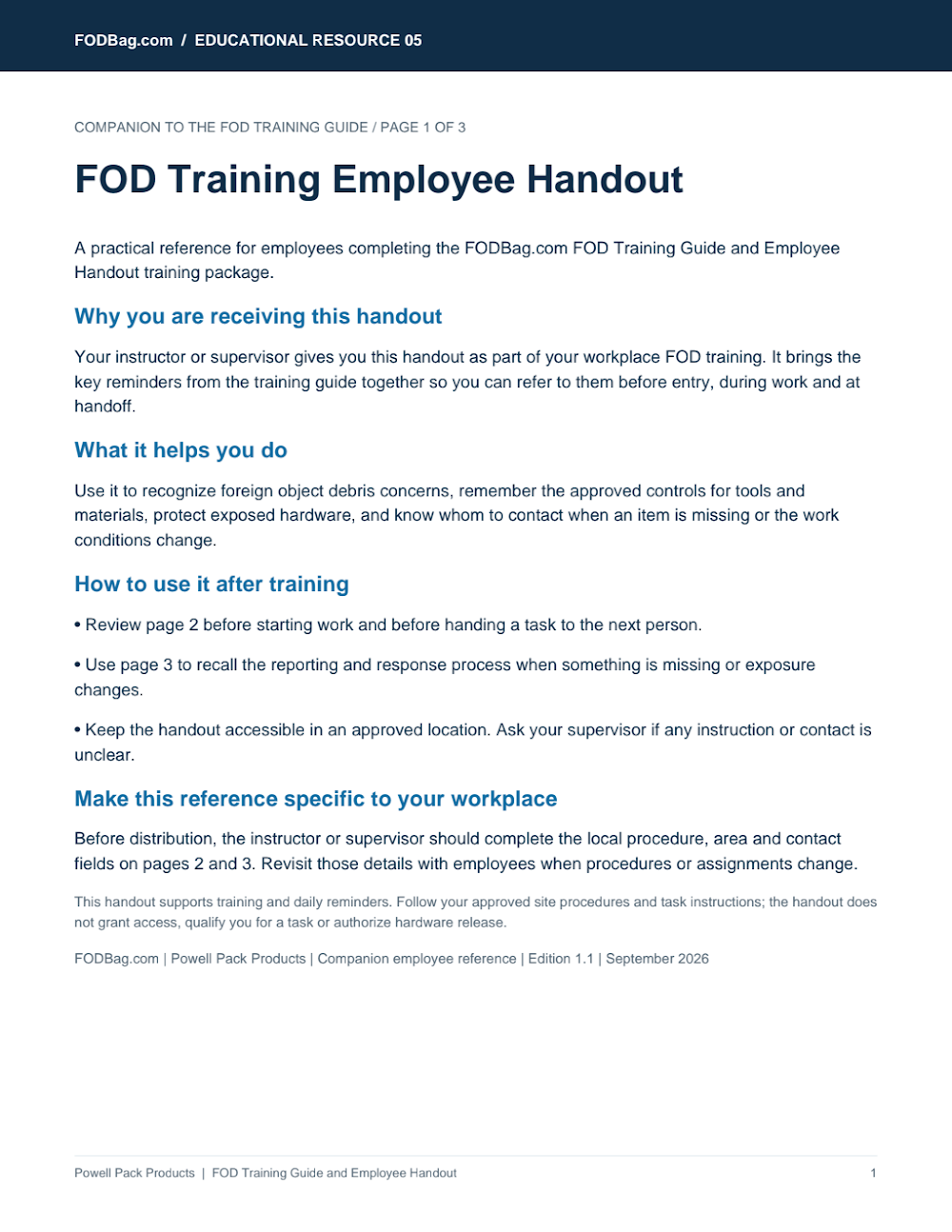
A practical, print-ready reference for employees completing FOD training, with daily reminders for before entry, while you work and before handoff. Get the Free GuideSee What's Inside3
Pages
3
Work Moments Covered
1
Missing-Item Response Page
Print-Ready
About the FOD Training Employee Handout
Reviewed by Trent Powell, Founder, FODBag · Reviewed: November 10, 2026
Quick answer: This handout brings the key reminders from the FOD Training Guide into a short reference employees can use before entry, during work and at handoff. It helps employees recognize FOD concerns, remember approved controls for tools and materials, protect exposed hardware and know whom to contact when an item is missing or work conditions change.
Who it is for: Employees completing the FOD Training Guide and Employee Handout package, and the instructors and supervisors who issue it.

What’s Inside the Handout
Three pages: an overview, daily reminders and a response reference.
Why You Are Receiving It
Before You Enter
While You Work
Before Handoff or Closure
Missing Item or Changed Exposure
Make It Specific to Your Workplace
Daily FOD Reminders
The handout’s reminders for each point in the work cycle.
Before you enter
While you work
What FOD is
Missing item or changed exposure
Handle routine debris safely
Notice changes
What the handout does not do
How to Use the Handout
- Review page 2 before starting work and before handing a task to the next person.
- Use page 3 to recall the reporting and response process when something is missing or exposure changes.
- Keep the handout accessible in an approved location.
- Ask your supervisor if any instruction or contact is unclear.
Before You Distribute It
- Complete the local procedure, area and contact fields on pages 2 and 3.
- Issue the handout as part of workplace FOD training.
- Keep it accessible in an approved location.
- Revisit the local details with employees when procedures or assignments change.
What You Get
- 12-page print-ready PDF
- Daily FOD work reminders
- Missing-item response reference
- Space for local procedures and contacts
By FODBag.com · Updated November 10, 2026
Reviewed by Trent Powell, Founder, FODBag · Reviewed: November 10, 2026
FOD Training Employee Handout Playbook: What Employees Do Before Entry, During Work and at Handoff
Quick answer: A FOD employee handout is a short reminder employees use before entry, during work and at handoff. It should cover area rules and access, personal items and pockets, tool and hardware accountability, housekeeping, and who to call when an item is missing. It supports training and local procedures; it does not qualify anyone for a task.
This playbook is for instructors, supervisors and employees using the FOD Training Employee Handout. It ties each handout topic to what the public IAQG and NASA documents say, and shows how to track that every employee has received and acknowledged the handout. The distribution numbers in the example are invented for illustration, and the practical wording is a FODBag suggestion to adapt to your approved site procedures.
What the opened sources say employees need
IAQG guidance expects a FOD prevention training program that fits the risk assessment: initial and recurring training with defined content and intervals, an evaluation of effectiveness (for example measuring employee competency or FOD nonconformities) and documented information of training program compliance (IAQG SCMH 3.4.2 Rev. D, slide 23). Anyone entering a designated area needs the required training or an escort by trained personnel, including customers, visitors, contractors and infrastructure maintenance (IAQG SCMH 3.4.2 Rev. D, slide 24). Personal items are items owned by individuals or issued for personal use, such as keys, phones, wallets, food, pens and jewelry, plus organization-owned items like badges, stamps, PPE and tool chits, and a lost-item reporting process is expected (IAQG SCMH 3.4.2 Rev. D, slide 29).
Personal items: the section employees notice most
NASA defines personal items as anything brought into a FOD Sensitive Area that the work instructions do not require, and says they shall be removed and stored or secured under the area’s work rules (NASA MSFC-STD-3598 Rev. D, 5.7 and 5.7.1). Pouches, lockers or badge boards may be provided, and personal items shall not be kept in tool bags or tool storage (NASA MSFC-STD-3598 Rev. D, 5.7.1.1 and 5.7.1.3). Before entering a FOD Control Area, loose items above the waist are removed from pockets; before entering a FOD Critical Zone all pockets are emptied, and a personal organizer pouch is not opened inside the zone (NASA MSFC-STD-3598 Rev. D, 5.7.6). Jewelry is not worn in those areas (NASA MSFC-STD-3598 Rev. D, 5.7.3.1), and clothing accessories such as phones, key fobs and chains are not worn inside them (NASA MSFC-STD-3598 Rev. D, 5.7.5.1). These are NASA flight-hardware rules; your site sets its own.
Turn the handout into three habits
- Before entry: read the area rules, confirm access or escort, empty pockets as the area requires, store personal items, and ask the area owner if anything is unclear.
- During work: keep covers and protection on, control tools, parts, removed pieces and consumables, clean up as you go to the approved collection point, and report damaged collection equipment or escaping contents.
- At handoff: reconcile tools and items, communicate task and protection status and open findings, and do not treat a clean-looking area as a substitute for required hardware inspection.
Issue it, record it, and check it works
A handout only helps if employees have it and the program can show that. Record who received it and when, make the instructor or supervisor complete the local fields (procedure, area and contacts) before distribution, and revisit it when procedures change. Then check effectiveness the way IAQG describes: competency checks and trends in FOD nonconformities (IAQG SCMH 3.4.2 Rev. D, slide 23). A quiz result does not replace required hardware inspection.
Worked example: tracking handout acknowledgments across three shifts
This example is illustrative, not a customer case. A site issues the handout to 8 employees on each of 3 shifts and collects signed acknowledgments.
| Shift | Issued | Acknowledged | Outstanding |
|---|---|---|---|
| Shift A | 8 | 8 | 0 |
| Shift B | 8 | 7 | 1 |
| Shift C | 8 | 6 | 2 |
| Total | 24 | 21 | 3 |
Check: issued 8 + 8 + 8 = 24; acknowledged 8 + 7 + 6 = 21; outstanding 24 − 21 = 3 (0 + 1 + 2), and 21 ÷ 24 = 87.5%. The supervisor follows up with the three outstanding employees within the week, and those three do not enter FOD-designated areas unescorted until they are acknowledged. The log is kept as training documentation.
What good looks like
- Each employee has the current handout and the local fields are filled in.
- Handout content matches the approved site procedure and area rules.
- Acknowledgments are logged, with follow-up on outstanding employees.
- Effectiveness is checked by competency checks or nonconformity trends, not just attendance.
- Visitors and contractors are trained or escorted.
Matching FODBag products and resources
Equip employees for the three habits: FOD belt pouches; FOD tool bags; FOD signs; FOD cans; FOD field posters.
About FODBag. FODBag.com, a Powell Pack Products company in Mesa, Arizona, has made FOD bags, FOD tape, FOD stickers, FOD signs, FOD posters, FOD cans and FOD containers since 2016. FOD tape is 2 in × 108 ft and FOD signs start at $29.99. Questions? Call 602-874-1313, Monday–Friday, 9:00 a.m.–5:00 p.m. Arizona time.
Sources opened for this page
- IAQG SCMH 3.4.2 Rev. D, FOD Prevention Program: Guidance in Support of IAQG Standard 9146 (June 19, 2023) — Slides 23, 24 and 29 on training, personnel access and personal items. Opened and read for this page on November 10, 2026.
- NASA MSFC-STD-3598 Rev. D, Standard for Foreign Object Damage/Foreign Object Debris (FOD) Prevention (effective July 26, 2021) — Sections 5.7 to 5.7.6 on personal item control. Opened and read for this page on November 10, 2026.
Get the FOD Training Employee Handout
Enter your details and we will email you the PDF right away.
- 12-page print-ready handout (PDF)
- Daily FOD reminders for entry, work and handoff
- Missing-item response reference
- Companion to the FOD Training Guide
Free for internal organizational use. Educational resource from FODBag.com, a Powell Pack Products company.
Get the Free Guide
Enter your details and we will email you the PDF of FOD Training Employee Handout right away.
Related Reading
Go deeper on the topics in the FOD Training Employee Handout.
More Free FOD Prevention Guides
Each guide is free to request and written for aerospace, aviation, MRO and manufacturing teams.
Equip Your FOD Program
Frequently Asked Questions
What should a FOD employee handout cover?
Area rules and access, personal items and pockets, tool and hardware accountability, housekeeping and collection, status communication at handoff, and who to contact for a missing item. IAQG guidance expects training content tied to the FOD risk assessment (SCMH 3.4.2 Rev. D, slide 23).
What personal items should employees remove before entering a FOD area?
It depends on the area rules. NASA MSFC-STD-3598 Rev. D, section 5.7.6, requires loose items to be removed from pockets above the waist before a FOD Control Area and all pockets emptied before a FOD Critical Zone; section 5.7.3.1 bars jewelry in those areas. Follow your own site procedure.
Does a handout qualify an employee to work in a FOD area?
No. A handout supports training and daily reminders. Access requires the training your procedures define, or an escort by trained personnel (IAQG SCMH 3.4.2 Rev. D, slide 24).