
30-Day FOD Program Implementation Plan
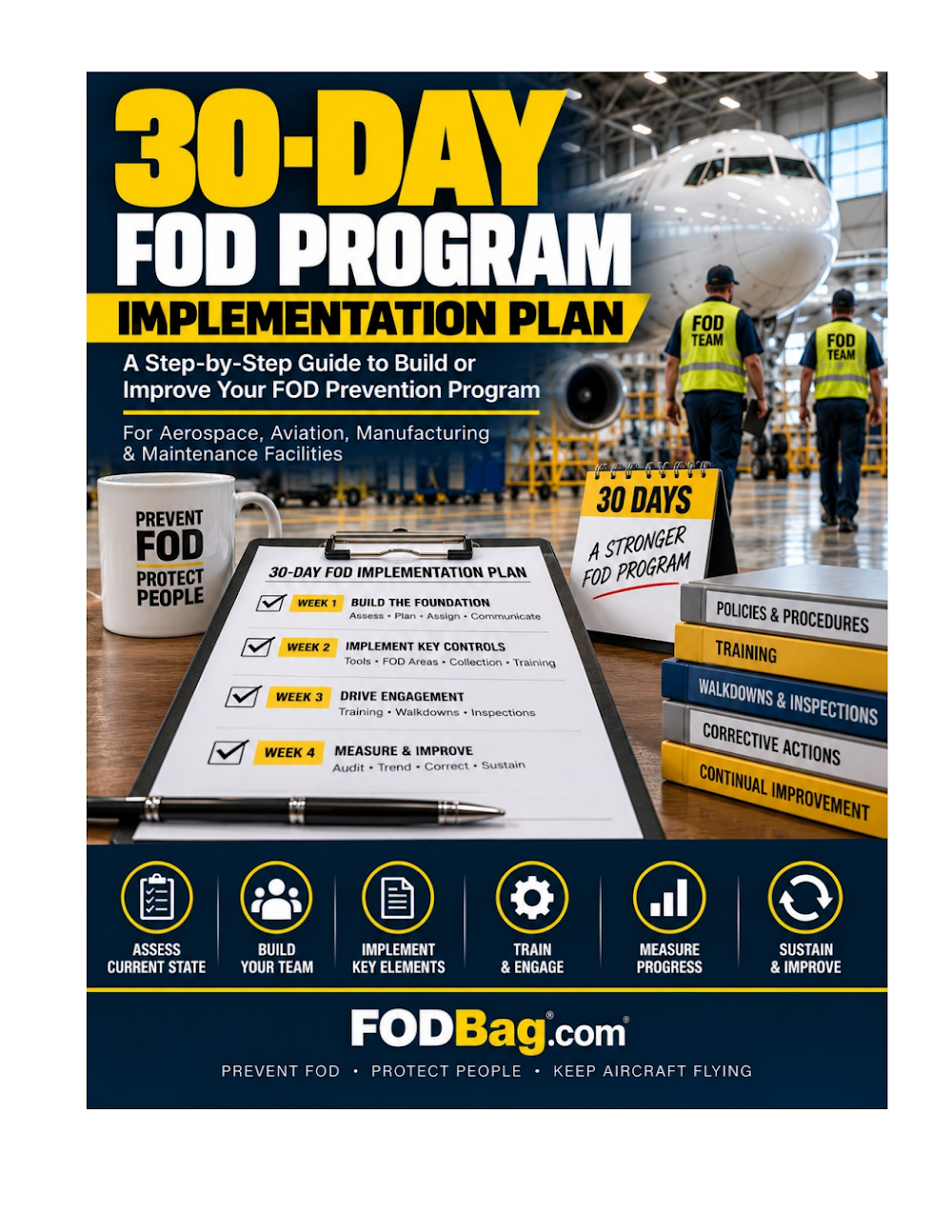
A practical 30-day roadmap for building a new Foreign Object Damage / Foreign Object Debris (FOD) Prevention Program or strengthening an existing program in aerospace, aviation, manufacturing, MRO and defense. Get the Free GuideSee What's Inside30
Days
4
Weeks
6
Phases
16
Pages
About the 30-Day FOD Program Implementation Plan
Reviewed by Trent Powell, Founder, FODBag · Reviewed: November 10, 2026
Quick answer: By Day 30, the organization should have a documented current-state assessment, assigned ownership, defined FOD risk areas, foundational policies and responsibilities, key controls in operation, trained personnel, routine inspections and walkdowns, an incident and corrective-action process, initial performance measures and a documented improvement backlog. This plan breaks that work into a day-by-day roadmap.
Who it is for: FOD managers, quality and operations leaders and implementation teams building a new FOD prevention program or strengthening an existing one.

What’s Inside the Plan
Six phases covering all 30 days, plus checklists and templates.
Before Day 1
Days 1 to 5: Assess and Define
Days 6 to 10: Build the Program
Days 11 to 15: Implement Controls
Days 16 to 20: Train and Engage
Days 21 to 30: Inspect, Measure and Sustain
The 30 Days at a Glance
The primary action for each phase of the roadmap.
Days 1 to 5: Assess and Define
Days 6 to 10: Build the Program
Days 11 to 15: Implement Controls
Days 16 to 20: Train and Engage
Days 21 to 25: Inspect, Test and Correct
Days 26 to 30: Measure, Review and Sustain
The Four-Week Roadmap
- Week 1, build the foundation: assess, define scope, identify requirements, assign leadership, classify risk and establish the implementation plan.
- Week 2, implement key controls: housekeeping, clean-as-you-go, tool, part and material control, collection, area marking, product protection and documentation.
- Week 3, train and engage: employee training, walkdowns, supervisor routines, reporting, contractor controls and communication.
- Week 4, measure and improve: audit, incident response, corrective action, trend data, management review, close gaps and create the sustainment plan.
How to Use This Plan
- Complete the Before Day 1 preparation and collect existing information.
- Work through each phase, assigning an owner to each day’s action.
- Track progress in the 30-Day Implementation Tracker.
- Use the program elements checklist to confirm what is implemented.
- Review metrics and management-review guidance on Days 26 to 28.
- Review the common implementation failures to avoid early mistakes.
Included in the Plan
- 30-Day Implementation Tracker
- Program elements checklist
- Metrics and management review guidance
- Common implementation failures
- Ready-to-use templates
By FODBag.com · Updated November 10, 2026
Reviewed by Trent Powell, Founder, FODBag · Reviewed: November 10, 2026
30-Day FOD Program Implementation Playbook: What the Sources Require, a 24-Person Shop and a 30-Day Count
This playbook is for the FOD manager, quality leader or implementation lead about to run the first month from the downloadable plan on this page. It sets out what a NASA standard, IAQG public guidance and an FAA advisory circular actually require of a written program, a named owner, area classes, training and measures; works one 24-person, three-bay MRO shop through the six phases; and gives a Day-30 readiness check. The 30-day calendar, the six-phase split and the four-week grouping are a FODBag suggestion for sequence and timing, not a published schedule.
What the published sources say a first month has to stand up, and what they do not schedule
NASA requires each flight-hardware project to develop a written Project FOD control program that includes twelve basic elements: a Project FOD Focal Point; identification of FOD-sensitive hardware; early design consideration for FOD prevention; manufacturing, assembly, test and operations planning; designation and control of FOD Sensitive Areas, with access control and control of overhead operations; housekeeping; control of tools, hardware, consumables and personal items; control of hazardous material; FOD prevention training; measuring techniques for analysis, trending and feedback; incident investigation, reporting and lessons learned; and employee awareness and feedback (NASA MSFC-STD-3598 Rev. D, paragraph 4.2(a)–(l)). Hardware that is FOD sensitive shall be listed in that program document (4.1.4). The Center FOD Focal Point designates the level of FOD control for each project facility, using three classes: FOD Awareness Area, FOD Control Area and FOD Critical Zone (5.1). A training program shall be developed and made available to personnel assigned to work in or support FOD Sensitive Areas (5.11). Those paragraphs require a written program, a named focal point, area classes, training and measures. They do not require that the work be finished in 30 days.
IAQG’s public guidance lists eight primary elements of a FOD prevention program: program management, operations, area designation, training and personnel access, product protection, housekeeping and clean-as-you-go, accountability and control of consumables, hardware and personal items, and tool accountability and control (IAQG SCMH 3.4.2 Rev. D, slide 10). The next slide describes a process approach and risk-based thinking, with a Plan-Do-Check-Act loop: establish the scope of the program through a FOD risk assessment, implement the applicable elements, maintain them, and report metrics and take action to improve (slide 11). To comply with the standard it supports, the organization needs to demonstrate leadership and commitment, including resources and authority for the FOD Prevention Program management representative, and to designate that representative with responsibility and authority for establishment, implementation and maintenance of the program (slide 12). Training must be commensurate with the risk assessment, and anyone entering a designated area must have received the required training or be escorted (slides 23–24). Those slides do not set a 30-day clock.
The FAA circular, which applies to airport FOD management, says a successful program typically contains four main areas: prevention, detection, removal and evaluation (AC 150/5210-24A, paragraph 2.3.2.1). Management’s commitment should be formally expressed in a statement of the organization’s FOD policy, which establishes the program and should be posted in conspicuous locations (3.1.2.1). Airport operators should designate an accountable staff member, dedicated or with other duties (3.1.2.2.1). Training and education typically include a documented requirements process, a validation of effectiveness, recurrent training and human factors (3.2.2). Those paragraphs are airport guidance. Using the four-area list to organize a hangar or factory month is a FODBag suggestion.
Worked example: a 24-person, three-bay MRO shop, first 30 days
This example is illustrative. It is not a customer case, and it does not claim that NASA or the FAA binds this shop to a 30-day finish. The shop uses NASA’s three area classes only as a way to label the bays. The phase lengths, the class size of eight and the 20-foot doorway tape estimate are FODBag suggestions.
Hangar annex B has 24 people and three bays. The current-state walk in Days 1 to 5 labels one bay a FOD Critical Zone (final close-out on flight hardware), one a FOD Control Area (open assembly) and one a FOD Awareness Area (stores and kitting), using NASA 5.1 as a map: 1 + 1 + 1 = 3 bays. The gap list from that walk has 12 items: 6 high, 4 medium and 2 low. Check: 6 + 4 + 2 = 12.
The six phases in this plan add to 30 days: Days 1–5, 6–10, 11–15, 16–20, 21–25 and 26–30, or 5 + 5 + 5 + 5 + 5 + 5 = 30. The four-week summary on this page is a grouping of the same work, not a second calendar. The tracker uses the day numbers.
| Phase (this plan) | Days | Checkable output in this shop | Count |
|---|---|---|---|
| Assess and define | 1–5 | Scope written; three bays walked and labelled; 12-item gap list prioritized. | 1 + 1 + 1 = 3 bays; 6 + 4 + 2 = 12 gaps. |
| Build the program | 6–10 | A named program manager / focal point, a signed policy or charter, and a draft procedure that states the source list. | 1 owner, 1 signed document (NASA 4.2; IAQG slide 12; FAA 3.1.2.1 as airport guidance). |
| Implement controls | 11–15 | Collection points, doorway marks and walkdown routes in all three bays, then a one-day pilot. | 3 bay cans + 1 shared can = 4; 3 × 20 = 60 ft of tape, and 60 < 108; 3 area signs. |
| Train and engage | 16–20 | Supervisors then the floor, with escort rules in force for anyone not yet trained (IAQG slide 24). | 24 people in classes of 8: 24 ÷ 8 = 3 classes; 3 × 35 = 105 minutes. |
| Inspect, test and correct | 21–25 | Formal walkdowns, a missing-item drill, a reporting drill, a first assessment and closure of high-priority gaps. | 3 bays × 2 formal walks = 6 walkdowns; 6 of 6 high-priority gaps given an owner. |
| Measure, review and sustain | 26–30 | A baseline from the six walks, a management review and a written sustainment plan (IAQG slide 11; NASA 4.2(j)–(l)). | 18 findings across 6 walks: 18 ÷ 6 = 3.00 findings per walk; 6 ÷ 6 = 100% of planned walks completed. |
The 60 ft of doorway tape is less than one 2 in × 108 ft roll, so one roll covers the three doorways with 108 − 60 = 48 ft left for a short interior line if the shop needs one. Area signs start at $29.99; the shop buys three, one for each bay class. Collection uses four FOD cans (3 + 1 = 4). Those product counts are a FODBag illustration of the Days 11 to 15 work, not a NASA bill of materials.
Training uses the 35-minute session from the companion FOD Training Guide and Employee Handout: 3 × 35 = 105 minutes of delivery for 24 people. The Charter and Kickoff Pack is the fill-in place for the signed policy and the named owner that Days 6 to 10 should produce. Both packs are FODBag formats.
Arithmetic recap, all checked: 1 + 1 + 1 = 3 bays; 6 + 4 + 2 = 12 gaps; 5 + 5 + 5 + 5 + 5 + 5 = 30 days; 3 + 1 = 4 cans; 3 × 20 = 60 and 60 < 108; 108 − 60 = 48; 24 ÷ 8 = 3 and 3 × 35 = 105; 3 × 2 = 6 walkdowns; 18 ÷ 6 = 3.00; 6 ÷ 6 = 100%.
Day-30 readiness check (illustrative)
This six-point check is a FODBag suggestion for the program manager the morning of Day 30, not a published audit list. Passing it does not mean the program is finished.
| Check | Pass if | Fail / action |
|---|---|---|
| A written program or policy exists and an owner is named | The document is signed, lists the binding source, and names a person with time and authority. | A draft in a drawer: finish the signatures before you call Day 30 a launch (NASA 4.2; IAQG slide 12; FAA 3.1.2.1 as airport guidance). |
| The 30 days actually add to 30, and each phase has an owner | 5 + 5 + 5 + 5 + 5 + 5 = 30 on the tracker, with a name on each day’s action. | A month that only says “stand up the program”: put the day counts back on the tracker. |
| The floor can see the areas | Each bay is labelled, the doorways are marked, and the cans promised in Days 11 to 15 are in place (here, 3 signs, 60 ft of tape, 4 cans). | Classes already run but the walls are still blank: hang the signs and finish the tape before the next walk. |
| People in the bays have been trained, or are escorted | 24 records exist, or the untrained names are on an escort list (IAQG slides 23–24; NASA 5.11). | Untrained, unescorted staff in a Control Area or Critical Zone: stop that access until a class and a record exist. |
| A first set of measures exists | The six planned walks ran (6 ÷ 6 = 100%) and a findings rate is written (here, 18 ÷ 6 = 3.00). | Awareness posters but no numbers: finish Days 26 to 27 before the management review (NASA 4.2(j); IAQG slide 11). |
| A sustainment plan is written, not implied | Day 30 produces a backlog with owners, and a date for the next review. Day 30 is a start. | A close-out email that says the program is done: reopen the backlog (this plan’s About note; IAQG slide 11). |
Where to go next
The downloadable 30-Day FOD Program Implementation Plan on this page holds the day-by-day roadmap, the 30-day tracker, the program-elements checklist, and the metrics and management-review guidance. Request it with the form below. The signed-owner documents that Days 6 to 10 need are in the Charter and Kickoff Pack. The Day 16 to 20 classes can use the FOD Training Guide and Employee Handout. For the physical controls in Days 11 to 15, shop FOD signs (from $29.99), FOD area signs, FOD floor tape in 2 in × 108 ft rolls, and FOD cans. Questions about matching a first month to signs, tape or cans? Call FODBag at 602-874-1313, Monday–Friday, 9:00 a.m.–5:00 p.m. America/Phoenix.
Sources and how we used them
- NASA MSFC-STD-3598 Rev. D, Standard for FOD Prevention (effective July 26, 2021) — Paragraphs 4.1.4 (FOD-sensitive hardware listed in the program document), 4.2 and 4.2(a)–(l) (written Project FOD control program and the twelve basic elements, including a Project FOD Focal Point, area designation, housekeeping, tool and consumable control, training, measuring techniques, incident investigation and employee feedback), 5.1 (Awareness Area, Control Area and Critical Zone designations), and 5.11 (awareness and prevention training program for personnel assigned to work in or support FOD Sensitive Areas). Free public PDF, read from the copy saved under sources/. Those paragraphs do not set a 30-day calendar, a six-phase split, or a required first-month tape or can count. Accessed for this page Nov. 10, 2026.
- FAA Advisory Circular 150/5210-24A, Airport Foreign Object Debris (FOD) Management (February 8, 2024; updated by errata May 20, 2024) — Paragraphs 2.3.2.1 (four typical areas of an airport FOD management program), 3.1.2.1 (formal policy statement that establishes the program; post it), 3.1.2.2.1 (designate an accountable staff member, dedicated or with other duties), and 3.2.2 (typical training-program features). Free public PDF, opened from the official FAA copy saved under sources/FAA_AC_150_5210_24A.txt. This AC is airport guidance, not a hangar or factory standard. Accessed for this page Nov. 10, 2026.
- IAQG SCMH 3.4.2 Rev. D, FOD Prevention Program: Guidance in Support of IAQG Standard 9146 (June 19, 2023) — Slides 10–12 (eight primary elements; process approach and risk-based thinking; Plan-Do-Check-Act, including establish scope through a FOD risk assessment, implement applicable elements, maintain them, and report metrics and take action to improve; leadership, resources and a designated management representative) and slides 23–24 (training program commensurate with the risk assessment; escort or required training before entry). Slide numbers are the footer numbers in the PDF. Free public document, read from the copy saved under sources/. The slides we read do not set a 30-day calendar. Accessed for this page Nov. 10, 2026.
AS9146 and NAS 412 are paid documents and are not reproduced or quoted here, and no clause numbers from them are cited. The 30-day calendar, the six-phase split, the four-week grouping, the class size of eight, the 20-foot doorway estimate, and the six-point Day-30 check are FODBag instruments described in this playbook; they are not published standard requirements. The worked example is illustrative and is not a customer case.
Get the 30-Day FOD Program Implementation Plan
Enter your details and we will email you the PDF right away.
- 20-page implementation plan (PDF)
- Day-by-day roadmap for 30 days
- 30-Day Implementation Tracker
- Program elements checklist and metrics guidance
Free for internal organizational use. Educational resource from FODBag.com, a Powell Pack Products company.
Get the Free Guide
Enter your details and we will email you the PDF of 30-Day FOD Program Implementation Plan right away.
Related Reading
Go deeper on the topics in the 30-Day FOD Program Implementation Plan.
More Free FOD Prevention Guides
Each guide is free to request and written for aerospace, aviation, MRO and manufacturing teams.
Equip Your FOD Program
Frequently Asked Questions
Is a 30-day FOD program implementation a standard requirement?
No. NASA MSFC-STD-3598 Rev. D, paragraph 4.2, requires a written Project FOD control program with twelve basic elements, including a Project FOD Focal Point. IAQG SCMH 3.4.2 Rev. D, slides 10 through 12, describes eight primary elements, a Plan-Do-Check-Act loop that starts with a FOD risk assessment, and a designated management representative. FAA Advisory Circular 150/5210-24A, paragraphs 3.1.2.1 and 3.1.2.2.1, which are airport guidance, call for a formal policy statement and an accountable staff member. None of those sources sets a 30-day calendar. The day-by-day roadmap in this plan is a FODBag suggestion.
What should be true by Day 30?
As this plan describes it, the organization should have a documented current-state assessment, assigned ownership, defined FOD risk areas, foundational policies and responsibilities, key controls in operation, trained personnel, routine inspections and walkdowns, an incident and corrective-action process, initial performance measures and a documented improvement backlog. Day 30 is the beginning, not the finish. An effective FOD prevention program requires continual attention.
How do the six phases map to four weeks?
The plan uses both views. The six phases are Days 1 to 5 (assess and define), 6 to 10 (build the program), 11 to 15 (implement controls), 16 to 20 (train and engage), 21 to 25 (inspect, test and correct) and 26 to 30 (measure, review and sustain). That addition is 5 + 5 + 5 + 5 + 5 + 5 = 30. The four-week summary groups the same work: week 1 builds the foundation, week 2 implements key controls, week 3 trains and engages, and week 4 measures and improves. Use the day-by-day tracker as the calendar; the four-week list is a grouping, not a second schedule.
Which source list of program elements should we follow?
Follow the list in your contract. NASA 4.2 lists twelve elements. IAQG slide 10 lists eight primary elements. FAA paragraph 2.3.2.1 describes four typical areas of an airport FOD management program (prevention, detection, removal and evaluation) and is airport guidance. Using the FAA four areas to organize a hangar or factory 30-day plan is a FODBag suggestion. Do not hang two conflicting lists on the wall.
When should we start training in the 30 days?
This plan places finalize-and-deliver training in Days 16 to 20, after the procedure and the floor controls exist so the class can name real areas, signs and missing-item rules. That timing is a FODBag suggestion. NASA 5.11 still requires a training program for people who work in or support FOD Sensitive Areas, and IAQG slide 23 requires a training program commensurate with the risk assessment, including internal and external personnel. IAQG slide 24 requires an escort for anyone entering a designated area who has not yet received the required training. Do not leave untrained people unescorted in a higher-control bay while you wait for Day 18.
What physical controls belong in days 11 to 15?
In this plan those days cover collection points, storage, marking and communicating controlled areas, walkdown routes and checklists, and a pilot of the controls. That sequence is a FODBag suggestion. It lines up with NASA 4.2 elements on designation and control of FOD Sensitive Areas, housekeeping, and control of tools, hardware, consumables and personal items, and with NASA 5.1 area classes (Awareness, Control, Critical) used only as a way to label bays. Your contract may require the same controls on a different day.
Does Day 30 mean the program is finished?
No. The About note on this page says Day 30 is the beginning, not the finish, and that an effective program requires continual attention. IAQG slide 11 describes a Plan-Do-Check-Act loop: establish scope through a FOD risk assessment, implement the applicable elements, maintain them, and report metrics and take action to improve. NASA 4.2 includes measuring techniques, incident investigation and employee feedback as ongoing elements, not a one-month close-out.
Can we skip the charter and jump into this 30-day plan?
You can start the assessment on Day 1, but you still need a named owner and a written program or policy. NASA 4.2 requires a written Project FOD control program and a Project FOD Focal Point. IAQG slide 12 requires a designated management representative with responsibility and authority. FAA 3.1.2.1, which is airport guidance, says management commitment should be formally expressed in a policy statement that establishes the program. The Charter and Kickoff Pack on this site is a companion fill-in format; it is also a FODBag suggestion, not a published template.