
Runway and Taxiway FOD Inspection Log
Runway and taxiway FOD inspection practice for airport self-inspections, with log templates built for recording what was found, what was done and where problems recur. Get the Free GuideSee What's Inside10
Pages
11
Sections
12
Months Records Kept (139.327)
4
Printable Logs and Records
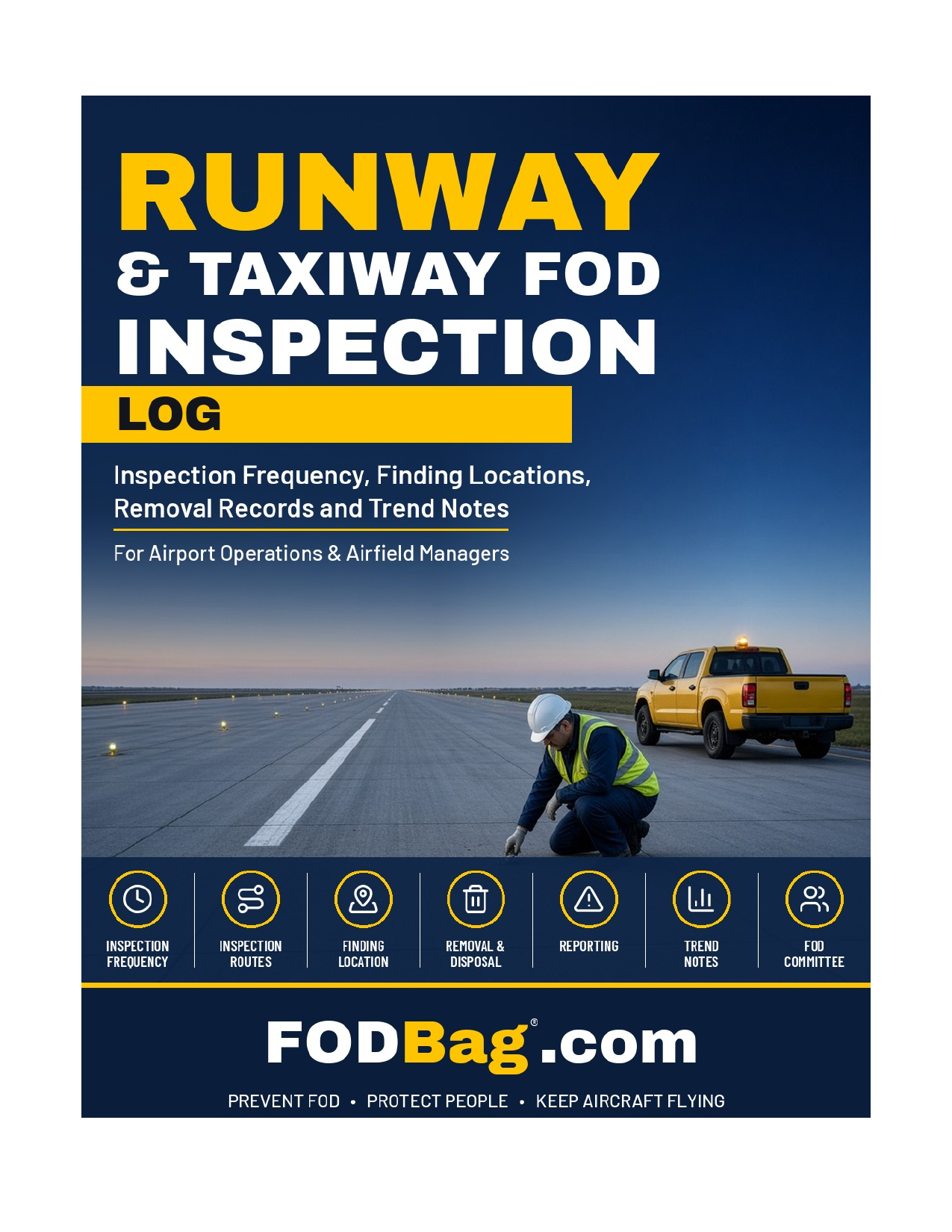
About the Runway and Taxiway FOD Inspection Log
Reviewed by Trent Powell, Founder, FODBag · Reviewed: November 10, 2026
Quick answer: Runways and taxiways are where foreign object debris meets aircraft at high speed. A fragment of pavement, a lost fastener or a piece of construction material in the path of a departing aircraft can be ingested by an engine or cut a tire. Airport self-inspections are the primary defense against FOD on the runway, and the record of those inspections shows what was found, what was done and where problems keep recurring.
Who it is for: Airport operations managers, airfield inspectors, operations supervisors, FOD program managers and FOD committee members at certificated and general aviation airports.

What’s Inside the Guide
Eleven sections, from regulatory context to monthly trend notes for the FOD committee.
Regulatory and Guidance Context
Where Runway FOD Comes From
Inspection Frequency Planning
Inspection Technique
Recording Finding Locations
Removal, Escalation and Forms
Key Practices From the Guide
A short preview of what the guide covers in depth.
Follow Part 139 and your ACM first
Plan frequency beyond the baseline
Use more than one pass
Inspect the takeoff portion with particular care
Record location consistently
Escalate when FOD cannot be removed promptly
How to Use This Guide
- Use Sections 1 and 2 to understand the requirements and where runway and taxiway FOD comes from.
- Use Sections 3 and 4 to plan inspection frequency and technique.
- Use Sections 5 and 6 to record locations and handle removal, disposal and escalation.
- Use the logs, grid and trend notes in Sections 7 to 10 as working records or a starting point for your own controlled forms.
Before You Start
- Confirm the inspection schedule and procedures in your ACM.
- Set the location reference system for every runway and taxiway.
- Train inspectors on movement-area access and radio communication.
- Agree removal and escalation steps for FOD that cannot be removed promptly.
- Set where logs are kept, for at least 12 consecutive calendar months.
- Decide what trend summary goes to the FOD committee each month.
Forms in the Toolkit
- Runway and Taxiway FOD Inspection Log (Section 7)
- Finding Location Grid (Section 8)
- Removal and Disposal Record (Section 9)
- Monthly Trend Notes for the FOD Committee (Section 10)
By FODBag.com · Updated November 10, 2026
Reviewed by Trent Powell, Founder, FODBag · Reviewed: November 10, 2026
Runway and Taxiway FOD Log Playbook: Where to Look, What to Record, How Long to Keep It
Quick answer: On runways and taxiways, inspect at least daily and after events, look first where FOD collects, record what you found, where and its likely source, and keep the records at least two years. FAA guidance says pavement joints are main sources of ingested objects and the takeoff portion of a runway is where departing aircraft are most susceptible.
This playbook shows what to look for on movement areas and how to keep a log that supports trends. It uses FAA AC 150/5210-24A and works a one-week log example with checked arithmetic. The counts are invented and the log layout is a FODBag suggestion. Inspection procedures for your airport come from your airport certification manual and FAA self-inspection guidance, which were not opened here.
What the opened source says
FAA AC 150/5210-24A says the portion of the runway used for takeoff is where departing aircraft are most susceptible to FOD damage, that deteriorating pavement can spall and crack, that service roads crossing taxiways should be monitored closely, that unpaved shoulders should be stabilized, that pavement joints and cracks are the main sources of foreign objects which are ingested, and that turf areas and fence-lines collect trash that can blow back (FAA AC 150/5210-24A, 4.3.1.1.1). It states operational areas are inspected at least once each day, with additional inspections in construction areas and after incidents or spills (FAA AC 150/5210-24A, 4.3.2.1). It recommends recording how FOD was detected, when, a description, location, possible source and who found it (FAA AC 150/5210-24A, 6.1.1), and says records should be kept in sufficient detail for at least 2 years (FAA AC 150/5210-24A, 6.1.4).
Inspection log fields
- Date, time and inspector.
- Area inspected: runway, taxiway, shoulder, crossing.
- What was found: category, size, color, and whether removed.
- Where: location reference on the airfield.
- Possible source and action: and who was told.
Where to look first
Start at pavement joints, cracks, service road crossings and the takeoff end. After wind, check fence-lines and turf. After construction work, check the haul routes.
If FOD cannot be removed promptly
Report it to airport operations right away so the area can be restricted or marked according to your airport procedures, and record the time and action.
Worked example: a week of runway and taxiway findings
This example is illustrative, not data from a real airport:
| Where found | Items |
|---|---|
| Pavement joints and cracks | 5 |
| Service road crossing | 3 |
| Shoulder edge | 2 |
| Other | 2 |
| Total in 7 daily inspections | 12; 12 ÷ 7 = 1.7 per inspection |
| Records kept at least 2 years | 2 × 365 = 730 daily entries |
Check: 5 + 3 + 2 + 2 = 12 items; 12 ÷ 7 = 1.7 per inspection; 2 × 365 = 730 daily entries kept at minimum. Pavement joints lead, so the operator adds joint cleaning to the maintenance plan and compares next week’s log.
What good looks like
- Daily and event-driven inspections are logged.
- Entries show what, where and likely source.
- Hot spots such as joints and crossings are checked first.
- Records are kept at least two years.
- Trends feed maintenance planning.
Matching FODBag products and resources
Products that support airfield FOD work: FOD cans; FOD bags; belt pouches; FOD signs; clear bags.
About FODBag. FODBag.com, a Powell Pack Products company in Mesa, Arizona, has made FOD bags, FOD tape, FOD stickers, FOD signs, FOD posters, FOD cans and FOD containers since 2016. FOD tape is 2 in × 108 ft and FOD signs start at $29.99. Questions? Call 602-874-1313, Monday–Friday, 9:00 a.m.–5:00 p.m. Arizona time.
Sources opened for this page
- FAA Advisory Circular 150/5210-24A, Airport Foreign Object Debris (FOD) Management (February 8, 2024) — Sections 4.3.1.1.1, 4.3.2.1, 6.1.1 and 6.1.4. Opened and read for this page on November 10, 2026.
Get the Runway and Taxiway FOD Inspection Log
Enter your details and we will email you the PDF right away.
- 10-page log pack (PDF)
- Part 139 and FAA guidance summary
- Inspection frequency, technique and location method
- Inspection log, location grid, removal record and trend notes
Free for internal organizational use. Educational resource from FODBag.com, a Powell Pack Products company. Questions? Call 602-874-1313.
Get the Free Guide
Enter your details and we will email you the PDF of Runway and Taxiway FOD Inspection Log right away.
Related Reading
Go deeper on the topics in the Runway and Taxiway FOD Inspection Log.
More Free FOD Prevention Guides
Each guide is free to request and written for aerospace, aviation, MRO and manufacturing teams.
Equip Your FOD Program
Frequently Asked Questions
What causes FOD on the runway?
AC 150/5210-24A lists FOD-prone locations and conditions such as the takeoff portion of the runway, deteriorating pavement with spalling and cracking, and pavement joints, along with lost hardware and construction material.
How often are runways inspected for FOD?
14 CFR 139.327 requires daily self-inspections unless the ACM states otherwise, plus inspections when unusual conditions such as construction or weather may affect safe operations and immediately after an accident or incident.
How should a runway FOD inspection be driven?
AC 150/5210-24A states the most effective inspection uses two or more passes. With time for one pass, drive opposite the direction of landing aircraft where practical, with beacon and headlights on.
How long must runway inspection records be kept?
Part 139 self-inspection records are kept for at least 12 consecutive calendar months.
What should you do if FOD on the runway cannot be removed promptly?
Follow your ACM procedures for reporting, closing the area and issuing NOTAMs as required, and notify operations and affected operators.
What causes FOD on the runway?
FAA AC 150/5210-24A lists deteriorating pavement, construction debris, items carried by vehicles from aprons and service roads, shoulders, pavement joints and cracks, turf and fence-line trash (section 4.3.1.1.1).
How often are runways inspected for FOD?
FAA AC 150/5210-24A says operational areas are inspected at least once each day, with additional inspections in construction areas and after incidents or spills (section 4.3.2.1).
How long must runway inspection records be kept?
FAA AC 150/5210-24A says records should be maintained in sufficient detail for at least 2 years (section 6.1.4).