
Composite Layup and Bonding FOD Control Guide
How to control backing film, release paper, peel ply, trimmings, tape and other materials during composite layup, vacuum bagging and bonding so nothing is laminated in or left behind. Get the Free GuideSee What's Inside6
Pages
6
Sections
2
Printable Forms
1
Free PDF Download
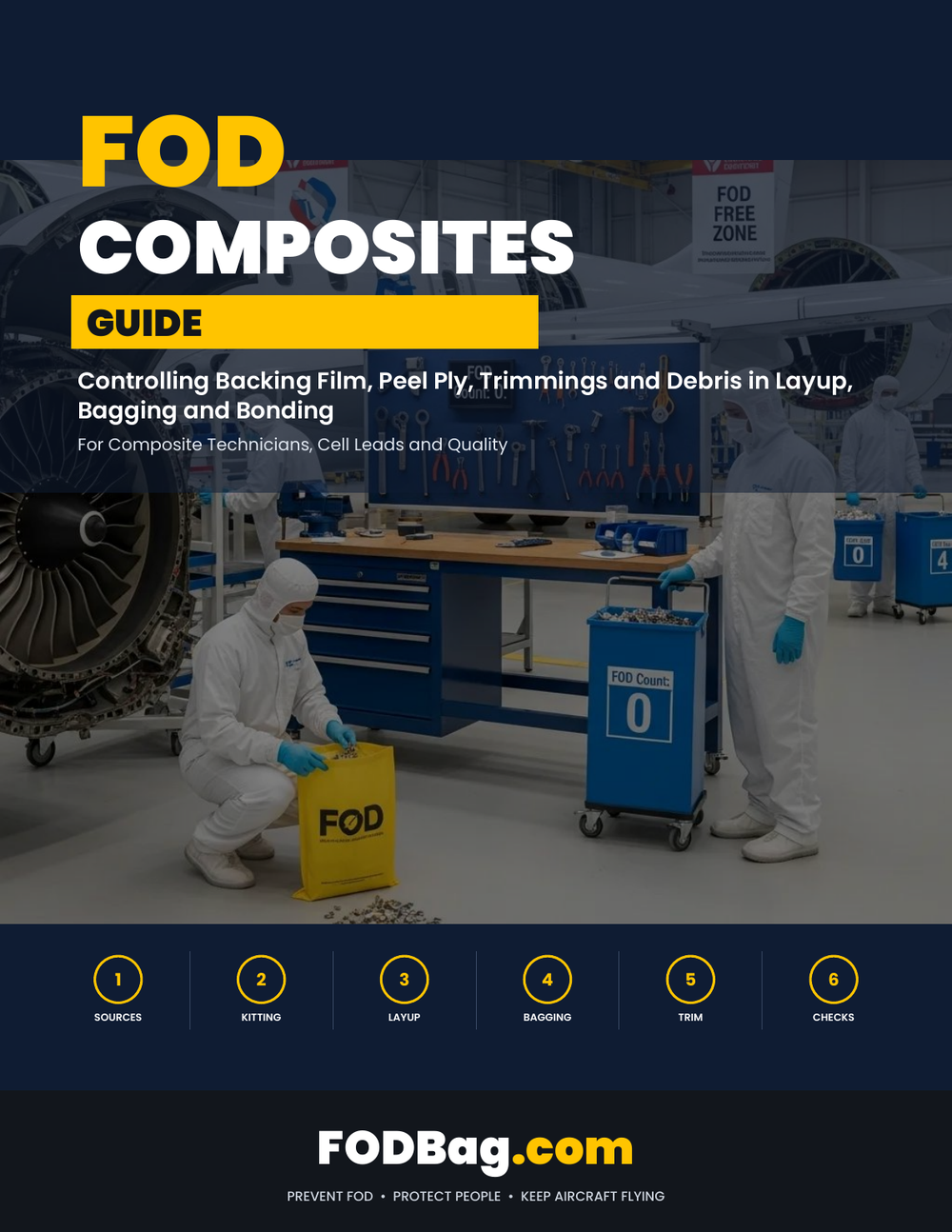
About the Composite Layup and Bonding FOD Control Guide
Reviewed by Trent Powell, Founder, FODBag · Reviewed: November 10, 2026
Quick answer: In composite layup, the classic foreign objects are the process materials themselves: backing film and release paper from prepreg, peel ply and bagging materials, tape, trimmings and gloves. A piece of backing film left between plies is laminated into the part. Control it by kitting materials, removing and collecting every backing piece as it comes off, checking each ply before the next one goes down, and controlling trimming and sanding debris. Follow your process specifications and quality requirements first. That discipline is foreign material exclusion: keeping process materials and debris out of the part and its openings.
Who it is for: Composite technicians, layup and bonding cell leads, quality inspectors and manufacturing engineers.
What’s Inside the Guide
Six sections: FOD sources in composites, kitting, layup, bagging and cure, trimming and finishing, and a printable ply and backing check.
FOD Sources
Kitting
Layup
Bagging and Cure
Trim and Finish
Printable Check
Key Practices From the Guide
A short preview of what the guide covers in depth.
Kit materials by job
Use contrasting backing
Collect backing immediately
Check every ply
Count bagging materials
Control trim debris
How to Use This Guide
- Identify sources with Section 1.
- Set up kitting with Section 2.
- Follow Sections 3 and 4 at the table.
- Use Section 5 and the Section 6 check.
Before You Start
- List process materials per part.
- Set up a backing collection container.
- Agree ply check sign-off with quality.
- Name who owns the cell FOD check.
Forms in the Toolkit
- Ply and Backing Check Sheet (Section 6)
- Bagging Materials Count (Section 6)
By FODBag.com · Updated November 10, 2026
Reviewed by Trent Powell, Founder, FODBag · Reviewed: November 10, 2026
Composite Layup and Bonding FOD Playbook: Count Backing Film, Check Every Ply and Keep Trimmings Out
Quick answer: In composite layup the classic foreign objects are the process materials themselves: backing film, release paper, peel ply, bagging materials, tape, trimmings and gloves. Kit materials, remove and collect every backing piece as it comes off, check each ply before the next goes down, and control trimming and sanding debris, following your process specification.
This playbook is for layup technicians, bonding and cure operators, composite shop leads and quality inspectors. It uses the public IAQG guidance on process debris and protective materials and works a per-ply backing-film reconciliation with checked arithmetic. It does not replace your process specification or the part drawing. The check frequency and counts are FODBag suggestions and invented data.
What the opened sources support
IAQG guidance includes protection against contamination such as plastic material, caps, covers and plugs in product protection, and protection against manufacturing process debris that has risk of affecting product characteristics, such as coatings, paint and machining chips (IAQG SCMH 3.4.2 Rev. D, slides 25 and 26). It expects housekeeping and clean-as-you-go processes with defined intervals (IAQG SCMH 3.4.2 Rev. D, slide 27), and consumables accountability with lost-item reporting (IAQG SCMH 3.4.2 Rev. D, slides 29 and 30). FODBag treats backing film, peel ply and bagging as consumables to account for in the same way.
Controls that fit layup
- Kit materials by job and count the plies and the backing pieces issued.
- Remove each backing piece as the ply goes down and collect it in a lidded container at the table, not on the floor.
- Check each ply before laying the next: look at the surface and the edges.
- Control trimming and sanding debris with collection at the cutting point.
- Keep gloves, tape and bagging materials counted or collected at the end of the job.
Count backing against plies
Each ply that carries backing film should return one backing piece. At set intervals and at the end, the number of backing pieces collected must equal the number of plies laid. A shortfall is a stop: a piece left between plies is laminated into the part and cannot be removed afterwards.
Cure and bag check
Before bagging and cure, inspect the layup, edges and bag area for stray material, then record the check. The method and criteria come from your process specification.
Worked example: backing film reconciliation for a 24-ply layup
This example is illustrative, not a customer case. A 24-ply laminate is laid in three stages. Backing pieces expected equals plies laid; backing pieces collected is counted at each stage:
| Stage | Backing expected | Backing collected | Difference | Result |
|---|---|---|---|---|
| Ply 1 to 8 | 8 | 8 | 0 | Reconciled |
| Ply 9 to 16 | 8 | 8 | 0 | Reconciled |
| Ply 17 to 24 | 8 | 7 | 1 | STOP: 1 backing piece unaccounted for |
| Total | 24 | 23 | 1 |
Check: 8 + 8 + 8 = 24 expected; 8 + 8 + 7 = 23 collected; 24 − 23 = 1. One backing piece is unaccounted for in the third stage, so layup stops: the technician checks the table, the container and the last plies laid before another ply goes down. If the piece cannot be found, the quality representative is notified and the laminate is dispositioned per the process specification. The lesson of the reconciliation is catching it at ply 24, not after cure.
What good looks like
- Materials are kitted and counted, with backing counts recorded.
- Each backing piece is removed and collected as the ply goes down.
- Each ply is checked before the next.
- Trimming and sanding debris is collected at the source.
- Backing collected equals plies laid, or the job stops.
Matching FODBag products and resources
Layup area FOD products: FOD cans; Clear FOD bags; FOD belt pouches; FOD signs; FOD stickers.
About FODBag. FODBag.com, a Powell Pack Products company in Mesa, Arizona, has made FOD bags, FOD tape, FOD stickers, FOD signs, FOD posters, FOD cans and FOD containers since 2016. FOD tape is 2 in × 108 ft and FOD signs start at $29.99. Questions? Call 602-874-1313, Monday–Friday, 9:00 a.m.–5:00 p.m. Arizona time.
Sources opened for this page
- IAQG SCMH 3.4.2 Rev. D, FOD Prevention Program: Guidance in Support of IAQG Standard 9146 (June 19, 2023) — Slides 25, 26, 27, 29 and 30 on product protection, process debris, housekeeping and consumables. Opened and read for this page on November 10, 2026.
Get the Composite Layup and Bonding FOD Control Guide
Enter your details and we will email you the PDF right away.
- 6-page guide (PDF)
- Composite FOD sources
- Layup and bagging controls
- Ply and backing check sheet
Free for internal organizational use. Educational resource from FODBag.com, a Powell Pack Products company. Questions? Call 602-874-1313.
Get the Free Guide
Enter your details and we will email you the PDF of Composite Layup and Bonding FOD Control Guide right away.
Related Reading
Go deeper on the topics in the Composite Layup and Bonding FOD Control Guide.
More Free FOD Prevention Guides
Each guide is free to request and written for aerospace, aviation, MRO and manufacturing teams.
Equip Your FOD Program
Frequently Asked Questions
What is the most common FOD in composite layup?
Process materials such as prepreg backing film and release paper, peel ply, bagging materials, tape, trimmings and glove pieces.
How do you stop backing film being laminated into a part?
Remove each backing piece as the ply is placed, put it straight into a collection container and check the ply surface before the next ply goes down.
Should backing pieces be counted?
For critical parts, many shops reconcile backing pieces against plies placed. Follow your process specification and quality requirements.
How should trimming and sanding debris be controlled?
Contain it at the source with extraction or covers, clean as you go and keep debris away from uncured materials and open assemblies.
Does this guide replace process specifications?
No. Process specifications, engineering and quality requirements always take precedence.
How do you stop backing film from being laminated into a composite part?
Remove each backing piece as the ply goes down, collect it at the table, check each ply before the next, and count backing pieces collected against plies laid. A shortfall stops the job. Follow your process specification for criteria.
Should composite backing pieces be counted?
Yes, count them against the plies laid so a missing piece is caught immediately; FODBag recommends reconciling at set intervals and at the end of the layup. IAQG expects consumables to be accounted for and controlled (SCMH 3.4.2 Rev. D, slide 29).
How do you control trimming and sanding debris in composite work?
Collect it at the cutting or sanding point with extraction or a collection tray, clean the area before the next step, and keep it away from open layups. IAQG names process debris such as coatings and machining chips as a product risk (slide 26).