
FOD Training for Manufacturing: Facilitator Guide
A complete, ready-to-run 60-minute FOD training session for aerospace manufacturing employees, with hands-on exercises, an assessment and a refresher schedule. Get the Free GuideSee What's Inside9
Pages
60
Minute Session
10
Question Assessment
2
Hands-On Exercises
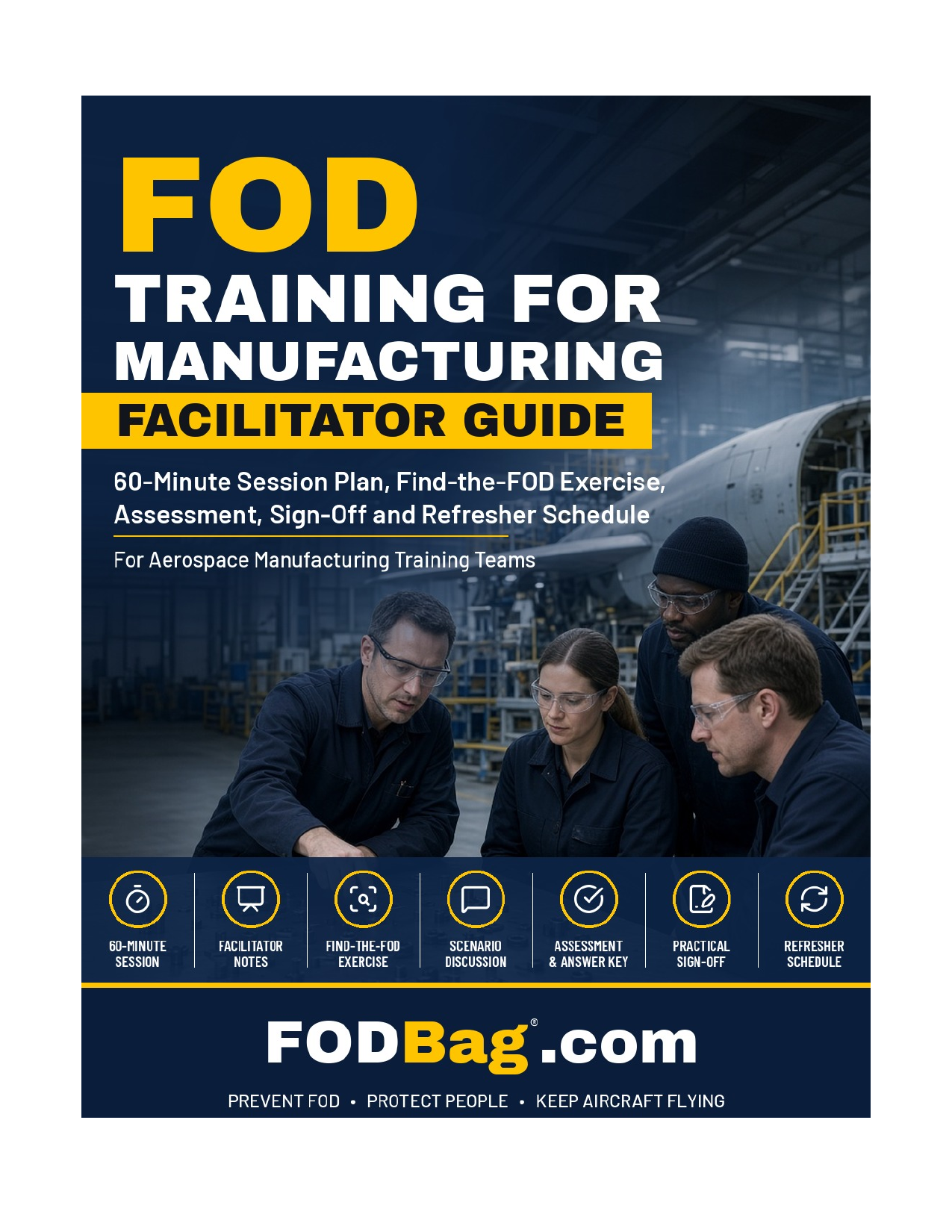
About the FOD Training for Manufacturing: Facilitator Guide
Reviewed by Trent Powell, Founder, FODBag · Reviewed: November 10, 2026
Quick answer: In aerospace manufacturing, FOD means foreign object debris and the foreign object damage it can cause to parts, assemblies and finished aircraft, engines and space hardware. Drill chips in a wire harness, a fastener in a fuel tank or a rag in a duct can turn into rework, an escape to the customer or a safety event. This facilitator guide gives training departments a complete 60-minute FOD training session for manufacturing employees.
Who it is for: Trainers, FOD program managers, production supervisors and quality staff at aerospace manufacturers and suppliers.

What’s Inside the Guide
Eight sections, from learning objectives to a refresher schedule.
Learning Objectives and Audience
60-Minute Session Plan
Facilitator Notes by Module
Hands-On Exercises
Assessment and Practical Sign-Off
Refresher Schedule
Key Practices From the Guide
A short preview of what the guide covers in depth.
Explain FOD in manufacturing terms
Train close to the work
Demonstrate daily controls
Practice product protection and lost item response
Let people find the FOD
Assess and refresh
How to Use This Guide
- Use Section 1 to confirm learning objectives and the audience for each session.
- Use Sections 2 and 3 to run the 60-minute plan with the facilitator notes.
- Use Section 4 to set up the hands-on exercises.
- Use Sections 5 to 7 for the assessment, practical sign-off, training record and refresher schedule.
Before You Start
- Book a training space close to, or with a view of, a real work area.
- Gather ten everyday items or photos for the sorting exercise.
- Prepare a tool kit, FOD bag, FOD container, hardware bag, caps, plugs and covers.
- Set up the find-the-FOD station with a seeded item list.
- Print the assessment, answer key and training record.
- Adapt examples to your products, processes and area designations.
Forms in the Toolkit
- 60-Minute Session Plan and Setup Checklist (Section 2)
- Find-the-FOD Station Seeded Item List (Section 4)
- Knowledge Assessment and Answer Key (Section 5)
- Practical Sign-Off and Training Record (Section 6)
By FODBag.com · Updated November 10, 2026
Reviewed by Trent Powell, Founder, FODBag · Reviewed: November 10, 2026
Manufacturing FOD Facilitator Playbook: What Public Guidance Requires, a 16-Person Cell and a 60-Minute Count
This playbook is for the trainer, FOD program manager or production supervisor about to run the 60-minute session in the downloadable facilitator guide. It sets out what public IAQG guidance in support of AS9146 actually says about a training program, escorts, clean-as-you-go, personal items and tool control; works one 16-person composite-bonding cell through a 60-minute count; and gives a delivery-readiness check. The 60-minute agenda, the 10-question assessment and the annual refresher default are a FODBag suggestion for format and timing, not a published course length.
What the opened public source says a manufacturing training program has to do
IAQG’s public slides tell an organization, in order to comply with the 9146 standard they support, to establish, implement and maintain a FOD Prevention training program commensurate with FOD risk-assessment results: determine initial training criteria and content; identify internal and external personnel training requirements; establish training methods (for example, lecture or electronic); establish recurring training criteria, content and intervals; evaluate training effectiveness (for example, measuring employee competency and FOD/FOd nonconformities); and maintain documented information of training-program compliance (IAQG SCMH 3.4.2 Rev. D, slide 23). The next slide requires provisions so that anyone entering FOD Prevention designated areas has received the required FOD Prevention training or is escorted by trained personnel, including customers, visitors, contractors and infrastructure maintenance staff not typically assigned to the area (slide 24). Those slides do not set a 60-minute class, a 10-question test or an annual interval.
The same guidance is the right vocabulary for a manufacturing room. Slide 5 defines a foreign object (FO) as an alien substance or article — tools, consumables, hardware, product protective devices, personal items, process debris, operations debris or environmental debris — that could enter and migrate into or onto a product or system, become FOd, and potentially cause FOD if it is not removed and controlled. Foreign object debris (FOd) is FO that has already entered and migrated; foreign object damage (FOD) is damage attributed to that debris, expressed in physical or economic terms, that could degrade required safety and performance. The session should use that three-part convention so people can name what they just found on a bench.
Daily-control modules in this guide should also track the manufacturing controls the slides actually list. The organization needs housekeeping and clean-as-you-go processes in all work areas and infrastructure, including cleaning at the completion of work or end of shift, and cleaning product-side operations debris at appropriate intervals — for example after each operation and before the next — with examples that include machining chips, drill shavings, safety-wire remnants, solder balls, tie wraps and hardware remnants (slides 27). It needs processes to account for and control consumables, hardware and personal items, and documented reporting of lost items; personal items include keys, phones, food, pens and company badges (slide 29). It needs a process to account for and control company and personally owned tools, including storage, identification and inventory, location, condition (cleanliness, no broken or missing pieces), and documented reporting of lost tools or broken details (slide 31). Those are the demonstrations the facilitator should put on the table, not a generic lecture.
Worked example: a 16-person composite-bonding cell, one 60-minute refresher
This example is illustrative. It is not a customer case, and it does not claim that AS9146 or NAS 412 requires this timing. The 60-minute split, the class size, the 12-item seed list and the same-session retake are FODBag suggestions.
Cell 2 bonds composite assemblies for a prime contractor. Sixteen people will sit the session this month: 10 technicians assigned to the bonding Control Area, 4 kitting and stores staff who only enter escorted until they are signed off, and 2 leads who will later give toolbox talks. Check: 10 + 4 + 2 = 16. Untrained visitors stay escorted (IAQG slide 24).
The facilitator runs the package’s 60-minute plan as follows: 5 minutes of welcome and local scope; 8 minutes on FO, FOd and FOD and the sources in this cell; 7 minutes walking to the area entry to show signs and markings; 10 minutes demonstrating clean-as-you-go, tool control, hardware control and personal-item rules with a real tool kit, FOD bag and FOD can; 5 minutes on caps, covers and a lost-item scenario; 10 minutes at the find-the-FOD station (including the three-minute search); 8 minutes on the ten-item sorting exercise; and 7 minutes for the 10-question assessment, practical sign-off and close. Addition: 5 + 8 + 7 + 10 + 5 + 10 + 8 + 7 = 60.
Find-the-FOD is seeded with 12 known items: 4 hardware (washer, fastener, safety-wire clipping, nut), 4 process debris (drill chips, a ply scrap, a glove fragment, a peel-ply thread) and 4 personal or tool items (pen cap, badge reel, tape tab, broken tool bit). Check: 4 + 4 + 4 = 12. The 16 people work as 5 pairs and 2 groups of three: 5 × 2 + 2 × 3 = 10 + 6 = 16. After three minutes the class has found 11 of the 12; the missed safety-wire clipping is under a fixture. 11 + 1 = 12, and that missed item becomes the lost-item talk.
On the assessment, 15 of 16 pass on the first try; one person retakes two questions in the same hour and then passes. Completions: 15 + 1 = 16. Each of the 16 also receives a practical sign-off against the cell’s approved demonstration. Records closed this session: 16. Printed packets (assessment plus record) are 2 pages each: 16 × 2 = 32 pages.
The walk-to-the-doorway module needs the actual marks the class will use after the session: FOD signs (from $29.99), FOD floor tape in 2 in × 108 ft rolls, a FOD bag and a FOD can on the demonstration table, and FOD covers for the product-protection module. Those are the props the “Before You Start” list already calls for, not a NASA bill of materials.
Arithmetic recap, all checked: 10 + 4 + 2 = 16 people; 5 + 8 + 7 + 10 + 5 + 10 + 8 + 7 = 60 minutes; 4 + 4 + 4 = 12 seeded items; 5 × 2 + 2 × 3 = 16 in groups; 11 + 1 = 12; 15 + 1 = 16 assessments; 16 × 2 = 32 pages.
Delivery-readiness check (illustrative)
This six-point check is a FODBag suggestion for the facilitator the morning of the class, not a published audit list.
| Check | Pass if | Fail / action |
|---|---|---|
| The 60 minutes add up, or your actual plan adds up | 5 + 8 + 7 + 10 + 5 + 10 + 8 + 7 = 60, and both hands-on exercises are still on the clock. | A lecture that drops the find-the-FOD station to “save time”: restore the exercises (this package). |
| The room is close to real work, and the doorway walk is possible | Signs and floor marks are already up, and the class can walk to them. | A windowless classroom with no marks: move the session or hang the signs first. |
| The seeded list is known only to the facilitator | 12 items are placed and written down before anyone enters, and the count is 4 + 4 + 4 = 12. | An unlisted station: write the list; otherwise you cannot score the find. |
| Untrained people are not already alone in the cell | Escort rules hold until the record is signed (IAQG slide 24). | New kitting staff already unescorted: hold access until the sign-off exists. |
| A written score is not treated as competence | Each record has the 10-question result and a practical sign-off (IAQG slide 23). | A quiz-only close: add the demonstration before you file the record. |
| Recurring training is written, not assumed | The refresher interval and the triggers (area change, event, new process) are in the procedure. Annual is a FODBag default, not a published number. | “We trained everyone once”: set the interval the same week (IAQG slide 23). |
Where to go next
The downloadable Facilitator Guide on this page holds the 60-minute session plan, facilitator notes, both exercises, the 10-question assessment and answer key, the practical sign-off, the training record and the refresher schedule. Request it with the form below. A related employee-facing package is the FOD Training Guide and Employee Handout. For a map of the paid standard this public guidance supports, see the AS9146 Requirements Guide and the NAS 412 FOD Compliance Guide — both describe those standards without reproducing them. For the demonstration props, shop FOD signs (from $29.99), FOD floor tape in 2 in × 108 ft rolls, FOD bags, FOD cans and FOD covers. Questions? Call FODBag at 602-874-1313, Monday–Friday, 9:00 a.m.–5:00 p.m. America/Phoenix.
Sources and how we used them
- IAQG SCMH 3.4.2 Rev. D, FOD Prevention Program: Guidance in Support of IAQG Standard 9146 (June 19, 2023) — Slides 5 (FO, FOd and FOD definitions used in this session), 23–24 (establish, implement and maintain a FOD Prevention training program commensurate with the FOD risk assessment, including initial criteria and content, internal and external personnel, methods, recurring criteria and intervals, evaluation of effectiveness, and documented information of compliance; provisions so that anyone entering designated areas has received required training or is escorted, including customers, visitors, contractors and infrastructure maintenance), 27 (housekeeping and clean-as-you-go, including interval examples and operations-debris examples), 29 (accountability and control of consumables, hardware and personal items, and reporting of lost items) and 31 (tool accountability and control, including storage, identification, location, condition, and reporting of lost tools or broken details). Slide numbers are the footer numbers in the PDF. Free public document, read from the copy saved under sources/. The slides we read do not set a 60-minute class, a 10-question assessment, or an annual interval. Accessed for this page Nov. 10, 2026.
AS9146 and NAS 412 are paid documents and are not reproduced or quoted here, and no clause numbers from them are cited. The 60-minute agenda, the 12-item seed list, the class grouping, the same-session retake, and the six-point delivery-readiness check are FODBag instruments described in this playbook; they are not published standard requirements. The worked example is illustrative and is not a customer case.
Get the FOD Training for Manufacturing: Facilitator Guide
Enter your details and we will email you the PDF right away.
- 9-page facilitator guide (PDF)
- 60-minute session plan with facilitator notes
- Find-the-FOD exercise and 10-question assessment
- Practical sign-off, training record and refresher schedule
Free for internal organizational use. Educational resource from FODBag.com, a Powell Pack Products company. Questions? Call 602-874-1313.
Get the Free Guide
Enter your details and we will email you the PDF of FOD Training for Manufacturing: Facilitator Guide right away.
Related Reading
Go deeper on the topics in the FOD Training for Manufacturing: Facilitator Guide.
More Free FOD Prevention Guides
Each guide is free to request and written for aerospace, aviation, MRO and manufacturing teams.
Equip Your FOD Program
Frequently Asked Questions
What does FOD mean in manufacturing?
In aerospace manufacturing, FOD means foreign object debris and the foreign object damage it can cause to parts, assemblies and finished aircraft, engines and space hardware. Many manufacturers use the FO, FOd and FOD convention.
How long should FOD training for manufacturing be?
The facilitator guide runs a complete session in 60 minutes, including two hands-on exercises, a knowledge assessment and a practical sign-off.
What is a find-the-FOD exercise?
A realistic work surface seeded with a known list of items. Groups of two or three get three minutes to find and record as many items as they can, then compare with the seeded list.
How often should FOD prevention in manufacturing training be refreshed?
Annually or at the interval your procedure sets, and with targeted sessions when someone moves to a higher area level, after a FOD event or escape, or when a process, product or layout changes.
Who should receive manufacturing FOD training?
New production employees before unescorted work in FOD-designated areas, experienced employees as an annual refresher, and supervisors and leads who then deliver monthly toolbox talks.
Does AS9146 or NAS 412 require a 60-minute FOD training class?
We have not opened those paid standards and do not cite them by clause. IAQG SCMH 3.4.2 Rev. D, slide 23, which is public guidance in support of AS9146, tells an organization to establish training methods and to set initial and recurring criteria, content and intervals commensurate with its FOD risk assessment. It does not publish a session length. The 60-minute plan in this facilitator guide is a FODBag suggestion.
Do visitors and contractors need the same 60-minute session before they enter a designated area?
IAQG SCMH 3.4.2 Rev. D, slide 24, says the organization needs provisions so that anyone entering FOD Prevention designated areas has received the required FOD Prevention training or is escorted by trained personnel, including customers, visitors, contractors and infrastructure maintenance staff not typically assigned to the area. Your procedure decides whether that required training is this 60-minute class, a shorter briefing, or an escort-only rule.
Does the 10-question assessment prove an employee is competent?
No. A written assessment supports learning. IAQG slide 23 tells the organization to evaluate training effectiveness, for example by measuring employee competency and FOD/FOd nonconformities, and to keep documented information of training-program compliance. This package pairs the 10-question assessment with a practical sign-off. Completing the class does not authorize work beyond the employee's assigned role.