
FOD Prevention Procedure (SOP) Template
A complete, drafted FOD prevention procedure you can adapt: daily controls, before close-up and operation checks, found-FOD response and missing item response. Get the Free GuideSee What's Inside10
Pages
14
Sections
6
Missing Item Steps
1
Missing Item Report Form
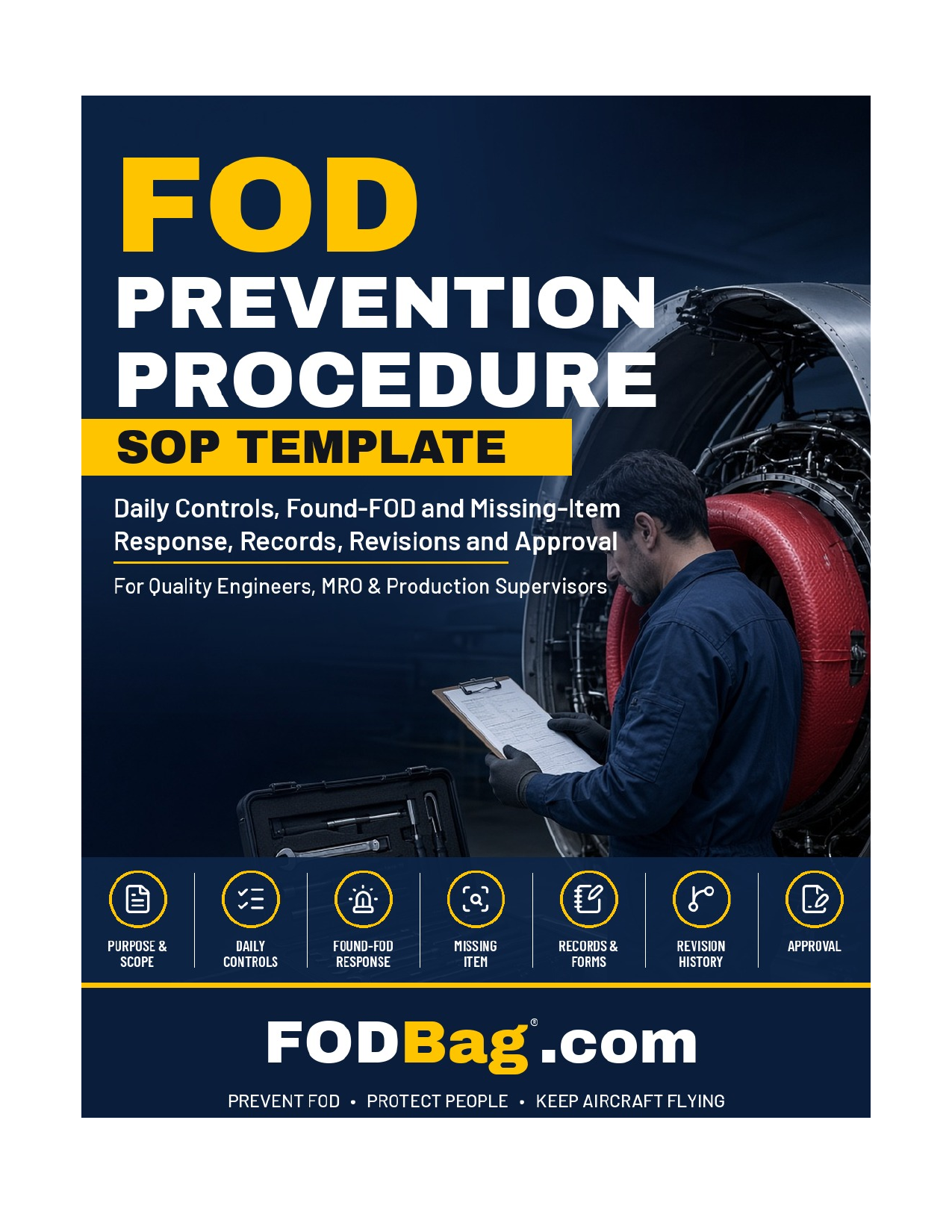
About the FOD Prevention Procedure (SOP) Template
Reviewed by Trent Powell, Founder, FODBag · Reviewed: November 10, 2026
Quick answer: A FOD prevention procedure, or standard operating procedure (SOP), tells people exactly what to do every day to keep foreign object debris out of products, aircraft and engines, and what to do when FOD is found or an item goes missing. This template is a complete, drafted SOP. Text in square brackets is for you to replace; the rest is written so it can be used with minimal editing if it matches your practice.
Who it is for: Quality engineers, FOD program managers, MRO and production supervisors, and document control staff.
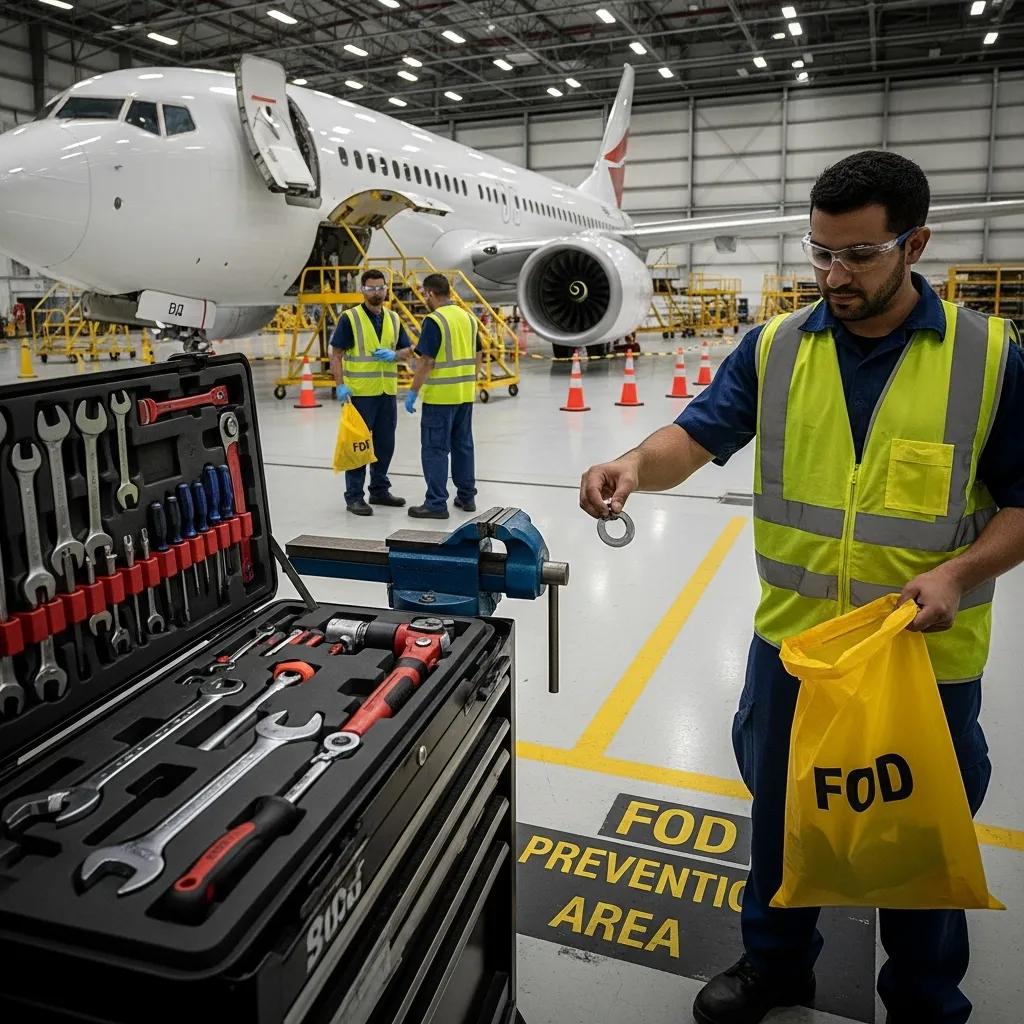
What’s Inside the Guide
Fourteen sections, from the SOP header to a missing item report form.
SOP Header, Purpose and Scope
References, Definitions and Responsibilities
Daily FOD Controls
Before Close-Up and Before Operation
Found-FOD and Missing Item Response
Records, Training and Approval
Key Practices From the Guide
A short preview of what the guide covers in depth.
Confirm every step matches what people actually do
Keep the SOP focused on daily controls and response
Start every shift the same way
Do not close up with anything unaccounted for
Respond to found FOD in a fixed order
Treat a missing item as a stop-work event
How to Use This Guide
- Use Sections 1 to 5 to complete the header, scope, references, definitions and responsibilities.
- Use Sections 6 and 7 for daily controls and checks before close-up and before operation.
- Use Sections 8 and 9 for the found-FOD and missing item response steps.
- Use Sections 10 to 13 for records, training, revision history and approval, and the missing item report form.
Before You Start
- Confirm the SOP number, owner and approver in your document control system.
- List the sites, buildings, lines and hangars the procedure covers.
- Replace bracketed text with your form numbers, roles and time limits.
- Walk each step with the people who perform it.
- Decide who gives disposition after a missing item search.
- Train affected employees before the effective date.
Forms in the Toolkit
- Missing Item Report Form (Section 13)
- Records and Forms List (Section 10)
- Revision History and Approval Block (Section 12)
- Responsibilities Table (Section 5)
By FODBag.com · Updated November 10, 2026
Reviewed by Trent Powell, Founder, FODBag · Reviewed: November 10, 2026
FOD Prevention SOP Playbook: Write Steps People Follow and Prove They Followed Them
Quick answer: A FOD prevention SOP tells people exactly what to do each shift and what to do when an item goes missing. Write short numbered steps with one owner each, state the stop rule (nothing is closed up or released while an item is unaccounted for), set a search time limit, define the records, and review the procedure on a schedule.
This playbook is for quality engineers, FOD program managers, MRO and production supervisors and document control staff who write or revise a FOD procedure. It draws on public IAQG guidance and NASA MSFC-STD-3598 Rev. D (a flight-hardware standard used here as a reference model) and works a missing-item timeline with checked arithmetic. The step wording and the example are FODBag suggestions and invented data, not requirements; your quality system, customer flow-down and approved data govern.
What the opened sources say a procedure should do
IAQG guidance expects operations processes to be established, with inspection and detection at appropriate steps (IAQG SCMH 3.4.2 Rev. D, slide 20), housekeeping and clean-as-you-go processes with intervals (IAQG SCMH 3.4.2 Rev. D, slide 27), and tool control that knows where tools are at all times and reports lost tools (IAQG SCMH 3.4.2 Rev. D, slide 31). NASA’s lost-tool procedure is a good model for the missing-item section: the employee notifies the supervisor immediately; work stops and a search starts; if the item is not found within 1 hour a report is recorded; items known to be inside hardware stay open until retrieved, with quality assurance notified; and no discipline follows when a lost item is reported immediately, unless losses are repetitive and careless or controls were circumvented (NASA MSFC-STD-3598 Rev. D, 5.12.3.4 a to e).
Structure of a usable SOP
- Header: title, number, revision, effective date, owner, approver.
- Purpose and scope: what it prevents and who and what areas it covers, including contractors and visitors.
- Definitions: use the same terms as the rest of your quality system.
- Responsibilities: one line per role.
- Daily steps: start-of-shift checks, tool and hardware control, consumables, personal items, housekeeping, end-of-shift counts.
- Stop rule: equipment is not closed up, run or released while any tool or item is unaccounted for.
- Missing item response: numbered steps with a search time limit.
- Records and training: what is recorded, where it is kept and who must be trained.
- Revision history and approval.
Write steps, not paragraphs
Use one action per step, an owner, and a verb first: “Count tools against the kit list and sign the log.” Put the stop rule where people cannot miss it. Avoid “as appropriate” language that cannot be audited. Test the draft by having someone who did not write it follow it on the floor.
Records and review
List each record the SOP creates, such as tool counts, missing item reports, walk-down logs and training sign-offs, with retention. Review the SOP when findings repeat, when work changes and at a set interval, and record the revision.
Worked example: a missing tool, minute by minute
This example is illustrative, not a customer case. A technician finishes a task and counts a 42-tool kit at 13:30: 41 are present, so 42 − 41 = 1 tool is missing.
| Time | Event | Check |
|---|---|---|
| 13:30 | End-of-task kit count: 41 of 42 tools present | Difference of 1 found |
| 13:30 | Stop work; notify supervisor | Step 1 and 2 of the missing item response |
| 13:40 | Search starts; clock starts | Limit for formal report = 13:40 + 1 hour = 14:40 |
| 14:25 | Tool found in the toolbox lining | 45 minutes elapsed (14:25 − 13:40); under the 60-minute limit |
| 14:30 | Kit recount 42 of 42; closed in the log | Equipment may be closed up |
Check: search starts at 13:40; the 60-minute limit ends at 14:40; the tool was found at 14:25, which is 45 minutes into the search, so no formal lost-tool report was needed (a formal report starts at 60 minutes in the NASA model). If it had not been found by 14:40, the SOP would require the report, an interview of the person who reported it, and a wider search. In every case, no one closed up or released the equipment until the count showed 42 of 42.
What good looks like
- The SOP has a header, purpose, scope, owner and approval.
- Steps are numbered, one action each, with an owner.
- The stop rule and the search time limit are written.
- Records are listed with retention, and training is defined.
- The procedure was tested by someone who did not write it and is reviewed on a schedule.
Matching FODBag products and resources
Floor tools that make the SOP steps easy to follow: FOD tool and hardware control signs; FOD tool bags; FOD stickers; FOD cans; FOD floor tape (2 in × 108 ft).
About FODBag. FODBag.com, a Powell Pack Products company in Mesa, Arizona, has made FOD bags, FOD tape, FOD stickers, FOD signs, FOD posters, FOD cans and FOD containers since 2016. FOD tape is 2 in × 108 ft and FOD signs start at $29.99. Questions? Call 602-874-1313, Monday–Friday, 9:00 a.m.–5:00 p.m. Arizona time.
Sources opened for this page
- IAQG SCMH 3.4.2 Rev. D, FOD Prevention Program: Guidance in Support of IAQG Standard 9146 (June 19, 2023) — Slides 20, 27 and 31 on operations, housekeeping and tool accountability. Opened and read for this page on November 10, 2026.
- NASA MSFC-STD-3598 Rev. D, Standard for Foreign Object Damage/Foreign Object Debris (FOD) Prevention (effective July 26, 2021) — Section 5.12.3.4 a to e on lost tool and item procedures. Opened and read for this page on November 10, 2026.
Get the FOD Prevention Procedure (SOP) Template
Enter your details and we will email you the PDF right away.
- 10-page SOP template (PDF)
- Drafted daily FOD controls and start-of-shift steps
- Found-FOD and missing item response
- Missing item report form and approval block
Free for internal organizational use. Educational resource from FODBag.com, a Powell Pack Products company. Questions? Call 602-874-1313.
Get the Free Guide
Enter your details and we will email you the PDF of FOD Prevention Procedure (SOP) Template right away.
Related Reading
Go deeper on the topics in the FOD Prevention Procedure (SOP) Template.
More Free FOD Prevention Guides
Each guide is free to request and written for aerospace, aviation, MRO and manufacturing teams.
Equip Your FOD Program
Frequently Asked Questions
What is a FOD procedure?
A FOD prevention procedure, or SOP, tells people exactly what to do every day to keep foreign object debris out of products, aircraft and engines, and what to do when FOD is found or an item goes missing.
What is the difference between a FOD prevention plan and a FOD procedure?
The plan holds program-level content such as objectives, area classification and review cycles. The procedure focuses on daily controls and the response when FOD is found or an item is missing.
What should a FOD control procedure include?
Purpose, scope, references, definitions, responsibilities, daily controls, checks before close-up and operation, found-FOD response, missing item response, records, training, revision history and approval.
What should you do if a tool is missing before close-up?
Do not close up, run or release the equipment. Follow the missing item response: stop, search, document the result on the missing item report form and obtain disposition before release.
Is the FOD procedure template a PDF?
Yes. The template is a 10-page PDF with drafted text and bracketed fields to replace with your own form numbers, roles and time limits.
What should a FOD prevention SOP include?
A header with owner and approval, purpose and scope, definitions, responsibilities, daily steps, a stop rule, a missing item response, records and training, and a revision history. IAQG guidance expects defined operations, housekeeping and tool accountability processes (SCMH 3.4.2 Rev. D, slides 20, 27 and 31).
How long should you search for a missing tool before reporting it?
NASA MSFC-STD-3598 Rev. D, section 5.12.3.4, starts a formal lost tool report if the item is not found within 1 hour of searching, and stops work as soon as a tool is reported missing. Set your own limit in your SOP from your risk.
Should people be disciplined for reporting a missing tool?
NASA says no disciplinary action as long as the loss is reported immediately, except for repetitive and careless losses or deliberate circumvention of tool control (MSFC-STD-3598 Rev. D, section 5.12.3.4 c). A no-blame reporting rule encourages prompt reports.