
FOD Prevention Program Charter and Kickoff Pack
The documents leadership needs to launch or relaunch a foreign object damage prevention program with authority and structure: a charter, a steering team, a kickoff and a first 30-day plan. Get the Free GuideSee What's Inside11
Pages
10
Sections
75
Minute Kickoff Agenda
30
Day Action Plan

About the FOD Prevention Program Charter and Kickoff Pack
Reviewed by Trent Powell, Founder, FODBag · Reviewed: November 10, 2026
Quick answer: A FOD Prevention Program is the organized set of policies, responsibilities, controls, training, inspections, records and reviews an organization uses to prevent foreign objects from damaging its products, aircraft, systems and people. It is not a single procedure or an annual FOD walk. It is a management system with an owner, objectives and evidence, and it succeeds or fails in its first weeks.
Who it is for: Accountable managers, general managers, quality and safety directors, operations leaders, and the person who will be appointed FOD program manager or FOD focal point.
What’s Inside the Guide
Ten sections, from what a FOD prevention program is to a launch readiness checklist.
What a FOD Prevention Program Is
Leadership Decisions Before Launch
FOD Prevention Program Charter Template
Steering Team and Responsibility Matrix
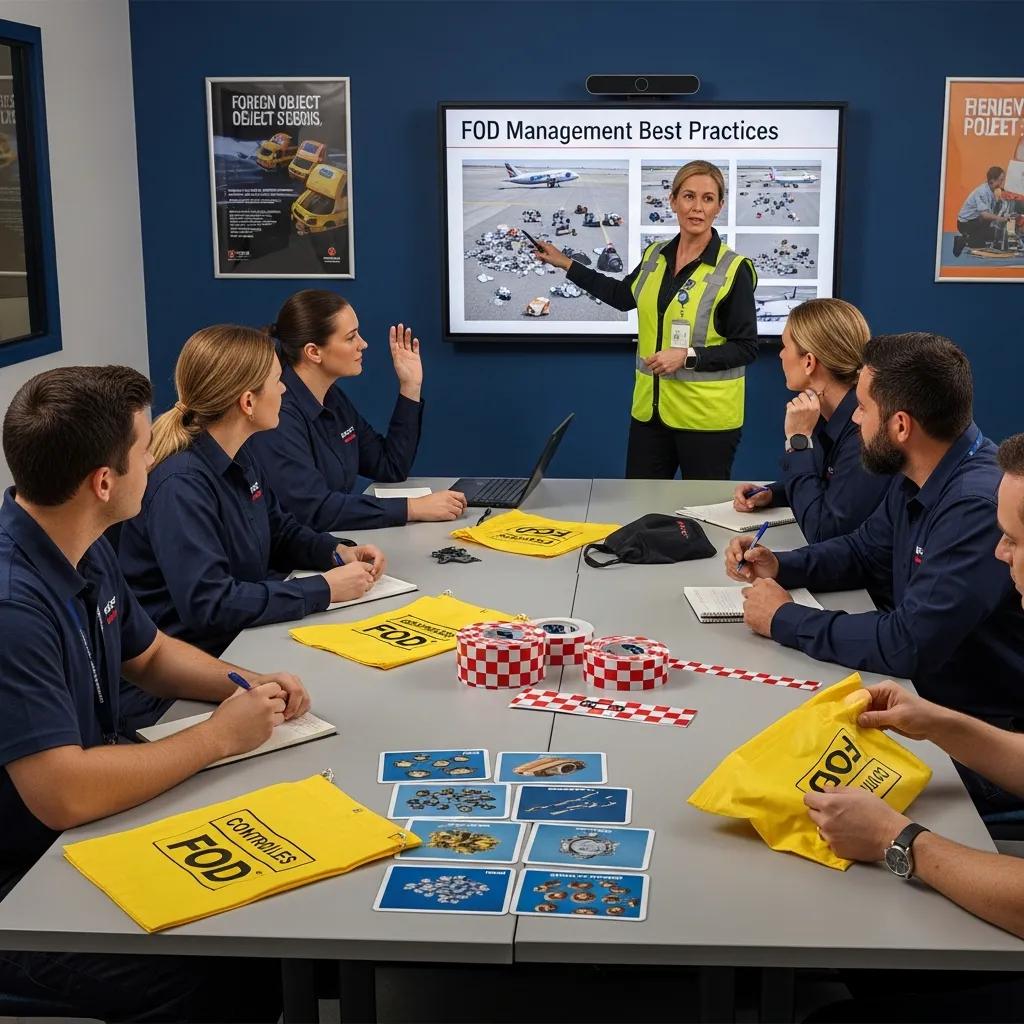
Kickoff Meeting and Briefing
30-Day Plan, Communication and Readiness
Key Practices From the Guide
A short preview of what the guide covers in depth.
Launch a program, not a campaign
Decide before you kick off
Put authority in the charter
Have the executive sponsor open and close the kickoff
Give every action an owner and a date
Plan what the floor hears
How to Use This Guide
- Use Sections 1 and 2 to agree what the program is and make the leadership decisions.
- Use Sections 3 and 4 to complete the charter and name the steering team and owners.
- Use Sections 5 and 6 to run the kickoff meeting and build the briefing.
- Use Sections 7 to 9 for the first 30 days, communication to the floor and the launch readiness check.
Before You Start
- Name the executive sponsor who will chair the periodic review.
- Appoint the FOD program manager or focal point and allocate their time.
- Define the sites, buildings, hangars, ramps, lines and contractors in phase one.
- List the customer, contract, regulatory and standard requirements that apply.
- Set 90-day and 12-month objectives and how they will be measured.
- Decide the program manager’s authority, including stop-work authority.
Forms in the Toolkit
- FOD Prevention Program Charter Template (Section 3)
- Steering Team Roster and Responsibility Matrix (Section 4)
- Kickoff Meeting Agenda and Briefing Outline (Sections 5 and 6)
- First 30-Day Action Plan (Section 7)
- Communication Plan and Launch Readiness Checklist (Sections 8 and 9)
By FODBag.com · Updated November 10, 2026
Reviewed by Trent Powell, Founder, FODBag · Reviewed: November 10, 2026
FOD Program Charter and Kickoff Playbook: What the Sources Require, a 75-Minute Agenda and a 30-Day Count
This playbook is for the accountable manager and the person about to be named FOD program manager or focal point. It sets out what a NASA standard, an FAA advisory circular and IAQG public guidance actually say about a written program, a named owner and a formal policy; works one 40-person hangar campus through a 75-minute kickoff and a four-week first month; and gives a launch-readiness check. The fill-in charter, the 75-minute agenda and the 30-day calendar in the downloadable pack are a FODBag suggestion for format and timing, not a published template.
What the published sources say about a written program, a named owner and a formal start
NASA requires each flight-hardware project to develop a written Project FOD control program that includes twelve basic elements: a Project FOD Focal Point; identification of FOD-sensitive hardware; early design consideration for FOD prevention; manufacturing, assembly, test and operations planning; designation and control of FOD Sensitive Areas; housekeeping; control of tools, hardware, consumables and personal items; control of hazardous material; FOD prevention training; measuring techniques for analysis, trending and feedback; incident investigation, reporting and lessons learned; and employee awareness and feedback (NASA MSFC-STD-3598 Rev. D, paragraph 4.2(a)–(l)). Hardware that is FOD sensitive shall be listed in that program document (4.1.4). That is a written program with a named focal point, not a poster campaign.
IAQG’s public guidance lists eight primary elements of a FOD prevention program: program management, operations, area designation, training and personnel access, product protection, housekeeping and clean-as-you-go, accountability and control of consumables, hardware and personal items, and tool accountability and control (IAQG SCMH 3.4.2 Rev. D, slide 10). The next slide describes a process approach and risk-based thinking, with a Plan-Do-Check-Act loop: establish the scope of the program through a FOD risk assessment, implement the applicable elements, maintain them, and report metrics and take action to improve (slide 11). To comply with the standard it supports, the organization needs to demonstrate leadership and commitment by providing support and necessary resources, including setting expectations, providing resources and authority for the FOD Prevention Program management representative, fostering a FOD-prevention culture through employee engagement, and listening to and acting on employee concerns. It also needs to designate a FOD Prevention Program management representative with the responsibility and authority for establishment, implementation and maintenance of the program (slide 12).
The FAA circular, which applies to airport FOD management, says a successful FOD management program typically contains four main areas: prevention (awareness, including existence of the program and management support; training and education; maintenance), detection, removal, and evaluation (data collection and analysis, and continuous improvement, including trending, feedback and incident investigation) (AC 150/5210-24A, paragraph 2.3.2.1 and Figure 2-1). Management’s commitment to FOD prevention should be formally expressed in a statement of the organization’s FOD policy; that statement will serve to formally establish the FOD management program, and posting it in conspicuous locations will help reinforce the commitment and remind employees of their duties. Key elements of an airport’s FOD policy, the AC says, include an outline of the methods and processes the organization will use to achieve desired safety outcomes, and the organization’s policy concerning responsibility and accountability (3.1.2.1). Airport operators should designate an accountable staff member to manage the airport’s FOD programs; that person can be a dedicated FOD manager or can have other duties (3.1.2.2.1).
| Decision or artifact | What the sources we read actually say | What this pack adds (FODBag suggestion) |
|---|---|---|
| Written program | NASA 4.2: a written Project FOD control program with twelve elements. IAQG slides 10–11: eight primary elements, scoped by a risk assessment. | An 11-page kickoff pack and a fill-in charter template. |
| Named owner | NASA 4.2(a): a Project FOD Focal Point. IAQG slide 12: a management representative with responsibility and authority, plus resources. FAA 3.1.2.2.1: an accountable staff member, dedicated or not. | The title “program manager” and a named executive sponsor who opens and closes the kickoff. |
| Formal start / policy | FAA 3.1.2.1: a formal policy statement that establishes the airport program, posted in conspicuous locations, covering methods and accountability. | The charter signature block and a 75-minute kickoff with all supervisors in scope. |
| How the program is organized | FAA 2.3.2.1: four typical airport areas. NASA 4.2: twelve elements. IAQG slide 10: eight elements. | Using the FAA four-area list inside a hangar or shop. Do not treat that as an FAA hangar rule. |
| First-month calendar | Not timed in the paragraphs we read. IAQG slide 11 is a Plan-Do-Check-Act loop, not a 30-day schedule. NASA 5.12 requires metrics once the program is running. | The week-by-week 30-day action plan in this pack, including the baseline walk in week one. |
Worked example (illustrative): kicking off a 40-person hangar campus
This is an illustrative example. The roster, the bay count, the agenda times and the equipment quantities are invented to show the arithmetic. Your risk assessment, contract and written program set the real list. The setting is a single hangar campus with 40 people in scope and four bays (Bay 1 through Bay 4).
- Make the leadership decisions and write them down before the meeting. Name an executive sponsor (FODBag suggestion) and a program manager / focal point who has time and authority (NASA 4.2(a); IAQG slide 12; FAA 3.1.2.2.1). Define phase-one scope as the four bays and the people who work in them (40 people). List the requirements that actually apply. Set a 90-day objective (in this example: a completed baseline, classified bays, and a first month of walk-completion metrics) and a 12-month objective. Decide whether the program manager can stop work. Sign the charter. That signed page is this pack’s way of doing what FAA 3.1.2.1 calls a formal policy statement; if your quality system already has a policy document, use that document and treat the charter as a launch record, not a second conflicting policy.
- Run a 75-minute kickoff that actually adds to 75. The pack’s duration is a FODBag suggestion. A timing that checks: 10 minutes, sponsor opening and the policy statement; 15 minutes, what the program is and which source list you are using (FAA four areas, NASA 4.2, or IAQG eight elements — pick the one that binds you); 15 minutes, charter, roles and the program manager’s authority; 15 minutes, the first 30-day plan and who owns each week; 15 minutes, questions from the supervisors; 5 minutes, sponsor close and the date of the first weekly review. Check: 10 + 15 + 15 + 15 + 15 + 5 = 75. Invite the steering team and all supervisors in scope. Opening and closing by the sponsor is a FODBag suggestion for making management support visible, which FAA 3.1.2.1 and IAQG slide 12 both emphasize.
- Walk the first 30 days with counts you can check. Week 1: charter signed, kickoff held, one baseline walk of all four bays (4 bays in one walk). Week 2: classify the four bays in writing (in this example, 1 Critical, 2 Control, 1 Awareness, which is a FODBag-suggested split, not a NASA quota: 1 + 2 + 1 = 4), post a sign at each bay entrance (4 signs; FODBag FOD signs are offered from $29.99), and mark entrances with FOD floor tape in 2 in × 108 ft rolls. If each of the four entrances gets a 20 ft line, that is 4 × 20 = 80 ft, which is less than one roll (80 < 108), with 28 ft unused. Week 3: place 6 FOD cans (one in each bay and one each at the tool crib and the apron door: 4 + 2 = 6) and brief all 40 people in four sessions of 10 (4 × 10 = 40). Week 4: start the daily checks and collect the first walk-completion and findings figures for the monthly review. Hold a short weekly status review all four weeks (a FODBag cadence, not a NASA interval).
| Item | Count or time | How it is built | Source of the method |
|---|---|---|---|
| People in scope | 40 | Given in the example | Your written scope (IAQG slide 11: establish scope through a risk assessment) |
| Kickoff length | 75 minutes | 10 + 15 + 15 + 15 + 15 + 5 = 75 | FODBag agenda; not a published duration |
| Bays classified in week 2 | 4 (1 + 2 + 1) | 1 Critical + 2 Control + 1 Awareness, illustrative only | NASA 5.1 classes; the split is not a quota |
| Entrance signs | 4 | One per bay | FODBag first-month action; signs from $29.99 |
| Entrance tape | 80 ft, one 2 in × 108 ft roll | 4 × 20 = 80; 80 < 108, remainder 28 ft | FODBag layout; NASA does not require this footage |
| FOD cans placed | 6 | 4 bays + crib + apron door = 6 | FODBag first-month action |
| Briefings | 4 sessions of 10 = 40 people | 4 × 10 = 40 | FODBag way to reach everyone in scope |
| Baseline walk | 1 walk of 4 bays in week 1 | All bays, once, in week 1 | FODBag 30-day plan |
Check the arithmetic before you copy the method: 10 + 15 + 15 + 15 + 15 + 5 = 75; 1 + 2 + 1 = 4; 4 × 20 = 80 and 80 < 108; 4 + 2 = 6; 4 × 10 = 40.
Launch-readiness check (illustrative)
This six-point check is a FODBag suggestion for the sponsor and the program manager the morning of kickoff, not a published audit list.
| Check | Pass if | Fail / action |
|---|---|---|
| A written program or charter exists and is signed | The page names the owner, the scope, the objectives and the authority, and it is signed. | An unsigned draft: finish the signatures before you call the kickoff a launch (FAA 3.1.2.1; NASA 4.2). |
| The owner has time and authority | The program manager / focal point is named, and stop-work or equivalent authority is written down if your program grants it. | A name with no hours and no authority: fix it before week 2 (IAQG slide 12; FAA 3.1.2.2.1). |
| The source list is stated | The charter says whether you are working to the FAA four areas, NASA 4.2, IAQG’s eight elements, or a customer list. | Two conflicting lists on the wall: pick the binding one and take the other down. |
| The kickoff timing adds to 75, or to the length you actually planned | The agenda times are written and sum correctly (here, 75). | A meeting with no close, or a sponsor who is not coming: reschedule rather than launch quietly. |
| The first 30 days have owners and counts | Weeks 1–4 each have a named owner and a checkable output (walk, signs, briefings, first metrics). | A month that only says “stand up the program”: add the counts before kickoff. |
| The floor will be able to see the start | You know where the policy or charter will be posted (FAA 3.1.2.1: conspicuous locations) and who will brief the 40 people. | A signed charter in a drawer only: post it and put the briefings on the calendar. |
Where to go next
The downloadable Charter and Kickoff Pack on this page holds the fill-in charter, the 75-minute agenda, the 30-day plan and the launch-readiness checklist. Request it with the form below. The week-by-week work in month one is spelled out in more detail in the 30-day FOD program implementation plan. For the first physical controls, shop FOD signs (from $29.99), FOD floor tape in 2 in × 108 ft rolls, and FOD cans so the containers you promised in week 3 are actually on the floor. Questions about matching signs, tape or cans to a first-month plan? Call FODBag at 602-874-1313, Monday–Friday, 9:00 a.m.–5:00 p.m. America/Phoenix.
Sources and how we used them
- NASA MSFC-STD-3598 Rev. D, Standard for FOD Prevention (effective July 26, 2021) — Paragraphs 4.1.4 (FOD-sensitive hardware listed in the program document), 4.2 and 4.2(a)–(l) (written Project FOD control program and the twelve basic elements, including a Project FOD Focal Point), and 5.1 (area classes, used only to label an illustrative four-bay split). Free public PDF, read from the copy saved under sources/. Those paragraphs do not set a 75-minute kickoff, a 30-day calendar, or a required charter template. Accessed for this page Nov. 10, 2026.
- FAA Advisory Circular 150/5210-24A, Airport Foreign Object Debris (FOD) Management (February 8, 2024; updated by errata May 20, 2024) — Paragraphs 2.3.2.1 and Figure 2-1 (four typical areas of an airport FOD management program: prevention, detection, removal, evaluation), 3.1.2.1 (formal policy statement that establishes the program; post it; methods and accountability), and 3.1.2.2.1 (designate an accountable staff member, dedicated or with other duties). Free public PDF, opened from the official FAA copy saved under sources/FAA_AC_150_5210_24A.txt. This AC is airport guidance, not a hangar or factory standard. Accessed for this page Nov. 10, 2026.
- IAQG SCMH 3.4.2 Rev. D, FOD Prevention Program: Guidance in Support of IAQG Standard 9146 (June 19, 2023) — Slides 10–12 (eight primary elements; process approach and risk-based thinking; Plan-Do-Check-Act, including establish scope through a FOD risk assessment and report metrics; leadership and commitment, resources and authority, and a designated management representative). Slide numbers are the footer numbers in the PDF. Free public document, read from the copy saved under sources/. The slides we read do not set a kickoff length or a 30-day calendar. Accessed for this page Nov. 10, 2026.
AS9146 and NAS 412 are paid documents and are not reproduced or quoted here, and no clause numbers from them are cited. The fill-in charter, the 75-minute agenda, the executive-sponsor role, and the 30-day calendar are FODBag instruments described in this pack; they are not published standard requirements. The worked example is illustrative and is not a customer case.
Get the FOD Prevention Program Charter and Kickoff Pack
Enter your details and we will email you the PDF right away.
- 11-page kit (PDF)
- FOD prevention program charter template
- 75-minute kickoff agenda and briefing outline
- First 30-day plan and launch readiness checklist
Free for internal organizational use. Educational resource from FODBag.com, a Powell Pack Products company. Questions? Call 602-874-1313.
Get the Free Guide
Enter your details and we will email you the PDF of FOD Prevention Program Charter and Kickoff Pack right away.
Related Reading
Go deeper on the topics in the FOD Prevention Program Charter and Kickoff Pack.
More Free FOD Prevention Guides
Each guide is free to request and written for aerospace, aviation, MRO and manufacturing teams.
Equip Your FOD Program
Frequently Asked Questions
What is the FOD prevention program?
A FOD prevention program is the organized set of policies, responsibilities, controls, training, inspections, records and reviews an organization uses to prevent foreign objects from damaging its products, aircraft, systems and people. It is a management system with an owner, objectives and evidence.
What are the four areas of a foreign object damage prevention program?
FAA AC 150/5210-24A describes four main areas of an airport FOD management program: prevention, detection, removal and evaluation. The same four areas work in a hangar, a production plant or a test facility.
What goes in a FOD prevention program charter?
Scope, objectives, authority, roles, metrics and signature blocks, based on leadership decisions about the executive sponsor, program manager, scope, requirements and objectives.
How long should a FOD program kickoff meeting be?
The pack plans for about 75 minutes with the steering team and all supervisors in scope, opened and closed by the executive sponsor.
What happens in the first 30 days of a FOD prevention program?
The charter is signed, the kickoff is held and a baseline walk is done in week one, then areas are classified and marked, containers placed, briefings delivered, daily checks started and first metrics collected.
Does FAA Advisory Circular 150/5210-24A require a hangar or factory to use its four-area model?
No. Paragraph 2.3.2.1 of AC 150/5210-24A says a successful airport FOD management program typically contains four main areas: prevention, detection, removal and evaluation. That is airport guidance, dated February 8, 2024 (errata May 20, 2024). Using those four areas to organize a hangar, shop or factory program is a FODBag suggestion. NASA MSFC-STD-3598 Rev. D, paragraph 4.2, lists twelve elements of a written Project FOD control program, and IAQG SCMH 3.4.2 Rev. D, slide 10, lists eight primary elements. Use the list that your contract actually names.
Is a 75-minute kickoff meeting or this charter template required by NASA or FAA?
No. FAA 3.1.2.1 says management's commitment should be formally expressed in a statement of the organization's FOD policy, and that the statement will serve to formally establish an airport FOD management program. IAQG slide 12 says the organization needs to demonstrate leadership and commitment, provide support and resources, and designate a FOD Prevention Program management representative with responsibility and authority. NASA 4.2 requires a written Project FOD control program and a Project FOD Focal Point. The fill-in charter, the 75-minute agenda and the 30-day calendar in this pack are FODBag forms and a FODBag schedule, not a published duration or template.
Who has to be named before a FOD program is launched?
FAA 3.1.2.2.1 says airport operators should designate an accountable staff member to manage the airport's FOD programs; that person can be a dedicated FOD manager or can have other duties. IAQG slide 12 calls for a designated management representative with responsibility and authority, and for resources. NASA 4.2(a) requires a Project FOD Focal Point. This pack also asks you to name an executive sponsor who will open and close the kickoff and chair the periodic review; that sponsor role is a FODBag suggestion, not a title in those paragraphs.