
NAS 412 FOD Compliance Guide
An implementation guide and compliance toolkit for building a defensible, risk-based FOD prevention system, with worksheets, checklists and templates you can adapt. Get the Free GuideSee What's Inside29
Pages
17
Sections
9
Incident Response Steps
30-60-90
Day Implementation Plan
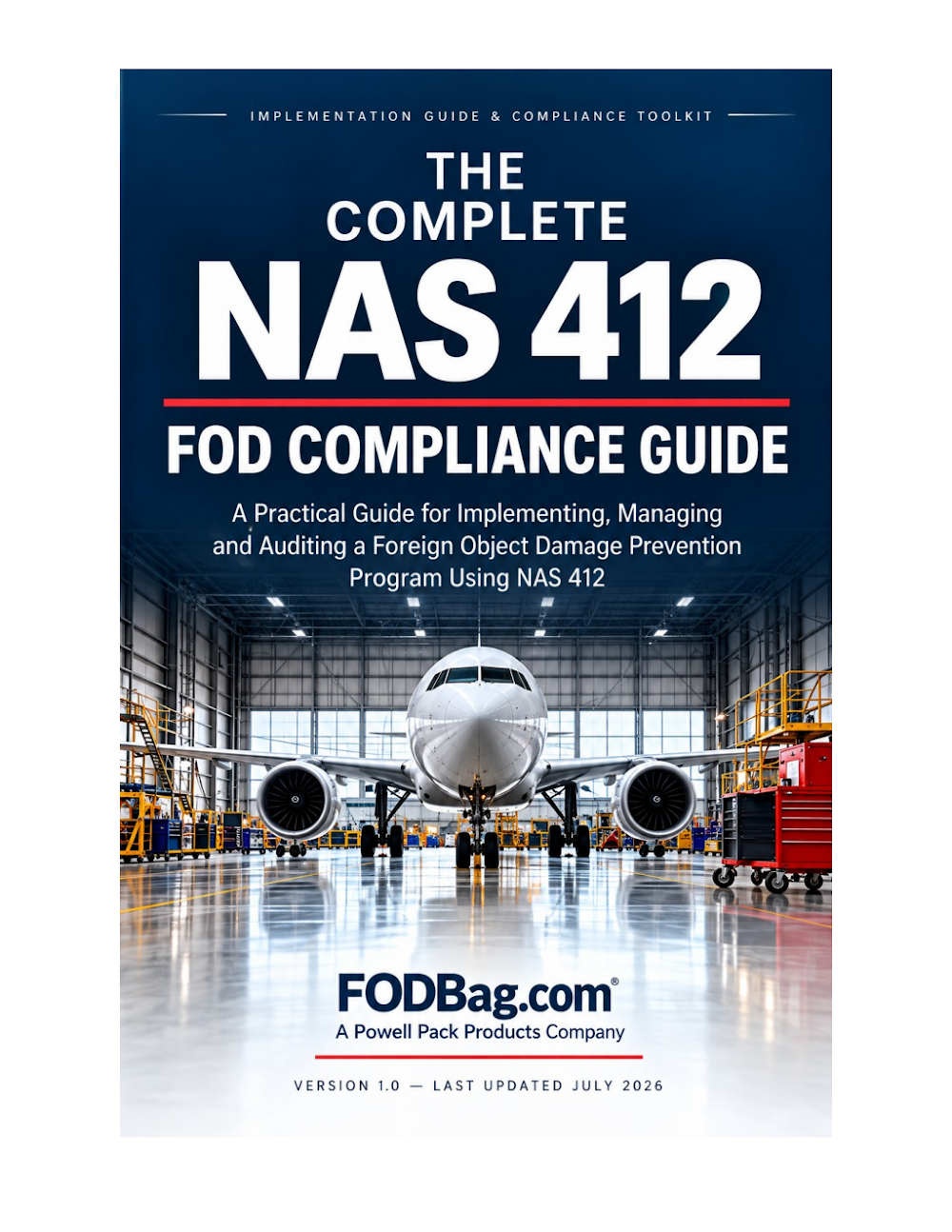
About the NAS 412 FOD Compliance Guide
Quick answer: NAS412 Rev. 3 is Foreign Object Damage prevention guidance published through the Aerospace Industries Association (AIA), while AS9146, published by SAE International/IAQG, is a requirements standard that can be flowed down contractually. This guide shows how to build a risk-based FOD prevention system around both, covering leadership, risk assessment, area controls, product protection, tool accountability, inspection, incident response and continual improvement.
Who it is for: FOD program managers, quality leaders, manufacturing supervisors, maintenance organizations, safety teams and suppliers.
For a plain-language overview, read NAS 412 explained.

What’s Inside the Guide
Seventeen sections moving from the standards landscape through risk-based controls to audit readiness.
Standards and Terminology
Risk-Based Program and Worksheet
Leadership, Areas and Training
Product Protection and Housekeeping
Tools, Hardware and Personal Items
Response, Measurement and Audit Readiness
Key Principles From the Guide
A short preview of the practices the guide develops in depth.
Clean is not the same as controlled
Build the program around risk
Know which documents are guidance and which are requirements
Protect product and verify before closure
Treat non-standard work as its own risk
Respond to FOD events in a defined order
Questions This Guide Helps You Answer
- Where can foreign objects enter, migrate, become trapped in, or damage our product?
- What controls are proportionate to the risk in each process, product and work area?
- How do we prove that the controls are understood, followed and effective?
- How do we detect weak signals and improve the program before a FOD event occurs?
How to Use This Guide
- Read the Standards Landscape and Risk-Based Program sections.
- Complete the FOD Risk Assessment Worksheet for each significant process or area.
- Use the Program Self-Assessment to identify gaps.
- Assign corrective actions and owners using the 30-60-90 Day Implementation Plan.
- Use the included FOD Walk, Tool Accountability, Training and Incident templates to create objective evidence.
- Reassess after process changes, non-standard work, incidents, customer findings or meaningful trend changes.
Templates in the Toolkit
- FOD Risk Assessment Worksheet
- Training record
- Tool / controlled-item log
- FOD finding log
- Non-standard work mini-assessment
- FOD incident report template
- Pre-closure verification questions
- FOD walk checklist
Get the NAS 412 FOD Compliance Guide
Enter your details and we will email you the PDF right away.
- 29-page implementation guide and compliance toolkit (PDF)
- Risk assessment worksheet and self-assessment tools
- Walk, tool accountability, training and incident templates
- 30-60-90 day implementation plan
Free for internal organizational use. Educational resource from FODBag.com, a Powell Pack Products company.
Get the Free Guide
Enter your details and we will email you the PDF of NAS 412 FOD Compliance Guide right away.
Related Reading
Go deeper on the topics in the NAS 412 FOD Compliance Guide.
More Free FOD Prevention Guides
Each guide is free to request and written for aerospace, aviation, MRO and manufacturing teams.