
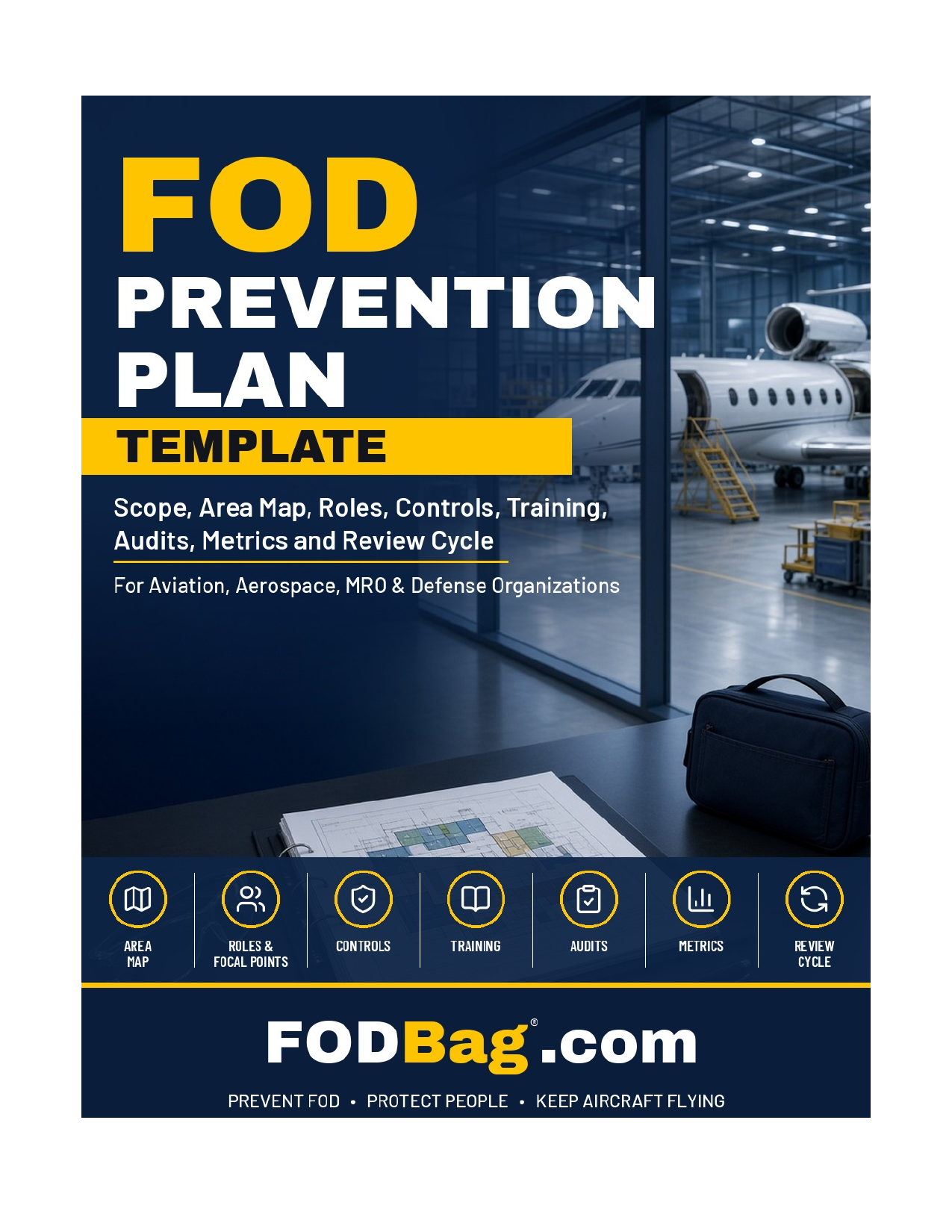
FOD Prevention Plan Template
A complete FOD prevention plan structure with fill-in fields and guidance, covering how your organization prevents, detects, removes and learns from FOD. Get the Free GuideSee What's Inside10
Pages
13
Sections
3
FOD Area Levels
12
Prevention Controls to Define
About the FOD Prevention Plan Template
Quick answer: A FOD prevention plan is the document that describes how an organization prevents, detects, removes and learns from foreign object debris and foreign object damage in its operations. Customers, auditors and registrars often ask to see it first. This template gives you a complete structure with fill-in fields, so your plan covers the elements auditors expect and reflects how your operation actually works.
Who it is for: FOD program managers, quality managers and safety managers at MROs, OEMs, suppliers, airlines and defense contractors.

What’s Inside the Guide
Thirteen sections, from purpose and scope to a cross-reference matrix.
Purpose, Scope and Document Control
Objectives and Targets
FOD Area Classification and Map
Roles, Responsibilities and Focal Points
Controls, Detection and Removal
Response, Training, Audits and Approval
Key Practices From the Guide
A short preview of what the guide covers in depth.
Describe what you actually do
Work through it with the people who own the work
Classify every area in scope
Reference procedures instead of repeating them
Set measurable objectives
Map the plan to your requirements
How to Use This Guide
- Use Sections 1 and 2 to set scope, requirements and measurable objectives.
- Use Sections 3 and 4 to classify areas and assign roles and focal points.
- Use Sections 5 to 9 to summarize controls, detection, removal, response and training.
- Use Sections 10 to 12 to define audits and metrics, the review cycle, approval and the cross-reference matrix.
Before You Start
- Name the plan owner and the executive sponsor.
- List the sites, buildings, hangars, ramps and lines in scope.
- Identify the customer, contract, regulatory and standard requirements that apply.
- Gather your existing FOD procedures, work instructions and forms.
- Draft a facility map for area classification.
- Agree the review cycle and who approves the plan.
Forms in the Toolkit
- Area Register and Facility Map (Section 3)
- Roles and Area FOD Focal Points Tables (Section 4)
- Audits and Metrics Table (Section 10)
- Plan Approval Block (Section 11)
- Cross-Reference Matrix (Section 12)
Get the FOD Prevention Plan Template
Enter your details and we will email you the PDF right away.
- 10-page template (PDF) with fill-in fields
- Three-level FOD area classification
- Roles, controls, detection and removal tables
- Review cycle, approval and cross-reference matrix
Free for internal organizational use. Educational resource from FODBag.com, a Powell Pack Products company. Questions? Call 602-874-1313.
Get the Free Guide
Enter your details and we will email you the PDF of FOD Prevention Plan Template right away.
Watch: How to Write a FOD Prevention Plan
A short video on the structure of a FOD prevention plan, from scope and area classification to roles, controls, training and review. Use it with the free FOD Prevention Plan Template on this page.
Related Reading
Go deeper on the topics in the FOD Prevention Plan Template.
More Free FOD Prevention Guides
Each guide is free to request and written for aerospace, aviation, MRO and manufacturing teams.
Equip Your FOD Program
Frequently Asked Questions
What is a FOD prevention plan?
A FOD prevention plan is the document that describes how an organization prevents, detects, removes and learns from foreign object debris and foreign object damage in its operations. Customers, auditors and registrars often ask to see it first.
What should a FOD prevention plan include?
Purpose and scope, objectives, area classification and map, roles and focal points, prevention controls, detection, removal, found-FOD and lost item response, training, audits and metrics, a review cycle with approval, and a cross-reference matrix.
How long should a FOD plan be?
Long enough to cover the elements auditors expect and no longer. A shorter plan that matches practice is stronger than a long plan that does not, and it should reference detailed procedures rather than repeat them.
What are FOD critical, control and awareness areas?
A common three-level model. Critical areas cover open systems and work where retrieval is difficult, control areas cover aircraft, engines and assemblies under work, and awareness areas cover adjacent support areas.
How often should a FOD control plan be reviewed?
At least annually and after significant change, such as changes in scope, requirements, facilities or results, with FOD committee and management review in between.