
New-Hire FOD Orientation Packet
Plain-language foreign object debris training for new employees: the FOD rules from day one, what signs and floor markings mean, and what to do if you find FOD or lose an item. Get the Free GuideSee What's Inside9
Pages
9
Sections
10
Day-One FOD Rules
5
Find-FOD Response Steps
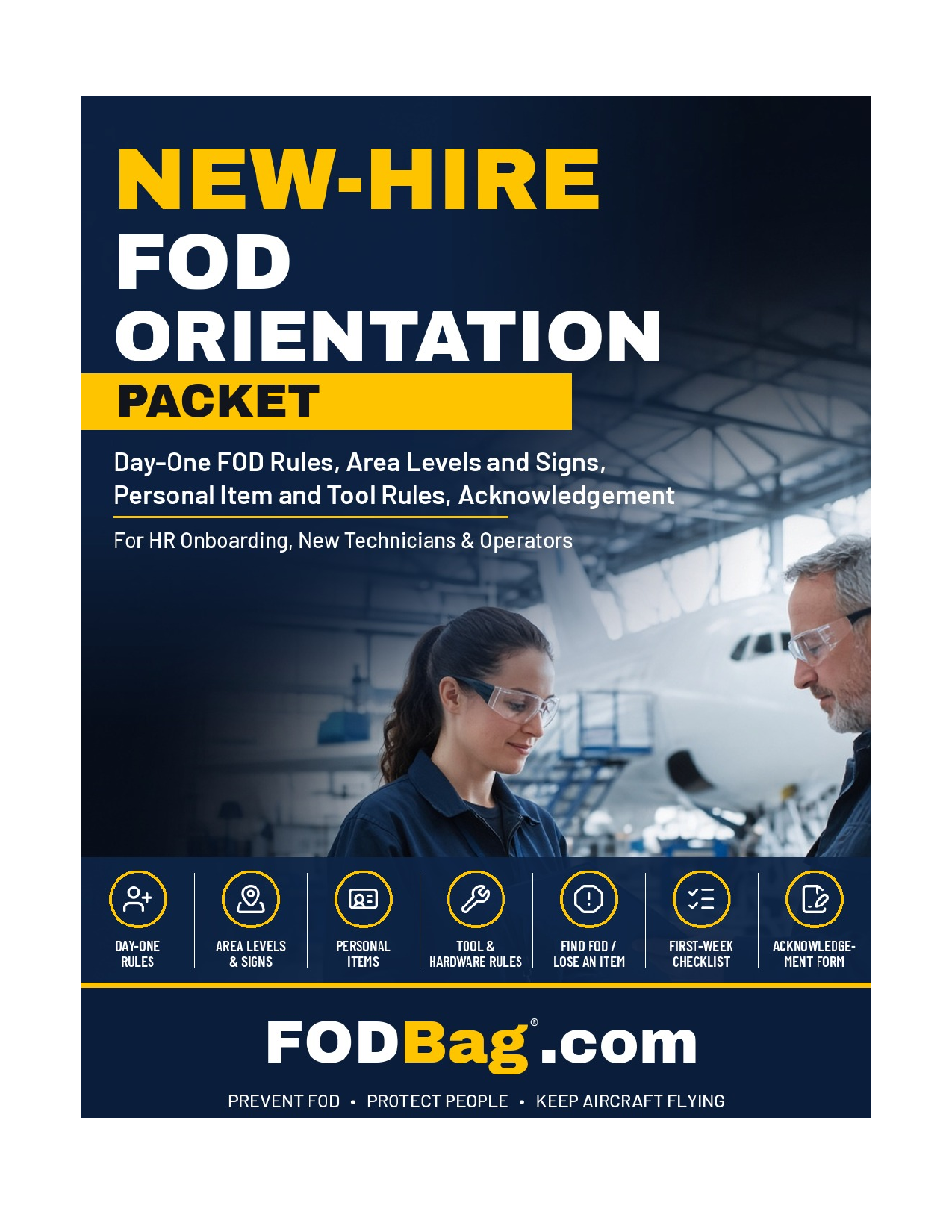
About the New-Hire FOD Orientation Packet
Reviewed by Trent Powell, Founder, FODBag · Reviewed: November 10, 2026
Quick answer: In aviation, aerospace and defense work, a single washer, pen cap or rag in the wrong place can damage an aircraft, an engine or a delivered product. This orientation packet is FOD training for new hires: in plain language, it explains the FOD rules they follow from the first day, what the signs and floor markings mean, how to handle tools and personal items, and what to do if they find FOD or lose an item.
Who it is for: New employees in aviation, aerospace and defense work, and the HR and onboarding teams, supervisors and trainers who welcome them. Employers add their own area levels, colors, contacts and procedures.
What’s Inside the Guide
Nine sections, from what FOD is to a signed acknowledgement form.
What FOD Is
Your Day-One FOD Rules
Area Levels, Signs and Floor Markings
Personal Item, Tool and Hardware Rules
If You Find FOD or Lose an Item
First-Week Checklist and Acknowledgement
Key Practices From the Guide
A short preview of what the guide covers in depth.
Clean as you go
Account for every tool
Take only the hardware you need
Follow the signs and floor markings
Stop and report
Ask when unsure
How to Use This Guide
- Use Sections 1 and 2 on the first day to explain FOD and the ten day-one rules.
- Use Sections 3 to 5 to walk through area levels, signs, floor markings, personal items and tool rules.
- Use Section 6 to practice what to do if you find FOD or lose an item.
- Use the first-week checklist and acknowledgement form in Sections 7 and 8 for the training record.
Before You Start
- Add your own area levels, colors and rules to the packet.
- Add supervisor and quality contacts.
- Walk the new hire to the nearest FOD area entry and signs.
- Show where FOD containers and FOD bags are kept.
- Set who completes the first-week checklist with the new hire.
- Keep the signed acknowledgement with the employee’s training record.
Forms in the Toolkit
- Ten Day-One FOD Rules (Section 2)
- First-Week FOD Checklist (Section 7)
- Acknowledgement Form (Section 8)
- Personal Item Do and Do-Not Table (Section 4)
By FODBag.com · Updated November 10, 2026
Reviewed by Trent Powell, Founder, FODBag · Reviewed: November 10, 2026
New Hire FOD Orientation Playbook: Ninety Minutes That Set the Habit
Quick answer: New hires should learn what FOD is, the basic rules, the area levels where they will work, how to control personal items and tools, and what to do when something is lost. Record the training before they enter controlled areas. IAQG guidance expects trained personnel or escorts for anyone entering designated areas.
This playbook gives employers a 90-minute orientation plan for new hires. It uses IAQG guidance in support of AS9146 on training and personnel access and the NASA MSFC training and records sections as a reference model, with a checked schedule example. The module times are an example and the plan is a FODBag suggestion. Add your own area levels, colors, contacts and procedures.
What the opened sources say
IAQG guidance in support of AS9146 expects organizations to identify training requirements, establish training methods, set recurring training criteria and intervals, and evaluate effectiveness (IAQG SCMH 3.4.2 Rev. D, slide 23), and to ensure anyone entering FOD prevention designated areas has received required training or is escorted by trained personnel, including visitors and contractors (IAQG SCMH 3.4.2 Rev. D, slide 24). Personal items such as keys, phones, pens and jewelry are named for control (IAQG SCMH 3.4.2 Rev. D, slide 29). NASA MSFC-STD-3598 Rev. D sets training levels with refresher intervals and requires training records (NASA MSFC-STD-3598 Rev. D, 5.11.1 to 5.11.5).
Orientation modules
- What FOD is and why it matters, with plain examples.
- The basic rules: clean as you go, look before you leave, stop and report, ask when unsure.
- Area levels and what changes when you enter each.
- Personal items and tools: what stays out and how tools are counted.
- Stop, secure, report and record if you lose something.
First week
Pair the new hire with a trained buddy, walk the work area together, and review the first week checklist at the end of the week. Use a short sign-off for the training record.
Records and refreshers
Keep the date, trainer, content version and a signed acknowledgement. Set a refresher interval that fits your risk and customer requirements.
Worked example: a 90-minute orientation schedule
This example is illustrative. Module times for a session:
| Module | Time |
|---|---|
| What FOD is and why it matters | 20 min |
| Ten rules and clean as you go | 15 min |
| Areas and what changes in each | 25 min |
| Personal items and tools | 15 min |
| Stop, secure, report and record | 15 min |
| Total | 20 + 15 + 25 + 15 + 15 = 90 min |
Check: 20 + 15 + 25 + 15 + 15 = 90 minutes. A plant hiring 12 people in a month runs two sessions of six, so the trainer needs 2 × 90 = 180 minutes, or 3 hours, plus time to sign records.
What good looks like
- Training is done before entry to controlled areas.
- Content covers rules, areas, personal items, tools and reporting.
- A buddy covers the first week.
- Records show date, trainer and version.
- Refreshers are scheduled.
Matching FODBag products and resources
Orientation materials: FOD field posters; FOD signs; FOD stickers; FOD tool bags; FOD bags.
About FODBag. FODBag.com, a Powell Pack Products company in Mesa, Arizona, has made FOD bags, FOD tape, FOD stickers, FOD signs, FOD posters, FOD cans and FOD containers since 2016. FOD tape is 2 in × 108 ft and FOD signs start at $29.99. Questions? Call 602-874-1313, Monday–Friday, 9:00 a.m.–5:00 p.m. Arizona time.
Sources opened for this page
- IAQG SCMH 3.4.2 Rev. D, FOD Prevention Program: Guidance in Support of IAQG Standard 9146 (June 19, 2023) — Slides 23, 24 and 29 on training, personnel access and personal items. Opened and read for this page on November 10, 2026.
- NASA MSFC-STD-3598 Rev. D, Standard for Foreign Object Damage/Foreign Object Debris (FOD) Prevention (effective July 26, 2021) — Sections 5.11.1 to 5.11.5 on training. Opened and read for this page on November 10, 2026.
Get the New-Hire FOD Orientation Packet
Enter your details and we will email you the PDF right away.
- 9-page orientation packet (PDF)
- Ten day-one FOD rules
- Area levels, signs, personal item and tool rules
- First-week checklist and acknowledgement form
Free for internal organizational use. Educational resource from FODBag.com, a Powell Pack Products company. Questions? Call 602-874-1313.
Get the Free Guide
Enter your details and we will email you the PDF of New-Hire FOD Orientation Packet right away.
Related Reading
Go deeper on the topics in the New-Hire FOD Orientation Packet.
More Free FOD Prevention Guides
Each guide is free to request and written for aerospace, aviation, MRO and manufacturing teams.
Equip Your FOD Program
Frequently Asked Questions
What should new-hire FOD training cover?
What FOD is, the day-one FOD rules, area levels, signs and floor markings, personal item and tool rules, and what to do if you find FOD or lose an item, with a signed acknowledgement.
What are the day-one FOD rules?
Clean as you go, look before you leave, account for every tool, take only the hardware you need, control personal items, protect openings, follow the signs and floor markings, use FOD containers, stop and report, and ask when unsure.
What should you do if you find foreign object debris?
Stop, secure the object so it cannot fall further in, remove it if it is loose and safe to pick up, report it to your supervisor or lead, and record what it was, where and when.
What is foreign object damage training for?
To show new employees that a single washer, pen cap or rag in the wrong place can damage an aircraft, an engine or a delivered product, and that preventing FOD is part of everyone's job.
What do FOD area levels mean?
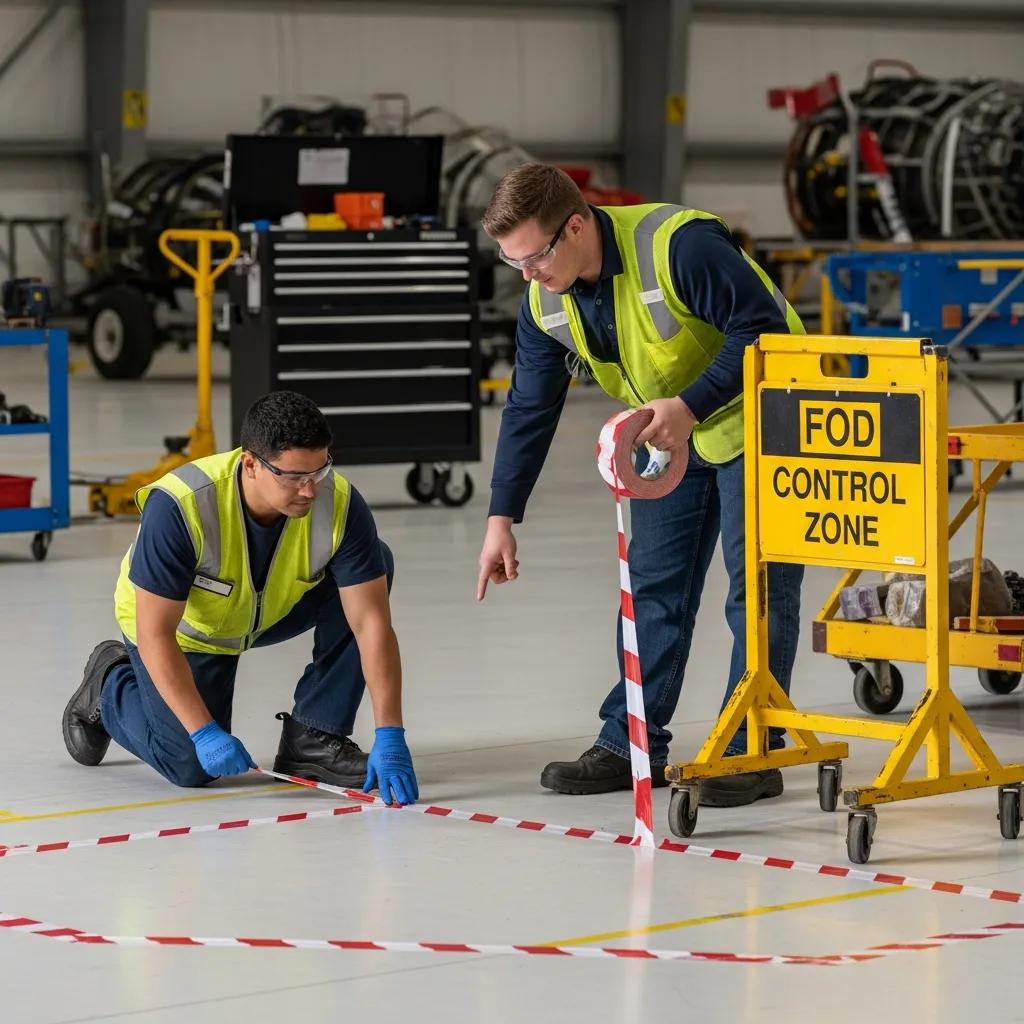
Many facilities use three levels: FOD awareness for support areas, FOD control where aircraft, engines or products are worked, and FOD critical where open systems make a lost item hard to find.
What should FOD orientation for new hires cover?
As a FODBag suggestion: what FOD is, basic rules, area levels, personal items and tools, and what to do when something is lost. IAQG guidance expects training and recurring criteria to be established (SCMH 3.4.2 Rev. D, slide 23).
Who may enter a FOD controlled area?
IAQG guidance expects anyone entering designated areas to have required FOD training or be escorted by trained personnel, including visitors and contractors (slide 24).
Should FOD training be recorded?
NASA MSFC-STD-3598 Rev. D requires training records (section 5.11.5). NASA material is a reference model, and your customers may add requirements.