
Military and Defense Tool Control Guide
Composite tool kits, shadow boards, tool marking, check-in and check-out, shift change inventories and lost tool procedures for military and defense maintenance organizations. Get the Free GuideSee What's Inside12
Pages
14
Sections
3
Ready-to-Use Templates
7
Lost Tool Procedure Steps
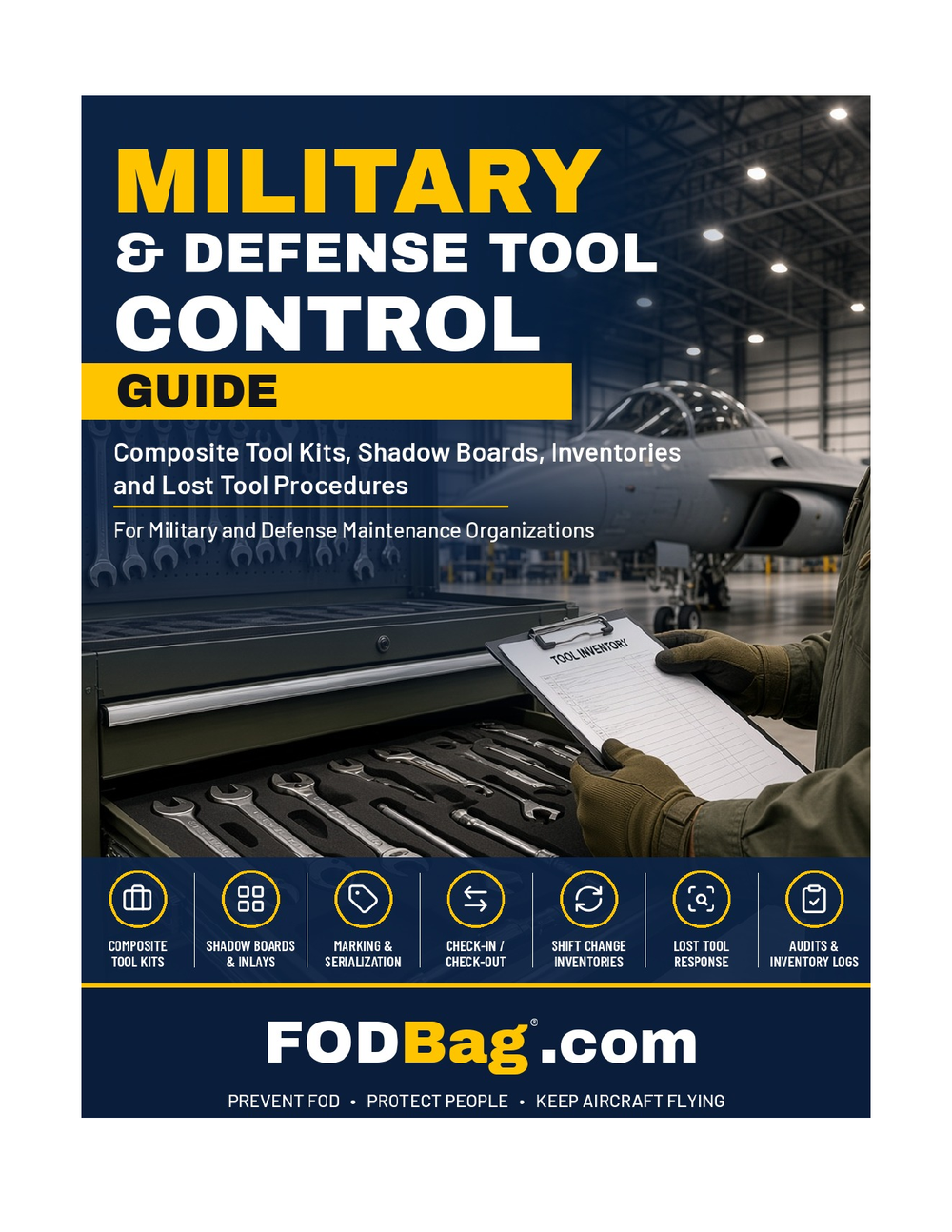
About the Military and Defense Tool Control Guide
Reviewed by Trent Powell, Founder, FODBag · Reviewed: November 10, 2026
Quick answer: Tool control is one of the most established disciplines in military and defense aircraft maintenance. Its purpose is simple: every tool, piece of equipment and accountable consumable taken to a job is accounted for before the aircraft, engine or system is released. Air Force programs, for example, group tools into composite tool kits (CTKs) and mark each item so it can be traced to its organization and kit.
Who it is for: maintenance supervisors, tool room and support section personnel, quality assurance staff, FOD program managers and defense contractor teams that support military aircraft, engines and weapon systems.

What’s Inside the Guide
Fourteen sections from why tool control matters to a printable tool inventory log.
Why Tool Control Matters and Program Elements
Composite Tool Kit (CTK) Concepts
Shadow Boards and Foam Inlays
Tool Marking, Etching and Serialization
Check-In, Check-Out and Shift Change
Lost Tool Procedure, Roles and Audits
Key Practices From the Guide
A short preview of what the guide covers in depth.
Treat tool control as a FOD prevention control first
Make the kit the unit of control
Inventory at every handoff
Do not reissue to cover a missing tool
Never assume a lost tool will turn up
Make reporting a routine, expected action
How to Use This Guide
- Use Sections 1 and 2 to explain why tool control matters and to check your program against the core elements.
- Use Sections 3 to 5 to design composite tool kits, shadow boards, foam inlays and a tool marking scheme.
- Use Sections 6 to 9 to set issue and return, shift change, consumable and lost tool procedures.
- Use the audit checklist and printable inventory log in Sections 11 and 12 as working documents or a starting point for your own controlled forms.
Before You Start
- Name a tool-control program owner and kit custodians, with quality assurance providing independent verification.
- Write or update a tool-control procedure that defines kits, inventories, issue and return, lost tool response and records.
- Build kit lists from your own task requirements and approved procedures.
- Choose one marking format for the organization and document it.
- Define inventory points: issue, return, shift change and before release.
- Brief contractors, depot teams and visiting personnel on local tool-control rules before they begin work.
Forms in the Toolkit
- Tool Control Audit Checklist (Section 11)
- Printable Tool Inventory Log (Section 12)
- Shift Change Handoff Record (Section 7)
- Example Kit Contents Record (Section 3)
By FODBag.com · Updated November 10, 2026
Reviewed by Trent Powell, Founder, FODBag · Reviewed: November 10, 2026
Military and Defense Tool Control Playbook: Visible, Logged, Searched
Quick answer: Give every tool a visible place, log tools in and out, account for each kit at issue, return and shift change, track tools that are away, and stop work and search when one is missing. NASA MSFC-STD-3598 requires shadowboards, a written record, chits for tools not returned, and no discipline for tools reported lost immediately.
This playbook gives tool rooms and maintenance supervisors a kit-inventory routine with a checked shift-change example. It uses NASA MSFC-STD-3598 Rev. D, IAQG guidance and an excerpt of DAFI 21-101, read for this page. It does not reproduce any military instruction or technical order, and the governing service, command and contract documents decide what applies. The counts are invented and the layout is a FODBag suggestion.
What the opened sources say
NASA MSFC-STD-3598 says tools in control areas are recorded in a written record kept at the work site, stored in shadowboxed kits or on shadowboards so that tools in use or missing are visually apparent, returned at the end of each shift, and tracked by a chit or other method when not returned or removed for repair or calibration (NASA MSFC-STD-3598 Rev. D, 5.8.2.1 d). Tools temporarily brought in are logged in and out with the user, date and time, and tools for critical zones are logged at the controlled entry, inspected and tethered (NASA MSFC-STD-3598 Rev. D, 5.8.2.1 e and f). When a tool is reported lost, work stops and a search starts, and there is no disciplinary action if the loss is immediately reported, except for repetitive careless loss or intentional circumvention (NASA MSFC-STD-3598 Rev. D, 5.12.3.4 c and d). IAQG guidance expects control of company and personally owned tools including identification, inventory, location, condition and a process for reporting tool-related events (IAQG SCMH 3.4.2 Rev. D, slide 31). The DAFI 21-101 excerpt says to inventory all items in accordance with its chapter 8 (DAFI 21-101, 11.8.3.1.3).
Kit inventory routine
- One item per position with a visible outline in the kit.
- Inventory at issue, at return, at shift change and before release.
- Log the person, kit and time for every issue and return.
- Chit or track any tool away for repair or calibration.
- Stop and search when a position is empty and the tool is not accounted for.
Handing a kit to the next shift
Both people inventory the kit together and sign the handoff record, with open chits and open searches listed. The incoming shift does not start work with an unexplained empty position.
Contractors and visitors
Brief them on local tool control rules before work, log their tools in and out, and keep personally owned tools in scope as the IAQG guidance expects.
Worked example: a shift-change inventory
This example is illustrative and not from a real unit:
| Kit | Positions | Result |
|---|---|---|
| Kit A | 48 positions | 48 present |
| Kit B | 62 positions | 61 present, 1 on a chit (out for calibration) |
| Kit C | 35 positions | 34 present, 1 missing |
| Total | 48 + 62 + 35 = 145 | 143 present + 1 chit + 1 missing = 145 |
Check: 48 + 62 + 35 = 145 positions; 48 + 61 + 34 = 143 present; 143 + 1 + 1 = 145, so every position is explained. The chit is listed on the handoff record and the missing tool in Kit C triggers a stop and a search before release.
What good looks like
- Every tool has a visible position in a kit or on a board.
- Tools in and out are logged by person.
- Away tools carry a chit or other tracking.
- Counts are explained at shift change.
- Missing tools stop work and are reported without blame when reported at once.
Matching FODBag products and resources
Products that support tool control: tool bags; belt pouches; FOD stickers; tool and hardware control signs; FOD cans.
About FODBag. FODBag.com, a Powell Pack Products company in Mesa, Arizona, has made FOD bags, FOD tape, FOD stickers, FOD signs, FOD posters, FOD cans and FOD containers since 2016. FOD tape is 2 in × 108 ft and FOD signs start at $29.99. Questions? Call 602-874-1313, Monday–Friday, 9:00 a.m.–5:00 p.m. Arizona time.
Sources opened for this page
- NASA MSFC-STD-3598 Rev. D, Standard for Foreign Object Damage/Foreign Object Debris (FOD) Prevention (effective July 26, 2021) — Sections 5.8.2.1 and 5.12.3.4. Opened and read for this page on November 10, 2026.
- IAQG SCMH 3.4.2 Rev. D, FOD Prevention Program: Guidance in Support of IAQG Standard 9146 (June 19, 2023) — Slide 31 on tool accountability and control. Opened and read for this page on November 10, 2026.
- DAFI 21-101, Aircraft and Equipment Maintenance Management, paragraph 11.8 (16 March 2026 edition; read as excerpts from search results, confirm the current text and your wing supplement) — Paragraph 11.8.3.1.3, read as an excerpt. Opened and read for this page on November 10, 2026.
Get the Military and Defense Tool Control Guide
Enter your details and we will email you the PDF right away.
- 12-page guide (PDF)
- Composite tool kit and shadow board guidance
- Seven-step lost tool procedure flowchart
- Tool control audit checklist and printable inventory log
Free for internal organizational use. Educational resource from FODBag.com, a Powell Pack Products company.
Get the Free Guide
Enter your details and we will email you the PDF of Military and Defense Tool Control Guide right away.
Watch: Military Tool Control Programs — CTKs, Shadow Boards and Lost Tools
A short video on composite tool kits, shadow boards, tool marking, check-in and check-out, and the lost tool procedure. Use it with the free Military and Defense Tool Control Guide on this page.
Related Reading
Go deeper on the topics in the Military and Defense Tool Control Guide.
More Free FOD Prevention Guides
Each guide is free to request and written for aerospace, aviation, MRO and manufacturing teams.
Equip Your FOD Program
Frequently Asked Questions
What is a tool accountability program?
A documented system that makes every tool visible and traceable so a missing item is found before the job is closed and the aircraft is released. Core elements are a written procedure, named ownership, kit design, tool identification, issue and return control, inventories, a lost tool response, training, and audits.
What is a composite tool kit (CTK)?
A controlled container of tools and equipment in which each item has a defined location and the kit is inventoried as a unit. Air Force tool control programs use CTKs; some publications use the term consolidated tool kit.
What happens when a tool is lost?
Work on the affected aircraft, engine or equipment stops, the supervisor and quality assurance are notified, and a documented search follows. If the tool is not found, a lost tool report is completed and the authorized release function decides the disposition before any release.
How do shadow boards and foam inlays support tool control?
A painted outline or a shaped foam cutout shows exactly where each tool belongs, so an empty location is obvious at a glance. High-contrast foam, one tool per location and labeled locations make inventories faster and more reliable.
When should tool kits be inventoried?
At issue, at return, at shift change and before release of the aircraft or equipment. When a kit changes hands at the job site, both people inventory it together and document the transfer.
Do contractors follow the same tool control rules?
Contractors and visiting teams follow the host organization's tool-control requirements or an approved equivalent agreed in advance, and should be briefed on local rules before they begin work.
What does NASA MSFC-STD-3598 require for tool control?
Section 5.8.2.1 requires a written record of tools kept at the work site, shadowboxed kits or shadowboards that make missing tools visible, return at end of shift, and chits for tools that are not returned or are away for repair or calibration.
What happens when a tool is lost under the NASA standard?
Section 5.12.3.4 says work stops immediately and a search starts, with no disciplinary action if the loss is immediately reported, except for repetitive and careless loss or intentional circumvention of procedures.
Does this page replace military tool control instructions?
No. It is a FODBag.com guide and does not reproduce or interpret any military instruction, technical order or contract requirement. Follow your governing documents.