
FOD Management System Guide
An end-to-end FOD management system for foreign object debris and foreign object damage: prevention, detection, removal, evaluation and investigation, connected to your QMS and SMS. Get the Free GuideSee What's Inside10
Pages
12
Sections
4
Layers of FOD Control
5
Maturity Levels
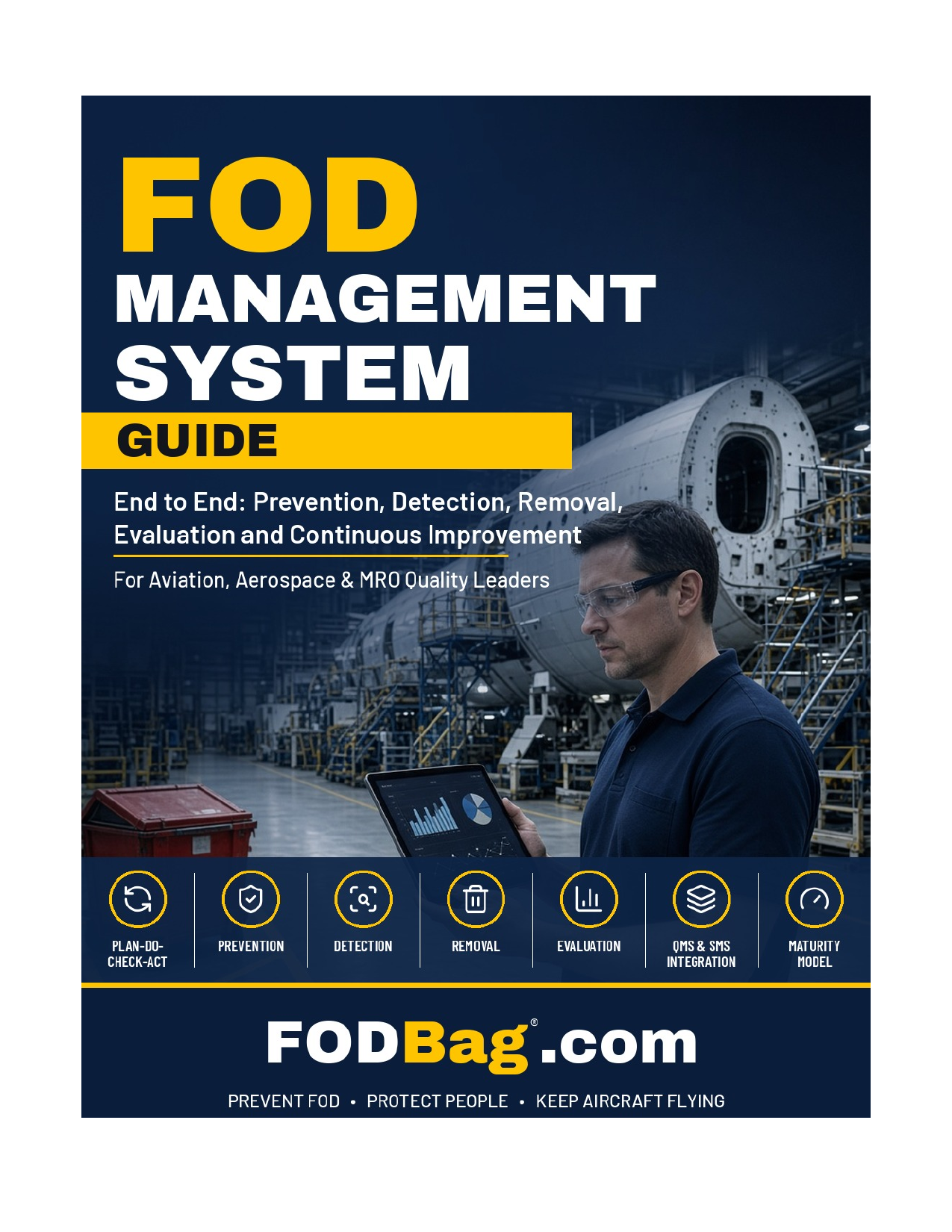
About the FOD Management System Guide
Reviewed by Trent Powell, Founder, FODBag · Reviewed: November 10, 2026
Quick answer: A FOD control is a single measure, such as a tool shadow board or a FOD container at a gate. A FOD program is the organized collection of those measures with an owner. A FOD management system adds defined objectives, data, analysis, audits, corrective action and management review, all connected so that what is learned in one area changes practice in another.
Who it is for: FOD program managers, quality and safety managers, and operations leaders at large MRO facilities, airline maintenance bases, airports, aerospace manufacturing plants and defense sites who need to connect day-to-day FOD controls with their QMS and SMS.

What’s Inside the Guide
Twelve sections, from what a FOD management system is to management review inputs.
The PDCA Model for FOD
Four Layers of FOD Control
Integration with the QMS and SMS
Leading and Lagging FOD Metrics
Five-Level Maturity Model
Self-Assessment and Management Review
Key Practices From the Guide
A short preview of what the guide covers in depth.
Know the difference between a program and a system
Run FOD management on Plan-Do-Check-Act
Cover all four layers
Connect FOD to the QMS and SMS
Measure leading and lagging indicators
Move one maturity level at a time
How to Use This Guide
- Use Sections 1 and 2 to define your FOD management system and the PDCA cycle behind it.
- Use Sections 3 to 6 to check that every layer of FOD control has controls and records.
- Use Sections 7 and 8 to connect FOD to your QMS and SMS and to choose metrics.
- Use the maturity model, self-assessment and management review inputs in Sections 9 to 11 to set milestones and report to leadership.
Before You Start
- Name the owner of the FOD management system.
- List the FOD controls already in place in each area.
- Identify the QMS and SMS processes FOD will use (nonconformance, corrective action, audit, management review).
- Choose a small set of leading and lagging FOD metrics.
- Score your current maturity level with the self-assessment.
- Set the next milestone and a target date.
Forms in the Toolkit
- FOD Management System Self-Assessment (Section 10)
- Management Review Input Checklist (Section 11)
- Maturity Milestone Plan (Section 9)
- Leading and Lagging Metrics Table (Section 8)
By FODBag.com · Updated November 10, 2026
Reviewed by Trent Powell, Founder, FODBag · Reviewed: November 10, 2026
FOD Management System Playbook: Objectives, Data, Audits, Review
Quick answer: A FOD management system connects the controls into one loop: set objectives, run the program, measure results, audit, fix what you find and review it with management. IAQG guidance describes this as plan, do, check and act, with a risk assessment first. Measure a few things consistently and act on the gaps.
This playbook shows how to build the measuring and review loop around a FOD program. It draws on IAQG guidance in support of AS9146 (the eight elements and plan-do-check-act approach) and the NASA MSFC metrics section, and works a scorecard with checked arithmetic. The scorecard numbers are invented and the measures are a FODBag suggestion. AS9146 and NAS 412 were not opened, so no clauses are cited.
What the opened sources say
IAQG guidance in support of AS9146 describes eight primary program elements: program management, operations, area designation, training and personnel access, product protection, housekeeping and clean-as-you-go, consumables, hardware and personal items, and tool accountability and control (IAQG SCMH 3.4.2 Rev. D, slide 10). It describes a process approach with risk-based thinking in a plan, do, check, act cycle that begins with a FOD risk assessment to establish scope (IAQG SCMH 3.4.2 Rev. D, slide 11). Program nonconformities are documented, effectiveness is evaluated, and results are reported through management review (IAQG SCMH 3.4.2 Rev. D, slide 16). NASA MSFC-STD-3598 Rev. D suggests metrics such as Pareto charts by location, trend charts of walk down completion percentage, and tracking of specific FOD types to show progress (NASA MSFC-STD-3598 Rev. D, 5.12.2.3 (a) to (d)).
Building the loop
- Assess the risk and set the scope of the program.
- Set objectives that a person could check, such as walk downs completed and actions closed.
- Collect data the same way every month.
- Audit on a schedule and record findings.
- Review with management and record decisions and owners.
Scorecard
Four to six measures are enough: walk down completion, audits completed, corrective actions closed, training current, and a trend of finds by type. Each needs an owner and a source of data.
Maturity
Maturity grows when the data changes decisions. A program that records numbers but never changes anything is still only a program, not a system.
Worked example: a monthly scorecard
This example is illustrative, not data from a real site:
| Measure | Actual | Calculation |
|---|---|---|
| Walk downs completed | 19 of 21 | 19 ÷ 21 = 90.5% |
| Audits completed | 3 of 4 | 3 ÷ 4 = 75.0% |
| Corrective actions closed | 12 of 15 | 12 ÷ 15 = 80.0% |
| Staff with current training | 46 of 50 | 46 ÷ 50 = 92.0% |
Check: 19 ÷ 21 = 90.5%; 3 ÷ 4 = 75.0%; 12 ÷ 15 = 80.0%; 46 ÷ 50 = 92.0%. Audits are the lowest, so the FOD manager schedules the missed audit and reports the gap in management review rather than waiting for next month.
What good looks like
- Scope and risk assessment are written.
- Objectives are measurable.
- Data comes from the same sources each month.
- Audits are on a schedule.
- Management review leads to recorded actions.
Matching FODBag products and resources
Physical controls that support the system: FOD signs; FOD floor tape (2 in × 108 ft); FOD cans; FOD tool bags; FOD field posters.
About FODBag. FODBag.com, a Powell Pack Products company in Mesa, Arizona, has made FOD bags, FOD tape, FOD stickers, FOD signs, FOD posters, FOD cans and FOD containers since 2016. FOD tape is 2 in × 108 ft and FOD signs start at $29.99. Questions? Call 602-874-1313, Monday–Friday, 9:00 a.m.–5:00 p.m. Arizona time.
Sources opened for this page
- IAQG SCMH 3.4.2 Rev. D, FOD Prevention Program: Guidance in Support of IAQG Standard 9146 (June 19, 2023) — Slides 10, 11 and 16 on elements, the PDCA approach and review. Opened and read for this page on November 10, 2026.
- NASA MSFC-STD-3598 Rev. D, Standard for Foreign Object Damage/Foreign Object Debris (FOD) Prevention (effective July 26, 2021) — Section 5.12.2.3 on metrics. Opened and read for this page on November 10, 2026.
Get the FOD Management System Guide
Enter your details and we will email you the PDF right away.
- 10-page guide (PDF)
- PDCA model and four layers of FOD control
- QMS and SMS integration map
- Metrics, maturity model and self-assessment
Free for internal organizational use. Educational resource from FODBag.com, a Powell Pack Products company. Questions? Call 602-874-1313.
Get the Free Guide
Enter your details and we will email you the PDF of FOD Management System Guide right away.
Related Reading
Go deeper on the topics in the FOD Management System Guide.
More Free FOD Prevention Guides
Each guide is free to request and written for aerospace, aviation, MRO and manufacturing teams.
Equip Your FOD Program
Frequently Asked Questions
What is FOD management?
FOD management is the connected set of FOD controls, measurements and reviews that shows whether those controls work and improves them when they do not, covering prevention, detection, removal, investigation and continuous improvement.
What is the difference between a FOD program and a FOD management system?
A FOD program is the organized collection of FOD controls with an owner. A FOD management system adds defined objectives, data, analysis, audits, corrective action and management review, all connected so lessons in one area change practice in another.
What are the four layers of FOD control?
Prevention, detection, removal, and evaluation and investigation. FAA AC 150/5210-24A organizes airport FOD management into prevention, detection, removal and evaluation.
How do you measure FOD reduction?
Track leading indicators, such as walk and check completion, alongside lagging indicators, such as FOD damage events, and review them regularly in management review.
What are the levels of FOD management maturity?
The guide describes five levels: Reactive, Defined, Implemented, Measured and Optimizing. Most organizations move one level at a time.
What is a FOD management system?
It is the organized loop around a FOD program: objectives, data, analysis, audits, corrective action and management review. IAQG guidance in support of AS9146 describes a plan, do, check, act approach with a FOD risk assessment first (SCMH 3.4.2 Rev. D, slide 11).
What are the eight elements of an AS9146 FOD program?
IAQG guidance lists program management, operations, area designation, training and personnel access, product protection, housekeeping and clean-as-you-go, consumables, hardware and personal items, and tool accountability and control (slide 10).
How do you measure a FOD program?
NASA MSFC-STD-3598 Rev. D suggests Pareto charts by location, trend charts of walk down completion, and tracking of specific FOD types (section 5.12.2.3). NASA material is a reference model for other sites.