
FOD Area Classification and Facility Marking Guide
Identify the risk. Mark the boundary. Make the required action clear. A practical framework for risk-based area designation, clear boundaries and everyday FOD prevention. Get the Free GuideSee What's Inside24
Pages
3
Levels of FOD-Sensitive Area
5
Question Task Assessment
4
Printable Tools
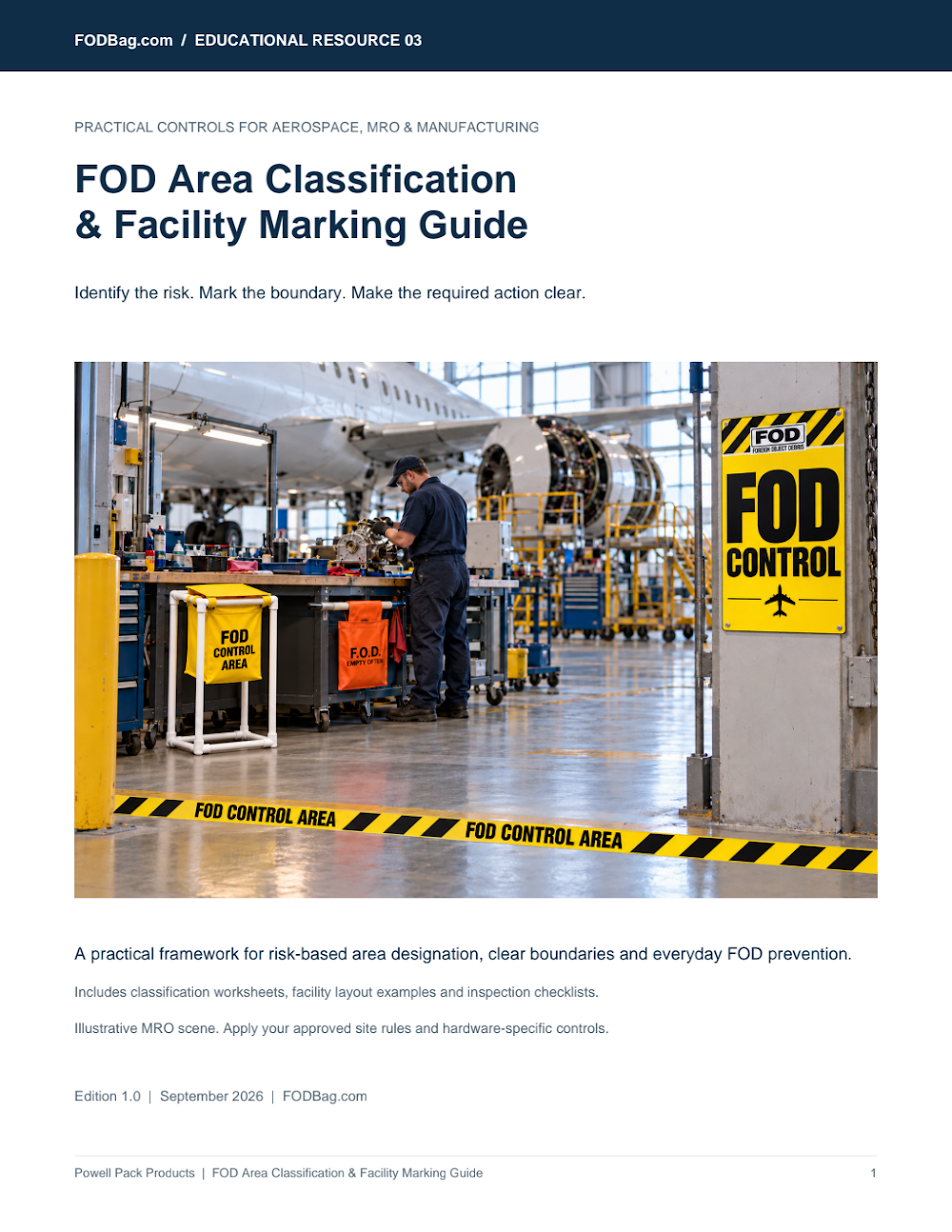
About the FOD Area Classification and Facility Marking Guide
Quick answer: A useful FOD boundary answers three questions before anyone crosses it: What area am I entering? What must I do? Who resolves uncertainty? This guide helps a FOD manager turn those answers into a repeatable facility-marking plan, using the three levels described in NASA MSFC-STD-3598D: Awareness Areas, Control Areas and Critical Zones.
Who it is for: FOD managers, facilities, operations and quality teams planning or improving area classification and marking in aerospace MRO and manufacturing.

What’s Inside the Guide
Twenty-four pages from classification to installation and audit.
Classification and Color
Assess and Record Decisions
Map and Mark
Signs, Tape and Stickers
Bags, Cans and Quantities
Install, Train, Audit and Forms
Key Principles From the Guide
A short preview of how the guide approaches area marking.
Start with one pilot area
Color helps recognition; words define action
Define FOD Safe Area carefully
Approve before you activate
Measure behavior, not just markings
Plan from a marking schedule
What You Will Leave With
- A documented classification decision for each work area and operation.
- A map connecting entry points, boundaries, collection locations and accountability stations.
- An approved marking schedule and instructions for employees, contractors and visitors.
- Evidence that the markings remain legible and the controls work in daily use.
Fast-Start Route
- Understand classification, color conventions and FOD Safe Area wording.
- Assess exposure, record decisions and handle changing operations.
- Map the facility and specify signs, tape and entry stations.
- Connect collection bags, cans and behavior reminders, and plan quantities.
- Install, train and audit the system.
- Use the printable records to maintain the system.
Printable Tools
- Tool 01: Area classification decision record
- Tool 02: Facility marking and station register
- Tool 03: Boundary and collection inspection
- Tool 04: Temporary zone and change approval
Get the FOD Area Classification and Facility Marking Guide
Enter your details and we will email you the PDF right away.
- 24-page guide (PDF)
- Classification, marking and layout guidance
- 4 printable records and registers
- Install, train and audit checklists
Free for internal organizational use. Educational resource from FODBag.com, a Powell Pack Products company.
Get the Free Guide
Enter your details and we will email you the PDF of FOD Area Classification & Facility Marking Guide right away.
Related Reading
Go deeper on the topics in the FOD Area Classification and Facility Marking Guide.
More Free FOD Prevention Guides
Each guide is free to request and written for aerospace, aviation, MRO and manufacturing teams.